Total Pageviews

Wednesday, 23 December 2015

The British Wild Man Survey


Broadside on the withdrawal of the wild men of the woods from a world that has changed for the worse; with a partially hand-coloured woodcut of a wild man and woman with two children and a dog in a landscape after Schäufelein (Hollstein 73-74) and 122 lines of letterpress verse in four columns by Hans Sachs. (n.p.: n.d.)
© The Trustees of the British Museum

I have to say that I thought, after posting yesterday's Time To Study The British Wild Men - http://terryhooper.blogspot.co.uk/2015/12/time-to-study-british-wild-men-reports.html -  it would get some enthusiastic responses from the UK "British Wild Man" community.  I linked up to a couple of sites and joined one of the Face Book groups.  "No one takes us seriously" and "science just is not interested" are the constant chants.  Well, here I was, an established naturalist and one with the mantra of "Dismiss nothing.  Investigate everything".

Reading that post you will see that I made it clear that I was not dismissing anything.  I would look at the evidence and see where it led. Apparently, being open and willing to listen was an attack on the reports and people involved!  Seriously, two nasty emails dismissing the idea out of hand while bemoaning that the established sciences will never listen.  And an exchange on Face Book where it appears my pointing out that I had never heard or had a report of a British wild man made to Me was also dismissing all the evidence.  In fact I had to explain myself several times -I got a private apology later but not one public on the group where people had probably seen me dismissed as calling it all fake -and, yes, taking down the comments does not mean that the conversation is deleted from my files.

Just what the hell is going on? 

I've no reason to close the study but if observers do not want to come forward I will need to assess based on what I can find.  But I'm leaving the invitation to report sightings open until 31st January 2016. 

So Now There Is NO Water On Mars...Well, maybe but we don't know...

Gullies On Mars Formed By Dry Ice, Not Liquid Water, Claims Study

Photo credit: The formation of gullies has been the cause of some debate. NASA

Undoubtedly one of the biggest science stories of 2015 was the discovery of water on Mars, with running liquids believed to be forming observable channels on the surface. But another piece of evidence for liquid water – namely gullies on the surface – should be called into question, according to new research.

A study published in Nature Geoscience suggests that these gullies, dark streaks formed at mid to high latitutes, were likely caused by dry ice composed of carbon dioxide, a theory that has been proposed before. Authors Cedric Pilorget and Francois Forget from the University of Paris explained how much of Mars is covered in a carbon dioxide frost, or dry ice, which is much thinner nearer the equator and thaws due to sublimation – with the ice turning directly into a gas.

During this defrosting process, pores beneath the ice can be filled with ice and shifted. The movement of gases beneath the surface can then destabilize the soil above, causing a debris flow as a result of the gas – and not water. The authors say this can create features such as the gullies we can see on Mars today. Many of these gullies were formed less than a million years ago, and even in the present day, which means there must be an ongoing process.

“We conclude that Martian gullies can result from geologic dry ice processes that have no terrestrial [Earth-like] analogues and do not require liquid water,” they write, adding: “The role of liquid water in gully formation should, therefore, be reconsidered, raising the question of the importance of its occurrence in Mars’ recent past.”

If their research is correct, it would have significant implications for our understanding of Mars. We are fairly certain the Red Planet had large bodies of liquid water a few hundred million years ago, suggesting it was once habitable, but the recent suggestion that liquid water is still present on the surface – despite the seemingly unfavorable surface conditions, namely the low temperatures and low pressure – suggested it may still be habitable, raising the possibility that microbial life lives there.

This research does not call into question the salty recurring slope lineae (RSL) that caused such a commotion earlier this year. But it does suggest that liquid water may not be so abundant on the surface of Mars.

“The RSL occur in times and places far too warm for CO2 frost, so this is not a viable formation model for RSL,” Dr Alfred McEwen, professor of planetary geology at the University of Arizona, told IFLScience. “I think this study will help to convince the science community that the CO2-driven gully model is viable and should be considered the main gully-forming mechanism today.”

We're fairly certain Mars once had water – but how much does it have today? NASA/GSFC


In an accompanying News and Views article, Colin Dundas of the Astrogeology Science Center at the U.S. Geological Survey (USGS) in Arizona suggests that processes on Mars may not as closely resemble those on Earth as we thought.


“When dealing with other worlds, we must take care to remember that unfamiliar processes are possible and even likely in alien environments,” he writes. “The Martian gullies may look like terrestrial landforms shaped by liquid water, but it may be CO2, not water, that is the culprit.”


The debate will likely rage on about how prevalent water is on Mars today. But we may have to temper some expectations regarding how much we are expecting to find, particularly in these somewhat mysterious gullies.

Tuesday, 22 December 2015

Time To Study British Wild Men Reports?

https://s-media-cache-ak0.pinimg.com/236x/b7/23/d7/b723d7d2235aff2b1c762cea307b20b3.jpgFor near to five decades now I have investigated and researched.  I spent 1977-2007 as a wildlife consultant on exotic fauna to UK police forces.  I have read through more magazines, journals, newspapers and books covering 1800-1940 than I care to even think about.

I have looked at the British wild-man of the past and even 19th century in my three books. The wild-man craze of the 19th century I had not even heard of until I came across obscure news items.

Over decades I have spoken to hunters, game-keepers, poachers, estate owners, naturalists (with some VERY weird interests) and even pagans who have spent years going deep into the UKs remaining ancient woodlands and forests.  All of these people have had "weird stories" covering ghosts, odd lights -all recounted as I talked to them as a naturalist looking into exotic fauna.

In all of this there is one thing I have never ever come across or heard one word of: a wild-man or Bigfoot type creature.

Even in the 1980s there were no such reports. 

Why have these accounts suddenly started appearing -and being back-dated) since the mid 1990s?  Fraud? Hoaxers? People seeing things?

John Hanson, one of the authors along with Dawn Holloway of the excellent Haunted Skies series of UK UFO encyclopedias, tells me they both spoke to one witness, Gary Higginson, who was quite genuine and still seemed to be unnerved by the experience.

So what is going on? 

As an historian I say "rubbish" -no wild-men lived into the 18th century in the UK let alone 21st century.

As a naturalist I have to say that I've seen evidence of possible relic wild-cat populations, definitely wolverine and large felids: spoor, kill methods and many, many eye witnesses accounts prove that. But I have never ever seen nor heard of "Bigfoot style-dens" nor territory markers and certainly never tree-tapping or stone-tapping.

As a research-investigator of the strange and weird for fifty years, again, never ever heard of any such accounts.  If someone told me they had seen a 7 feet tall pink, flashing green eyes, four-armed entity I don't bat an eye-lid.  I ask them to tell me everything and make a sketch no matter how bad.  I then look for reports of such entities and I have had cases that took 40-45 years to mark as "closed".

So what is going on? 

As it stands I find it all hard to believe because I have failed to find one actual witness willing to come forward and give their real names despite the fact that the strictest confidentiality is observed and never been  broken in all these decades.  Internet pseudonyms are not a sign that you should trust someone -as proven a few times over the last half century. 

Without first hand testimony then any investigation is dead before it starts.  Having corrected so many 'reliable' sources the idea of referring to published books on the subject also kills a potential study data base.   Authors spin a yarn and add or even take out information from reports.  Book writing is a money-making effort and not serious research findings.

To begin with there has to be an initial data base of reports built up.  From these you can decide which might be jokers, who is genuine or who might be misidentifying something.  You can then build up a data base map of sightings now this is important for a number of reasons.  Yes, it might show you "hot spots" of activity but it is more basic than that.  A large hominid needs to eat and drink, therefore you study the flora and fauna of the areas involved, basically, from roots up.  Assessing allof this could take six months or even a year, luckily, food sources I am aware of in most areas due to my work.

It is only after all of this is looked at that you can even begin to assess areas that might be worth field trips.  I could go out on the Mendip Hills or Dartmoor today and stand there all day but am I going to see a lynx, puma or melanistic leopard because they have been reported there?  No.  Cats have territories and if -if- there was such a thing as a British wild-man (though reports are clear that people are reporting more Sasquatch-like creatures) then it should have a territory it considers as home ground -especially if there are young and if you tell me only tall males are sighted and have continued to exist....without procreating then the matter is at an end.

At the moment I would say that, applying the scientific idea of "Dismiss nothing.  Investigate everything", I am not dismissive.  Doubts I have do not come into it.  Facts do.

So, I would appeal to anyone who claims to have encountered or seen a large, hairy homind get in touch in the strictest confidence (but -PLEASE- let me know if you have reported the incident to someone else so I don't confuse one case as two "similar" ones!) and tell me:

1.   Where (as close as possible or nearest village/town)
2.   When
3.   Time
4.   How far away from you the hominid was (+/-)
5.   As detailed a description of what (hominid)  you saw as possible
6.   As detailed an account as possible of why you were where you were, the incident itself and aftermath
      -how has the sighting affected you?

If you have photographs of the area involved then please include them.  If you have photographs of any physical evidence associated with the sighting please include them.

Now, if I only hear from one or two people then there is no study and, really, only one conclusion can be drawn.  But as far as I am concerned this needs to be seriously looked into.

Please contact me at blacktowercg@hotmail.com and do NOT leave contact details on the blog where they are public.

THANKS!

Medieval 'Wild Man'

Personally, having written about wild-men/ Sasquatch/Ucu and such since the 1970s -and in my books, of course, the idea that there was a similar hominid in the British Isles in the past holds no problems for me.  So this is quite interesting.

Now we just need to find intact skeletons of an "odd looking human"!

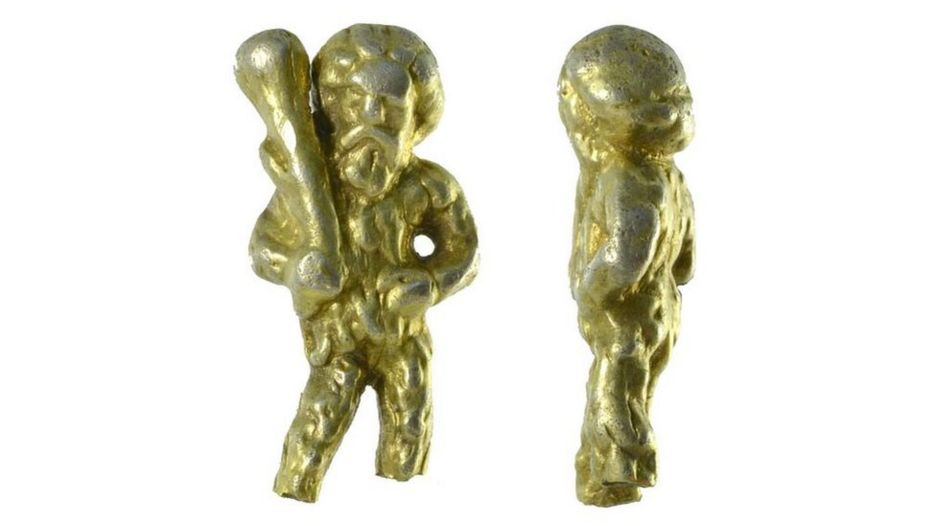
Rare treasure found in Suffolk depicts medieval 'Wild Man'


  • The Wild Man
Image copyright Suffolk County Council Archaeological Service
Image caption Historians say people were fascinated by the Wild Man in the medieval age

A 500-year-old artefact is one of the earliest depictions of a mythical figure from medieval Europe, an expert has claimed.

Metal detectorists found the spoon handle with an engraving of "Wild Man" near Woodbridge in Suffolk.
A leading historian has hailed the discovery as a "rare find".

Some of the earliest writings about The Wild Man come from Spain in the 9th Century and he was described as "barbaric, chaotic and unrestrained".

The 15th Century handle, found two years ago, was declared as treasure at an inquest in Ipswich this week.

Covered in leaves and brandishing a club, the hairy Wild Man was a popular medieval mythical figure mostly found in pictures and literature rather than on objects.

Professor of history Ronald Hutton, from the University of Bristol, said: "It's certainly one of the earliest depictions of the Wild Man.


The Wild Man
  • - A mythical figure popularised in Europe in the medieval period
  • - It is usually depicted with a hairy body and club
  • - It can be seen in church carvings, such as at All Saints in Hilbrorough, Norfolk (pictured)
  • - Related stories include Suffolk's Wild Man of Orford
"There would have been earlier ones on manuscripts and tapestries but not like this."

He said it would have been owned by someone "well-off" and from the "upper to middle class".


People were fascinated by the creature who was "barbaric, chaotic and unrestrained", he said.
"This might have been given to someone as a present to remind them of how not to behave," he added.
"He was a bogey in a world obsessed with religious and social order, an awful warning of the consequences of a lack of either."


The figure is being valued by the British Museum, which will then decide what to do with it.

 https://blogger.googleusercontent.com/img/b/R29vZ2xl/AVvXsEhG12Ahrf6A5JsCmg6H6IisN3jJfiBAXWYMedqB0qPfRwhlb92qz-0ChnHiht-t15H59nZtTRcofrPyif74S7j5gyNvhbeKxh4_1Fpy4WD9JRCxwQle7HW29sjPITP3bqKA0OBBqA9Z7DhT/s1600/peasenhall+wild+man+copy+low+res+caption.jpg

Sunday, 20 December 2015

It All Started As A Lovely Sunny Day!


Well, now good  old Nutkin is gathering and hiding nuts while the wallflowers continue flowering, blossom and buds on the trees and for two days I've had my window open -THAT is mild!


Captive Carnivores Discovered At Mexican Pyramid

 https://s-media-cache-ak0.pinimg.com/736x/4c/c9/51/4cc951d5176a6067fdd17cb09190d9d8.jpg

It surprises me that people are astonished when they read these articles. Humankind has a long history in the way it captures and  badly treats or misuses animals. If you know your Mesoamerican history you shouldn't be surprised.

Historically it is interesting as it tells us more about how this civilisation operated.  I am just hoping that one day -and it will happen- while I am still alive the archaeologists are going to find remains of animals science does not know about -whether a canid or felid -Onza-like cats?

Now a zoologist ought to really make a long study of the known records for Mesoamerica, pictographs and see what they can find because it is still true that a lot of remains lie hidden in South and Central American museums (as they do in European museums).

Remains Of Captive Carnivores Discovered At Mexican Pyramid

Pumas, wolves and eagles were raised by the inhabitants of the ancient city of Teotihuacan, probably for use in sacrificial rituals
Photo credit: Pumas, wolves and eagles were raised by the inhabitants of the ancient city of Teotihuacan, probably for use in sacrificial rituals. Ricardo David Sánchez via Wikimedia commons

Archaeologists have discovered the remains of the earliest known captive carnivores in Mesoamerica, after excavating the pyramids at the ancient city of Teotihuacan in Mexico. Among the findings were the bones of pumas, eagles and wolves, many of which displayed markings which probably correspond to brutal treatment by their human captors.

Remains of almost 200 animals were found in tunnels underneath the famous Moon Pyramid and Sun Pyramid, during excavations carried out between 1998 and 2004. It is believed that the creatures were placed there as offerings at various stages of the temples’ construction. As such, they predate all previous evidence for captive carnivores in the region, such as the famous descriptions of Aztec zoos and breeding programmes provided by early conquistadores and missionaries such as Hernán Cortés and Bernardino de Sahagún.

The latest findings, described in the journal PLOS ONE, are thought to date back to between 150 and 350 CE, and therefore suggest that the domestication of these creatures was prevalent more than 1,000 years earlier than previously thought.


The position of the discovered animals, combined with depictions of pumas and wolves dressed in military regalia while devouring human hearts, suggests that they were probably involved in sacrificial ceremonies, and may well have eaten humans who were offered to the gods. To confirm this, the researchers conducted isotope analysis on the bones they found. This involves the study of the atoms in organic remains, focusing particularly on isotopes – atoms with particular numbers of neutrons in their nuclei – which give clues as to what the animal may have eaten.

Drawings of pumas devouring human hearts suggest that they may have been involved in sacrificial rituals at Teotihuacan. Credit: Nawa Sugiyama


Many of the specimens found at Teotihuacan contained high levels of certain nitrogen isotopes that indicate they probably fed on omnivores such as humans or dogs. Furthermore, the presence of a carbon isotope called C4 suggests they ate large amounts of maize, implying that they were raised in captivity rather than in the wild.

Additionally, many of the animals displayed injuries that were probably inflicted by humans attempting to manipulate them. For instance, a number of eagles were found with fractures and other lesions on their legs, probably suffered as a result of being tethered. In addition, many of the skeletons were found to have been preserved using techniques resembling taxidermy. From this, the study authors hypothesize that these animals were probably accidentally killed before they could participate in ritual sacrifices, and were then stuffed so that they could still be used in these ceremonies.

Eagle remains discovered at Teotihuacan displayed injuries that were probably inflicted by human captors. Credit: Nawa Sugiyama

Adding up all of this evidence, the team concludes that the treatment of these captive beasts provides an interesting insight into the challenges involved in ancient Mesoamericans’ “initial experimentation in manipulating dangerous and specialized carnivores.”