Over the last three decades I've written about pre-Columbus travels to the Americas -in fact visits prior to even the Vikings. In the 1990s I was even asked to write an article on this for war-gamers.
Still, now it looks like I can laugh in the face of people who burst out laughing in mine -and others faces.
Hopefully....more photos on the page link below.
Startling new report on Oak Island could ‘rewrite history’ of the Americas
Oak Island. Image copyright 2015 DigitalGlobe
Roman artifacts allegedly found on and off Oak Island
Findings would pre-date Columbus by more than a thousands years
17:00Wednesday 16 December 2015
Ancient mariners visited the New World more than a thousand years before Columbus - according to a sensational new report.
The main findings of the study, which centres on the mysterious Oak Island, off Nova Scotia, have been exclusively revealed to Johnston Press.
ADVERTISING
A team of expert researchers reckon they have unearthed astonishing
evidence that Roman ships visited North America in antiquity - ‘during
the first century or earlier’ and long before Columbus landed in 1492.
The History Channel’s series Curse of Oak Island, now in its third season, follows the Lagina brothers as they attempt to discover the island’s long-held secret.
The Roman sword allegedly found in water just off the mysterious Oak Island, Nova Scotia. Photo: investigatinghistory.org
Now historic investigator J. Hutton Pulitzer, who previously featured
on the show, has put a large white paper together with a group of
academics from the AAPS (Ancient Artifact Preservation Society).
He claims to have evidence of a Roman sword found submerged just off Oak Island - and what is believed to be a Roman shipwreck.
Pulitzer says this sword is ‘100 per cent confirmed’ and described it as the ‘smoking gun’ to his theory.
“The ceremonial sword came out of that shipwreck,” he said. “It is one incredible Roman artifact.”
The object first came to his attention when a man contacted the show to reveal its existence.
Pulitzer
explained: “Some years ago, a man and his son were scalloping off Oak
Island, which sees them hang rake-like object off the back of their
boat. When they brought this up, the sword came up with it.
“The father kept it for decades, and when he died it went to his
wife, then his daughter. Then when she died many years later it went to
her husband. It was he who came forward to the island and said ‘I think
you should know about this and where it was found.”
Pulitzer claims the complex metallic properties of the sword match those of other ancient Roman artifacts.
“I began my forensic work into it using an XRF analyser - which is a
leading archaeological tool for analysing metals,” he explains. “And we
found all these other metals that tell you this was made from ore that
came directly from the ground. It has the same arsenic and lead
signature in it. We’ve been able to test this sword against another one
like it and it matches. This goes against everything we have been
taught.”
Exactly what else could lurk in the mysterious shipwreck
is unknown as it has not been investigated by divers. Astonishingly,
there are thousands of unexplored shipwrecks in the Nova Scotia area,
the majority of which are thought to date back to the 18th and 19th
century.
“The shipwreck is still there and has not been worked,”
said Pulitzer. “We have scanned it, we know exactly where it lays, but
it will be a touchy thing for the Nova Scotia government to allow an
archaeological team to survey it. We know beyond a shadow of a doubt
that it is Roman.
“I think this is the single most important discovery for the
Americas - an event that will re-write history.
They will talk about it
very briefly on Curse of Oak island but something like this
shouldn’t be a footnote in a TV show - this is a gunshot to be heard
around the world. It changes all of our history on this side of the
pond.”
He said mainstream historians often dismiss such finds by
suggesting artifacts that do not conform to the orthodoxy must have been
dropped by collectors in more modern times.
“That’s how they
poo-poo having to talk about it,” Pulitzer says. “But it’s a pretty
blatant Roman artifact. The knee-jerk reaction was to think somebody put
that sword there. It was found incredibly close to Oak Island in water
only 25ft deep. But if you dropped that rare collectors’ sword
overboard, wouldn’t you dive down to get it?”
In an attempt to demonstrate the Roman sword and shipwreck are more
than mere coincidence, Pultizer and his team examined the area around
Nova Scotia, alongside archaeological records to see if there were any
other ‘coincidences’. They looked at the indigenous natives of Nova
Scotia - the Mi’kmaq people - who are believed to have lived on their
ancestral lands for more than 8,000 years.
Pulitzer said: “The
Mi’kmaq carry the rarest DNA marker in the world which comes from the
ancient Levant (the eastern Mediterranean). You can’t screw with DNA.”
The
report details a number of Mi’kmaq petroglyphs (carved images) on cave
walls and boulders along riverbanks in Nova Scotia. Some of these
images, first discovered in the 1800s, depict what Pulitzer’s team
believe to be Roman legionnaires marching with their swords - and Roman
ships.
Myron Paine, author and former South Dakota State
University professor, notes there are numerous ancient pictographs in
the area which show voyages, advanced learning, foreign symbols, ancient
peoples and ancient mariners.
Pulitzer adds: “There are also 50
words in the Mi’kmaq language which are ancient nautical sailing terms
used by ancient mariners from Roman times - but they were not a
seafaring culture.
“Another very interesting ‘coincidence’ is a
bush on Oak Island and one on the mainland which is listed in Canada as
an invasive species (Berberis Vulgaris). “This was used by ancient
mariners, including Romans, to season their food and fight scurvy. It
grows in Oak Island and across the way in Halifax. All these things,
signs and symbols add up to more than just coincidence.”
Two
carved stones on Oak Island also ‘possess a language from the ancient
Levant’ according to Pulitzer. The first is the famous ‘90ft stone’
which was inscribed with strange symbols and first unearthed in 1803,
90ft down the money pit. The second is the so-called ‘HO stone’ - a
large boulder believed to have been sited on the shoreline and inscribed
with secret codes for mariners - but later blown up by treasure hunters
who thought the treasure was buried beneath. “How can someone in that
time have faked that?” he asks. “They wouldn’t have known about that
language.”
Other findings detailed in the report include a Roman
legionnaire’s whistle found on Oak Island in 1901, a metal ‘boss’ from
the centre of a Roman shield unearthed in Nova Scotia in the mid-1800s,
and a small Roman head sculpture found in Mexico City in 1933 under
foundations of a pre-colonial building dated to between 1476 and 1510.
What
Pulitzer’s team believe to be ancient burial mounds were also sited in
shallow water close to the western shoreline of Oak Island.
Prof
James P. Scherz, of the University of Wisconsin notes these mounds are
‘consistent with ancient European and Levant burial mounds, not native
American’.
In the report, Prof Scherz states: “I am in agreement
the underwater mounds being of a foreign (ancient mariner style) and not
native to Nova Scotia or traditional North American. These mounds, in
looking at the known ocean levels for the area, give a possible date of
occurring between 1500BC and 180AD.”
Gold Roman Carthage coins
have also been discovered on the mainland near Oak Island. A number of
these are said to have been found buried in the same location. Pulitzer
said: “We had them authenticated by some of the best experts. Yet in the
show, they dedicated just 90 seconds to the topic.”
Pulitzer and
his team are not the first to put forward a theory that ancient
Europeans visited the Americas in pre-Columbian times - with others also
pointing to the Minoans and the Phoenecians as having visited the
continent.
His report also references the 16th century scholar
Marineo Siculo who first claimed it was the Romans who discovered the
New World, not Columbus.
However, Pulitzer says, with the new discoveries and modern science, it’s time these findings were taken seriously.
Indeed,
he claims such findings in the past were ‘forgotten about and never
fully investigated’ as they did not fit with mainstream history.
“When
you put all these things together and you look at the anomalies, it’s
not a coincidence,” he says. “The plants, the DNA, the artifacts, the
language, the ancient drawings - you have something that deserves to be
taken seriously.
“We have absolutely been lead to believe that
nothing happened on this side of the pond before Christopher Columbus.
That’s a church-induced concept. All the ancient records that exist make
it very clear the world was circumnavigated and the world was round.
“But
when the Catholic Church and the Romans came in, all those records were
destroyed – so we had to kind of re-learn this stuff. History is
political on our side of the pond. There’s been so much politicizing of
who is native, and what was the first nation, that when discoveries come
about that change this, it’s wildly controversial.
“The problem
is, to rewrite history it would mean rewriting every textbook and
university course in the world. That’s the detriment. I think anything
that challenges history is very risky, very dangerous and extremely
political. But I think the world has matured and history may force
politics to mature.”
Speaking about the report, he said his team
of researchers include experts and academics who are largely ‘out of the
system’ so have nothing to lose by supporting unorthodox theories.
“Some are retired, and some have left the system for various reasons,”
Pulitzer explained. “I think we should all fight for the truth and
people should make up their own minds. We are just saying ‘here’s what
we have found’.”
Research team member Prof Carl Johannessen,
formerly of the University of Oregon, agrees: “Our research challenges
the orthodoxy of 1492 as the pivotal date when the New World met the Old
World.”
Praising the TV show, Pulitzer said Curse of Oak Island
had ‘captured people’s imaginations’ by offering viewers the exciting
opportunity to see history unfold on their television sets. However, he
criticsised the show’s producers for showing little interest in
alternative theories outside those of the Knights Templar, as he says
‘that is what they think audiences are hoping to see’.
“Google
will tell you that most of the searches for ‘Oak Island’ also include a
reference to the Knights Templar,” said Pulitzer. “Television uses this
information to appeal to the fans of those types of theories. But I’m a
historian and forensic researcher. My job is to not believe any
particular theory, but let the evidence tell me where to go.”
On
the show Pultizer told the Lagina brothers he believed the area of Oak
Island was visited in the past by Templars - but that they were ‘looking
for something’ - the same as teams are today.
“I believe that
many different ancient mariner societies came to Oak Island and it was
an important stop-over for them,” he says.
“We just hope our
report will open the dialogue that will re-write history as we know it.
If we can just get rid of this Columbus conspiracy.”
Concluding,
he added: “I think as humans we have evolved enough to be able to handle
the truth now. It’s time for theory to be reflected by hard science.
Even if there’s no gold inside Oak Island - it’s a trillion-dollar
treasure we are uncovering in history for our children and
grandchildren.”
The AAPS team’s report is scheduled to be published in full in early 2016.
An artist's impression of an exoplanet with the potential to support life NASA/JPL-Caltech
Again, it needs to be pointed out that this is based on what we know about Earth -and ask a scientist, out of 100% -what per centage figure covers what we know about Earth?
Conditions may vary for other life forms and we have found bacteria and other life forms on Earth living in conditions that had been thought totally impossible.
"Just" 14 light years away?
Wolf 1061c: Astronomers spot nearest 'Earth-like' planets capable of supporting life ever seen
The star is just 14 light years away — next door to us in space
terms — and has a planet going around it that sits perfectly in the
“Goldilocks zone” that makes worlds able to support life
Astronomers have spotted a planet that is the closest potentially habitable world humanity has ever seen.
The planet is four times as big as Earth and sits perfectly within
the “Goldilocks zone” that would make it able to support life.
Astronomers look for worlds that that sit in that perfect region, where
it is not too hot or cold to support liquid water.
It is one of the first times that astronomers have spotted a planet
near to us that has the kind of rocky, solid surface that is thought to
be necessary for alien life.
"It is a particularly exciting find because all three planets are of
low enough mass to be potentially rocky and have a solid surface, and
the middle planet, Wolf 1061c, sits within the 'Goldilocks' zone where
it might be possible for liquid water — and maybe even life — to exist,"
said lead study author Dr Duncan Wright in a statement.
"It is fascinating to look out at the vastness of space and think a
star so very close to us — a near neighbour — could host a habitable
planet.”
Scientists might now be able to catch a view of the planet, helping
them study its atmosphere and explore whether it might be able to
support life.
The team found three planets going around a star that is stable like
our own but smaller and relatively cool. One of the three planets, known
as Wolf 1061c, sits squarely within the habitable zone.
The team, from the University of New South Wales (UNSW), made the
discovery using the HARPS spectrograph, which is part of the European
Southern Observatory's 3.6 metre telescope in La Silla in Chile.
"Our team has developed a new technique that improves the analysis of
the data from this precise, purpose-built, planet-hunting instrument,
and we have studied more than a decade's worth of observations of Wolf
1061," Professor Chris Tinney, head of the Exoplanetary Science at UNSW
group, said in a statement.
"These three planets right next door to us join the small but growing
ranks of potentially habitable rocky worlds orbiting nearby stars
cooler than our Sun."
Scientists will now hope that they can explore the planet’s atmosphere in more detail.
"The close proximity of the planets around Wolf 1061 means there is a
good chance these planets may pass across the face of the star. If they
do, then it may be possible to study the atmospheres of these planets
in future to see whether they would be conducive to life," said team
member UNSW's Dr Rob Wittenmyer in a statement.
There is nothing new here. Weird stuff goes back a long ways but is any of it true? How much is misperception, misidentification or pure fakery?
In 2000 a TV production company wanted to send myself and a team of team with cameras -infra red, night vision, regular- for a week. What happened? Nothing. And the explanation as to why nothing happened is..."odd" in itself.
Two of the bosses at the company told the producer that they had discussed it and decided not to fund the documentary. Why? To paraphrase: "What if they go missing? Something really bad happens to them..." and I thought, hearing this, "Wow. Their hearts are in the right place!" but then "...we'd lose a lot of equipment -that's about seventy-five grands worth!"
ahem.
But I'm still up for it!
UFOs, ghosts and missing people: Is this the creepiest forest in the world?
Hoia Baciu is the 'Bermuda Triangle of Transylvania'
COULD this be the most supernatural place in the world?
The
Hoia Baciu forest is known as the Bermuda Triangle of Transylvania
because of the sheer number of scary things that happen there.
The creepy Romanian forest is just over 700 acres in size, and has been plagued by a number of unsettling events.
HoiaBaciuforest.com
In fact, it’s so terrifying that many Romanians are reportedly too frightened to go there at night.
The
forest has disturbing origins: it’s supposedly named after a shepherd
who mysteriously disappeared amongst the trees – along with his flock of
200 sheep.
HoiaBaciuforest.com
Trees within are strangely curved, and
there’s even a large clearing where no trees grow – yet no explanation
for why this is the case.
According to one legend, the clearing
is protected by the spirits of murdered peasants, who are guarding a
gateway to other spiritual dimensions.
Getty
People that enter the forest say that this clearing is the hotspot for the otherworldly feelings you get in Hoia Baciu.
Hoia Baciu: World's most haunted forest
Some have linked it to the reported UFO spottings. A photo,
supposedly taken in 1968 by biologist Alexandru Swift, shows a clear
disc in the sky – and it looks to be of extra-terrestrial origin.
And other photos seem to show similar alien objects.
Those
who enter the forest claim to have experienced feelings of
uncontrollable anxiety, and there are also stories of people seeing
paranormal lights and colours.
There are tales of disappearances too,
including one story of a five-year-old girl who vanished, only to
reappear five years later, unaged and with her clothes in perfect
condition.
Whether true or not, it’s unquestionable that Hoia
Baciu has developed a reputation for the eerie and supernatural. The
only way to verify these tales is to go for yourself...
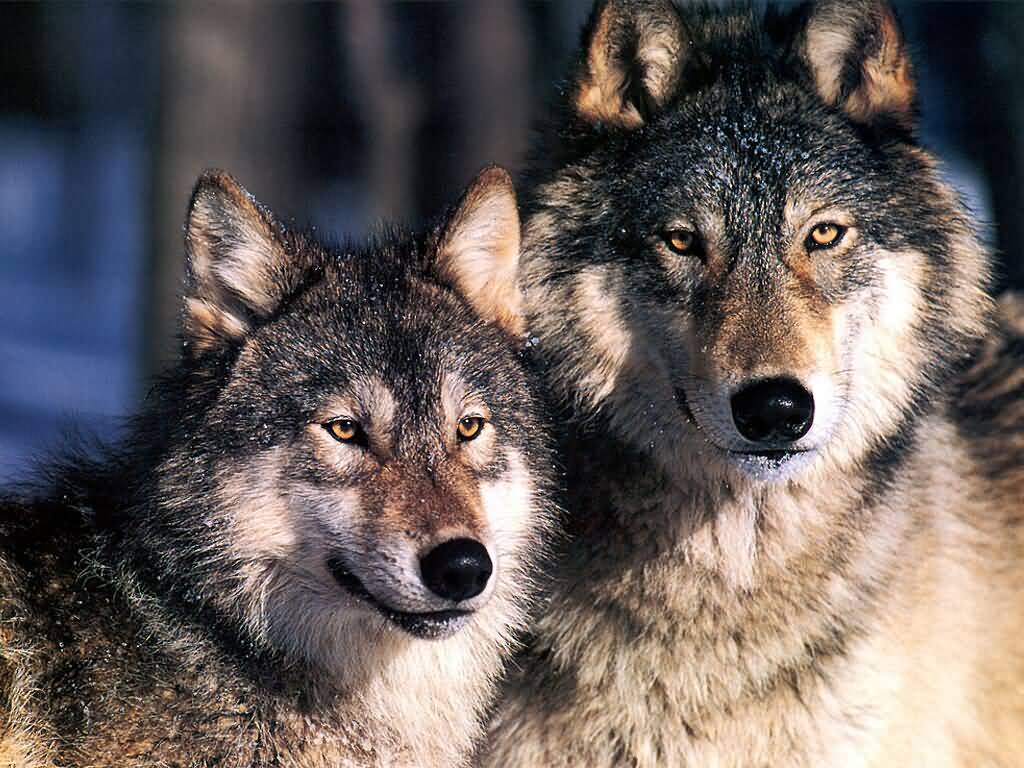
This from the Wolf Conservation Trust shows that European wolves are far from protected. A bunch of asses with money and lobbyists now get everything changed. Some 11,000 people want to be able to go out and kill 16 wolves. This means that 687.5 get to shoot one each of the 16 wolves.
So,that company in Norway: yes, I REALLY do need the money but I'm refusing until your country wakes up.
Norway to hunt half its wolves
Norway is gearing up for a wolf hunt: 11,000 people have applied for
licenses to shoot one of 16 wolves in this season's quota. As the wolf
population is estimated at just 35 wolves, this means that roughly half
will be killed.
The hunt is the result of successful lobbying by
the hunting and farming communities in Norway. As Norway is outside of
the EU, rules such as the Habitat Directive don't apply.
This is from 2012 on the William Lynn site. It shows that wolf hunting is still "fun sport". My new resolution is that I will not travel to any country in Europe that allows wolf hunting. Moronic asses.
Norway
recently entered into negotiations with Sweden to claim a population of
Swedish wolves as their own. This is to protect the interests of
Norwegian wolves, right? Not at all. Norway wants to claim these wolves
who range into its northern reaches so that it may eliminate wolves in
the lower two thirds of the country.
In British Columbia, a draft plan to control wolf populations through
the renewal of a bounty system is being finalized. Does BC have an
overpopulation of wolves? Not at all.
Powerful agricultural and hunting
interests want to see them driven from much of the landscape.
The actions of Norway and British Columbia may seem shocking to some,
but they reflect an effort to end wolf recovery that was pioneered in
the United States over the last two decades. Here is how it works.
Opponents of wolves gerrymander maps to create the impression that
wolves have recolonized a broad geographical region. They then define
the endpoint of wolf recovery programs according to barely adequate
population numbers. Combine the two and you can quickly undermine
decades of hard fought battles to protect wolves and their habitats.
In 1995 Grey wolves were restored to Yellowstone National Park, and
the wolf population was steadily increasing in Minnesota. By the ten
year anniversary of the Yellowstone restoration, Wolf packs would had
spread throughout the Greater Yellowstone Region, as well as into
Wisconsin and Michigan.
Mexican wolves had a tenuous hold in a small
section of the Blue Ranges on the border of Arizona and New Mexico. Red
wolves were just beginning to recover in the Alligator River National
Wildlife Refuge, having recently been reintroduced after a captive
breeding program on Bulls Island, SC. Huge swaths of the country that
were once home to wolves and in desperate need of their ecological
services remained to be recolonized.
Yet in 2003 the Bush administration began a long-term effort to
downgrade the protection wolves had received under the Endangered
Species Act. They began by down listing the grey wolf from endangered to
threatened. Shortly thereafter they sought to return wolf management to
the states.
As part of this effort, the administration began gerrymandered zones
of wolf recovery based on political not ecological criteria. They did
this by lumping multiple areas suitable for wolf recovery into single
geographical regions. They then adopted a policy that once wolves were
recovered in one portion of a region, they were declared recovered
across the entire region. Recovery efforts elsewhere were regarded as
unnecessary.
For example, the Midwest and the Northeast were counted as a single
“Eastern” region by the Bush Administration. Because wolves were
established in Minnesota, Wisconsin and Michigan, wolves were considered
to be recovered everywhere in the east. All without a paw on the ground
in New England, New York, Pennsylvania, Ohio, Indiana, Illinois, Iowa,
Missouri, North Dakota, South Dakota, Nebraska, and Arkansas. The
ongoing discussions with the USFWS about recovering wolves in New
England (e.g. Adirondack Park, Allagash River Basin) ground to a halt.
Creating the false impression that wolves have recolonized a region
was not enough. Left to their own devices, wolves would continue to
expand their range as young males and females dispersed across the
landscape. So Bush’s Department of the Interior cooked up a simple
scheme. They defined a successful recovery as a minimal number of
breeding pairs. This was absurd. It vastly understated the normal size
of healthy wolf packs and populations, and ignored the biological
carrying capacity for wolves. As such, the criteria themselves put
sustainable wolf populations at extreme risk of accident, disease,
poaching, and predator control.
Yet the criteria also created the false impression that there was an
overpopulation of wolves since there were more wolves than envisioned by
artificially low population targets. This facade of overpopulation was
then used to justify public hunting and trapping of wolves, predator
control by Wildlife Services, and permissive rules for killing wolves
out of hunting season. The stated goals circulated around protecting
children, restoring threatened ungulate populations, and restoring
“balance” to natural systems. The actual intent was to devastate wolf
populations in the few places they have recovered, and restrict the
remnant populations to a gulag of habitats surround by free-fire zones.
Why would the federal and state governments want to do this? There
are many reasons including political hostility to animal and
environmental protection, and deeply rooted cultural antipathy towards
wolves.
Since Europeans first arrived in North America, they have seen
wolves of “beasts of waste and desolation” (President Teddy Roosevelt’s
phrase). Exterminating predators including wolves was a goal of federal
and state government for over a hundred years, and was only haltingly
ended in the 1970s.
Even now there are powerful voices both in and out
of government who do not believe that wolves have an ecological role or
ethical right to inhabit natural environments.
There are also financial interests at stake. Many ranchers expect the
federal government to pick up the tab for predator control. The irony
is that much of their stock grazes virtually for free on federal and
state lands. In addition, wolves kill a negligible number of cattle and
sheep in the US. The vast majority of stock die because of disease,
exposure, and poor range management.
Gig game hunting also has cards in the game. They want predator
suppression (of wolves, bears, coyotes, and pumas) to artificially
increase the numbers of deer, elk and moose. This allows them to
increase the number of hunting licenses sold, lining the pockets of
hunting guides and outfitters. Hunting tags also fund a large proportion
of state wildlife management budgets. Because of this, agencies charged
with ecological management are faced with perverse incentives to manage
for the largest budget, not a healthy landscape.
When Barack Obama won his first term as President, many in the wolf
community assumed he would end the anti-wolf policies of the previous
administration. Obama appointed Ken Salazar as Secretary of the
Interior. Salazar is a wealthy corporate rancher who is hostile to wolf
recovery. And so much to the surprise of many (including myself), the
Obama administration extended previous policies on wolf management.
Nevertheless, legal challenges stymied the full implementation of the Bush-Obama policies. Neither the feds or the states could ever demonstrate that either the government’s wolf policies met the conditions required for recovery in the Endangered Species Act.
To overcome this legal barrier, the 2011 Congress attached a rider to
a budget bill that removed Grey wolves in the Rocky Mountains from the
endangered species list. Obama and Senate Democrats decided to throw
wolves under the bus to smooth the re-election of Senator John Tester
(Democrat, Montana), and Obama sighed the bill without objection. Wolves
were by an act of fiat no longer technically endangered. Wolf
management was quickly handed back to the states, where agricultural and
big game lobbies have historically manipulated wildlife management
agencies for their own interests. It surprised no one, then, that the
states prepared management plans modelled on the gerrymandering of maps
and deficient population levels that were pioneered by the federal
government.
This Fall saw wolves being hunted, wolf packs exterminated, and wolf
populations decimated across the US. Four decades of progress in wolf
recovery is coming to an end. Advocacy groups like Defenders of
Wildlife, the Sierra Club, and others are hurriedly reaching out to
their communities and decrying this injustice to wolves. But even as
their campaigns struggle to sound a moral note that would hold federal
and state wolf management account, it is far too little far too late.
Advocates for wolves were warned this would happen a decade ago. I
had been sounding this alarm since the late 1990s when I began to speak
widely on the ethics of wolf recovery. So too did scientists like David
Lavigne, Professor Emeritus of the University of Guelph and an expert on
values in environmental policy. He warned in a plenary address to the
World Wolf Congress of 2003 what would happen if the policy community
did not come to grips with the value-ladend dimensions of wolf
management. Those of us making this argument were concerned that we
would eventually lose the wolf wars if we did not complement the
scientific justification for wolves (which is strong) with robust
ethical arguments that advanced our moral responsibilities towards
wolves themselves. We implored citizens, scientists and policy makers to
reframe their arguments, to complement sound science with sound ethics,
to align facts with values, and in so doing create the conditions for
policy success.
Sadly, we were unsuccessful. The leadership of the mainline
environmental groups did not listen. They chose instead to curry
credibility with the very federal and state agencies that eventually
turned on them. And thus these organizations are reduced to making
emotive appeals hoping to shore up support for rearguard policy actions
that will do little to change the facts on the ground. We are, in some
senses, beginning wolf recovery in North America all over again.
It is Thanksgiving weekend in the States. I am deeply grateful for my
life. I have a loving home, good friends, and work I enjoy. Yet wolves
are dying in large numbers for senseless reasons right now. They will
continue to do so until there are few left to kill. This holiday season,
it seems that wolves have little to be thankful for.
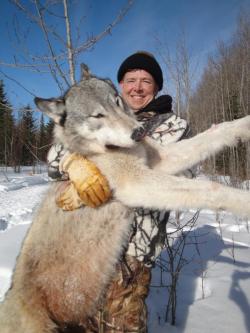
Image: The photograph is from Predator Nation,
a television show about “hunting the hunters” that airs on The
Sportsmans Channel and is hosted by Fred Eichler. Reflecting on killing
his first wolf, Eichler says in part,
"When we discovered the blood trail and found the wolf, I
was overjoyed and could barely contain my emotions. This is the first
time I took a wolf and I was ecstatic…. This was a day I will never
forget! Wolves are extremely smart and have my utmost respect. Managed
hunting helps to control populations to keep them from devastating game
populations."
"When we discovered the blood trail and found the wolf..." So, not even an outright kill shot the animal was wounded and in pain until it died. Remind me: which species did I say was the greatest vermin on the planet?
Researchers at the Large Hadron Collider at CERN are smashing together protons to search for new particles and forces.Credit
Fabrice Coffrini/Agence France-Presse — Getty Images
One
possibility, out of a gaggle of wild and not-so-wild ideas springing to
life as the day went on, is that the particle — assuming it is real —
is a heavier version of the Higgs boson,
a particle that explains why other particles have mass. Another is that
it is a graviton, the supposed quantum carrier of gravity, whose
discovery could imply the existence of extra dimensions of space-time.
At the end of a long chain of “ifs” could be a revolution, the first clues to a theory of nature that goes beyond the so-called Standard Model, which has ruled physics for the last quarter-century.
It is, however, far too soon to shout “whale ahoy,” physicists both inside and outside CERN
said, noting that the history of particle physics is rife with
statistical flukes and anomalies that disappeared when more data was
compiled.
A
coincidence is the most probable explanation for the surprising bumps
in data from the collider, physicists from the experiments cautioned,
saying that a lot more data was needed and would in fact soon be
available.
“I
don’t think there is anyone around who thinks this is conclusive,” said
Kyle Cranmer, a physicist from New York University who works on one of
the CERN teams, known as Atlas. “But it would be huge if true,” he said,
noting that many theorists had put their other work aside to study the
new result.
When
all the statistical effects are taken into consideration, Dr. Cranmer
said, the bump in the Atlas data had about a 1-in-93 chance of being a
fluke — far stronger than the 1-in-3.5-million odds of mere chance,
known as five-sigma, considered the gold standard for a discovery. That
might not be enough to bother presenting in a talk except for the fact
that the competing CERN team, named C.M.S., found a bump in the same
place.
“What
is nice is that it is not a particularly crazy signal, in a quite clean
channel,” said Nima Arkani-Hamed, a particle theorist at the Institute
for Advanced Study in Princeton, N.J., speaking before the announcement.
“So, while we are nowhere near moving champagne even vaguely close to
the fridge, it is intriguing.”
Physicists
could not help wondering if history was about to repeat itself. It was
four years ago this week that the same two teams’ detection of matching
bumps in Large Hadron Collider data set the clock ticking for the discovery of the Higgs boson
six months later. And so the auditorium at CERN, outside Geneva, was so
packed on Tuesday that some officials had to sit on the floor for a
two-hour presentation about the center’s recent work that began with the
entire crowd singing “Happy Birthday” to Claire Lee, one of the
experimenters, from Brookhaven National Laboratory on Long Island.
At one point, Rolf Heuer,
the departing director-general of CERN, tried to get people to move off
the steps, declaring they were a fire hazard. When they did not move,
he joked that he now knew he was a lame duck.
When physicists announced in 2012 that they had indeed discovered the Higgs boson, it was not the end of physics. It was not even, to paraphrase Winston Churchill, the beginning of the end.
It might, they hoped, be the end of the beginning.
The
Higgs boson was the last missing piece of the Standard Model, which
explains all we know about subatomic particles and forces. But there are
questions this model does not answer, such as what happens at the
bottom of a black hole, the identity of the dark matter and dark energy that rule the cosmos, or why the universe is matter and not antimatter.
The Large Hadron Collider
was built at a cost of some $10 billion, to speed protons around an
18-mile underground track at more than 99 percent of the speed of light
and smash them together in search of new particles and forces of nature.
By virtue of Einstein’s equivalence of mass and energy, the more energy
poured into these collisions, the more massive particles can come out
of them. And by the logic of quantum microscopy, the more energy they
have to spend, the smaller and more intimate details of nature
physicists can see.
Parked
along the underground racetrack are a pair of mammoth six-story
conglomerations of computers, crystals, wires and magnets: Atlas and
C.M.S., each operated by 3,000 physicists who aim to catch and classify
everything that comes out of those microscopic samples of primordial
fire.
During
its first two years of running, the collider fired protons, the
building blocks of ordinary matter, to energies of about four trillion
electron volts, in the interchangeable units of mass and energy that
physicists prefer. By way of comparison, the naked proton weighs in at
about one billion electron volts and the Higgs boson is about 125
billion electron volts.
Since
June, after a two-year shutdown, CERN physicists have been running
their collider at nearly twice the energy with which they discovered the
Higgs, firing twin beams of protons with 6.5 trillion electron volts of
energy at each other in search of new particles to help point them to
deeper laws.
The
main news since then has been mainly that there is no news yet, only
tantalizing hints, bumps in the data, that might be new particles and
signposts of new theories, or statistical demons.
The
most intriguing result so far, reported on Tuesday, is an excess of
pairs of gamma rays corresponding to an energy of about 750 billion
electron volts. The gamma rays, the physicists said, could be produced
by the radioactive decay of a new particle, in this case perhaps a
cousin of the Higgs boson, which itself was first noticed because it
decayed into an abundance of gamma rays.
Or
it could be a more massive particle that has decayed in steps down to a
pair of photons. Nobody knows. No model predicted this, which is how
some scientists like it.
“The
more nonstandard the better,” said Joe Lykken, the director of research
at the Fermi National Accelerator Laboratory and a member of one of the
CERN teams. “It will give people a lot to think about. We get paid to
speculate.”
Maria
Spiropulu, a professor at Caltech and member of one of the detector
teams, said, “As experimentalists, we see a 750-billion-electron-volt
beast decaying to two photons.” Explaining it, she added, is up to the
theorists.
The new results are based on the analysis of some 400 trillion proton-proton collisions.
If
the particle is real, Dr. Lykken said, physicists should know by this
summer, when they will have 10 times as much data to present to
scientists from around the world who will convene in Chicago, Fermilab’s
backyard.
Such
a discovery would augur a fruitful future for cosmological wanderings
and for the CERN collider, which will be running for the next 20 years.
It could also elevate proposals now on drawing boards in China and
elsewhere to build even larger, more powerful colliders.
“We
are barely coming to terms with the power and the glory” of the CERN
collider’s ability to operate at 13 trillion electron volts, Dr.
Spiropulu said in a text message. “We are now entering the era of taking
a shot in the dark!”
Correction: December 15, 2015
An earlier version of this article gave an incorrect figure for
the power the Large Hadron Collider has been running since June. It is
firing twin beams of protons with 6.5 trillion electron volts of energy,
not 6.5 billion volts.
A version of this article appears in print on December 16, 2015, on page A18 of the New York edition with the headline: Physicists in Europe Find Tantalizing Hints of a Mysterious New Particle. Order Reprints|
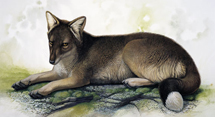
Achill Island wolf
It can get to be very monotonous,you know. I have found that old reports from the Flying Saucer Review -what was the journal of international Ufology- was not beyond reporting cases as being factual for many years -even though they had been provided with the details of hoaxes, etc., by the actual investigators.
The odd, shall we say 'joke', rather than hoax? Well the odd one of those crept in such as the Braemar, Scotland, 1958 UFO and occupant case. After 15 years I have given up. Absolutely no secondary source can be found for this report. It seems to have originated and ended with FSR.
CE IIIK and Entity case catalogues -remember me posting about the hostile reactions I got when I suggested researchers all cooperate on a data base that was freely available to all? All reports would need to have either the original investigation report or notes plus as many sources as possible. "Re-inventing the wheel" my ass. I suspect Ufologists knew damn well what would be found.
These are the "UFO researchers", by the way, who say there should be no contact with witnesses and that we should go by press, magazine clippings and published books. Lazy-assed, useless and contributing nothing but insults and negativity from their armchairs Ufologists. Where is their research? Their papers of original research on Ufology for us all to study and digest? Non-existent.
I have,in the last couple of months, tracked back original sources of reports -whether books or articles by the investigators: anything. I have corrected so many accounts on dates, details and so on that it goes to show these people are not serious researchers -hence not wishing to cooperate. And any more of their offensive emails will be publicly published here. Warned.
And no wonder someone coined the term "Craptozoologists" as better for cryptozoologists. Some of the biggest names have cribbed from one another, added bits here and there and plain lied about consulting the actual sources. I have proof: I have those original sources.
People,you have all been lied to by these "credible researchers". In every one of my books I have cited sources and given as many as I could. You can track back EVERYTHING I have written to the source and confirm it all.
Today, I have received an original document that proves a claimed statement by a highly regarded naturalist of the 19th/early 20th centuries was a lie. Added to, again, by people who spurn facts because they don't make books that sell.
Again and again I come across this on most "mystery" subjects.
Perhaps that is why my books don't sell? Hard facts are not as "sexy" as faked accounts. And people wonder why I do my research away from others.
Hmm.I get asked occasionally why I've never published a wildlife
magazine -after all, I've built wildlife ponds (some from the 1970s I'm
told still exist! and advised people on hedgehogs, talked on radio and so on enough times.
Well, in 1995 I set up the Ashton Vale Wild Life Group and in 1997 the Ashron Vale Wild Life Group Newsletter was published
looking at local wildlife as well as reports of non-native cats (pumas
and also wolverine in Wales in this case -specifically the "Beast of
Llangurig".
No. 2 looked at wildlife in Ashton Vale which, not surprisingly,no
one had studied in the 70 years of the estate! There was also a look at my on-going survey of the area. After all,on my first night I had a pair of barn owls fly low over me while in the garden and a little later saw a pair of foxes walking up the road -not to mention the biggest hedgehog I ever saw.
But then I was asked to act
as a wildlife consultant/naturalist for the proposed Yanley Park-a
rubbish dump that was to become a park area and landscaped for the community. To say I got
VERY negative reactions when this was mentioned is understating things -even threats (yeah,good luck with that!).
To put this into perspective: this was a rubbish dump
that had existed for many years and was going to be turned into a wildlife
friendly park for the area -benches and even play area for kids and the company involved and council thought "There is a naturalistliving and working there -we can't go wrong!"
Suddenly no one was interested in wildlife any more. The landscaped park was dumped as an idea because of local hostility -a simply covered over tip is okay but landscaped local park is out of the question?
So I carried on my work privately. In 2000 I published Felids: Wild
Cats, Ferals & Hybrids as an Exotic Animals Register (f 1977)-VWLG
publication. Wide circulation -even to museums in Europe and led to interesting feed-back from wild cat researchers there.
But as all the publications were
free I made no money on this, nor the newsletter -all printed on my old
desktop Canon FC220 copier (toner cartridges were costing £50 a time!).
So,I still write and advise and one day I WILL get around to an old
planned book -At Home With Wild Nature. Who knows!





 Norway
recently entered into negotiations with Sweden to claim a population of
Swedish wolves as their own. This is to protect the interests of
Norwegian wolves, right? Not at all. Norway wants to claim these wolves
who range into its northern reaches so that it may eliminate wolves in
the lower two thirds of the country.
Norway
recently entered into negotiations with Sweden to claim a population of
Swedish wolves as their own. This is to protect the interests of
Norwegian wolves, right? Not at all. Norway wants to claim these wolves
who range into its northern reaches so that it may eliminate wolves in
the lower two thirds of the country.