Total Pageviews

Monday, 30 September 2019

FEATURE DOCUMENTARY : The Mysterious Everglades : Abandoned Places, Lone...

Aliens -What Can We Expect


Exobiologists, who have remember never actually studied alien life first hand, look for so called "Goldilocks" or habitable zones around stars. Although they may be able  to decode certain emissions from a far distant world all the "artist impression of what --- might look like" images and speculation is just that.

Scientists are looking for planets that "could evolve or develop life similar to that on Earth". It is all guessing and to some a search of this type seems "the most likely way of discovering alien life"...but all the references and so on are then to micro organisms -bacteria, algae and so on. Which we will never discover beyond our solar system because we have yet to actually travel to or find such things in our own system.

What good is it to anyone to declare that a planet some 100 light years away "might" (triple underlined emphasis) "be suitable to support basic life forms"?

Rather like the CETI and SETI (Communications with Extra Terrestrial Intelligences and Search for Extra Terrestrial Intelligences) everything is based on what we know or think we know about our Earth. We think life will develop like the amoeba then slightly higher life forms until a human type race develops.

I recall once giving a talk and pointing out that had the dinosaurs not died out, had they remained the dominant life form, then they would have over millions of years developed to be the actual "highest life form" and humans be extinct or whatever. Two astronomers decided I had gone too far and told me that I was promulgating fantasies and had no credibility.  A few years later there were several television science documentaries that used scientific data to speculate on this same subject. The possibilities are still discussed today by many in the scientific community.

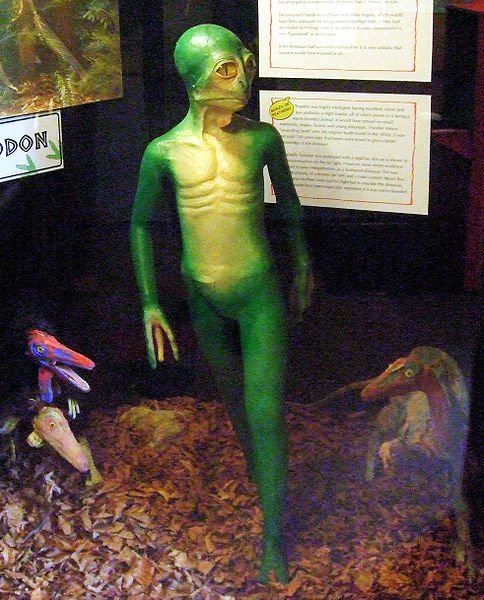
Above: how dinosaurs MIGHT have developed?  Credit -unknown: if known please let me know (c)the copyright owner

Well there are prejudices.  Ask some palaeontologists whether dinosaurs could have developed into a humanoid or semi-humanoid dominant species and some will positively screech at you that such a suggestion is an insult to the dinosaurs. There are some who suggest pteradons might still be flying around but that after 65,000,000 years evolution would change the dinosaurs -far, far too far for them.  Evolution only works, apparently, if you are using it for your pet theory. Take the Loch Ness Monster for instance: even as a 12 year old I could not understand why naturalist Sir Peter Scott and others were seriously suggesting that a plesiosaur of some type was in the Loch.  After 65 million years would it not have changed?

Well crocodiles, snakes, bees,Sea stars, horse shoe crabs, sharks -and others were around at the time of the dinosaurs -evolution can be a touchy subject in arguments.

Some have asked why the billions of dollars worth of deep space telescopes are not turned to study planets in our own solar system. These pieces of equipment produce great images but are designed and built for deep space viewing not near space and you might wonder, with asteroids whizzing past Earth, more money was not spent on near space telescopes and detectors?  We have had to rely on space probes to gather data and even then some argue about what finds indicate.

I well remember the actor Vladek Sheybal's character in the 1970s TV series UFO arguing that more money was being spent on imaging deep space while the microscopic world on Earth had no real funding. My own interest came at Secondary School (Greenway Boys Secondary Modern, Southmead, Bristol) in the early 1970s when I was allowed to help Mr Soper the Science teacher set up tesats for the next day and also get use of the microscope. A few years later, as a regular visitor to the newspaper section of Bristol Central Library, I read in an 1800's newspaper about Andrew Crosse (17th June 1784 – 6th July 1855) "The Thunder and Lightning Man" and his 'creation of life' -the Acarus.
 Above: Andrew Cross
Below: Acarus crossii

In more recent decades scientists have begun to probe the microscopic world more and with video recording as well as still photography we find a whole 'universe' of living creatures on Earth -with many yet to be discovered.

In fact we might say that every human is their own solar system supporting life and life supporting it. According to Greg Foot from BritLab in the video Disgusting Things That Live On Your Body “In a rather gross way, you are practically a walking petri dish, a home for more bugs and bacteria than you’d care think about.”

"Consider the skin on your face. As smooth and peachy as it may look, every square centimetre houses around one or two “demodex spiders”. They mostly lie low, but once you’re asleep they crawl across your face to mate and lay eggs in your pores. Don’t feel too disgusted, though – in return for their food and lodging, these spiders clean away some of the harmful bacteria that might cause a dangerous infection.

"Away from the face, humans can host three different types of lice, each of which has evolved to the unique environments of the scalp, pubic regions and the rest of our bodies. As the video explains, studying these bugs has helped scientists to work out when our ancestors started to cover their modesty with animal skins – after millions of years of walking around butt naked.

"By far the most numerous inhabitants are the microbial colonies inside the body itself – there are 10 times as many bacterial cells as human cells. Most are crucial for us to break down food into the nutrients we need to survive; these immigrants pay back just as much as we give them".

Now I know what the Reader is going to ask: "What has this got to do with what aliens might look like?" The thing is that we have this human prejudice that any intelligent life out in space must have developed like us.  Why?
Above: Tardigrade in 3D Diane Nelson and National Parks Service
What if alien life developed similarly, but obviously larger, to the tardigrades, known colloquially as water bears or moss piglets? They are a phylum of water-dwelling eight-legged segmented micro-animals and were first described by the German zoologist Johann August Ephraim Goeze in 1773 - who called them little water bears. They  range from 0.05 millimeters to 1.2 mm (0.002 to 0.05 inches) long, but they usually don't get any bigger than 1 mm (0.04 inches) long.

LiveScience ( https://www.livescience.com/57985-tardigrade-facts.html  ) reported that:

"Research has found that tardigrades can withstand environments as cold as minus 328 degrees Fahrenheit (minus 200 Celsius) or highs of more than 300 degrees F (148.9 C), according to Smithsonian magazine. They can also survive radiation, boiling liquids, massive amounts of pressure of up to six times the pressure of the deepest part of the ocean and even the vacuum of space without any protection. A 2008 study published in the journal Current Biology found that some species of tardigrade could survive 10 days at low Earth orbit while being exposed to a space vacuum and radiation.

"In fact, water bears could survive after humanity is long gone, researchers found. Scientists from Harvard and Oxford universities looked at the probabilities of certain astronomical events — Earth-pummeling asteroids, nearby supernova blasts and gamma-ray bursts, to name a few — over the next billions of years. Then, they looked at how likely it would be for those events to wipe out Earth's hardiest species. And while such catastrophic events would likely wipe out humans, the researchers found little tardigrades would survive most of them, they reported in a study published online July 14, 2017, in the journal Scientific Reports.

"To our surprise, we found that although nearby supernovas or large asteroid impacts would be catastrophic for people, tardigrades could be unaffected," David Sloan, a co-author of the new study and researcher at Oxford, said in a statement. "Therefore, it seems that life, once it gets going, is hard to wipe out entirely. Huge numbers of species, or even entire genera may become extinct, but life as a whole will go on."

So imagine long-lived Tardigrade type species with developed intelligence and evolving into a dominant life form that develops space travel. Not much they get exposed to in space or on other planets is going to be very life threatening.

If we look at the known microscopic life on Earth we find so many differing types and to many the images of these are mind-blowing.  Hollywood movie makers wanting suitable aliens need not ask someone to "imagine" a creature -they need only to flip through microscopic images online. A good place to start would be this site: https://listverse.com/2017/02/22/10-shockingly-intricate-microscopic-organisms/
Above: Radiolarians
Below: (it IS organic!) the Enterobacteria Phage T4

Any species, to survive, needs two things.  The first is to be the Apex creature on their planet with no superior predators.  Secondly, if the conditions are perfect for them then evolution (that some times dirty word) should step in. Why not an intelligent gastropod such as a slug, snail or whelk?  Even some aquatic or amphibean- a cold-blooded vertebrate animal of a class that comprises the frogs, toads, newts, salamanders, and caecilians. These are distinguished by having an aquatic gill-breathing larval stage followed (typically) by a terrestrial lung-breathing adult stage.

It may be that certain life forms develop a higher  intelligence but have weaker bodies and they may develop ways of encasing their bodies in a natural or manufactured body shell -perhaps not revealing any of the original body form.  Cases may be developed for certain tasks or to assume a similarity to the dominant life form on another planet that the species is studying.

Taking it further, there could be life forms that have none of their original form but are intelligences encased in robot like bodies or even assume a "colony form" comprising anywhere from 5, 10 or even 50 individuals.

Rather than "thinking outside the box" it is more a case that we need to "think away from the humanoid of Earth".

Exobiology is based on what we know of Earth and life here.  It is a good basis to start from but rather like theoretical physics it needs to go beyond "Earth-like" and ask how life on planets not like ours could develop because until we actually get to openly "meet and greet" genuine alien life we have no references.

Unless UFO percipients have encountered such entities?

Sunday, 29 September 2019

Are We All REALLY About To Panic?

Before we start a pet peeve. The National Aeronautics and Space Administration has an acronym -a name used by combining the first letter of each word.  NASA -in capitals and not as Google, internet bloggers and even online journalists write it "Nasa".

Now in this press piece we have NASAs Dr Green quoted though, as I can tell you from vast experience, what you read and see/hear via the media can be condensed from a 30 minutes long interview to...1 minute.

I tend to disagree with Dr Green's reported thoughts on this matter of discovering extraterrestrial life (see previous post).  I believe that what he is referring to are bacteria and microbiological organisms. Microscopic life rather than talking, walking alien intelligences. To see what Imean I suggest you go to You Tube and search for the channel Journey to the Microcosmos everything there is real. Exists. We normally never ever get to see these things.

I have yet to see panic-stricken crowds running through the streets or seeking sanctuary in churches and screaming: "The shape-shifting Euglenoids are here -save us!!"

For many decades we have heard theories of diseases from space and even evolution from space -life on Earth "might" have started as a result of a meteor from Mars hitting Earth -Diseases From Space and Evolution from Space by Professor Sir Fred Hoyle and Professor Chandra Wickramasinghe are two books I would recommend.

When the Apollo astronauts returned to Earth they were held (initially) in decontamination units "in case". Did everyone run around and panic at that point? No. Some might have been worried but that was it. Remember Michael Crichton's book (later made into a movie) The Andromeda Strain ? Best seller and did NOT create mass panic everywhere.

Orson Welles' radio broadcast in the 1930s of his version of The War of the Worlds by H. G. Wells did create some panic in the United States but that was a far more scientifically innocent time: remember that Clyde Tombaugh had only announced the discovery of Planet X on the 13th March, 1930 and leading up to the Welles broadcast there were reports of signals from Mars and much more -as detailed in UFO Contact?

Since 1930 we had the "Foo fighters" seen during World War 2 and then, 1947/1948 the "ghost rockets" -yes, some people got panicky but in one case there had been a war on and in the latter there was the threat of Soviet expansion and the possibility that the USSR had gotten hold of German super weapon scientists.

Since the advent of TV news spreads to a wider audience and if this is added to what people read and see in the cinemas then no one today, other than some isolated tribes, should be unaware of the term extraterrestrial -or "ET"- and since the 1980s TV screens and cinema has exploded with alien storylines or programmes looking at UFOs and alien abductions.  These TV programmes are now daily viewing -last night (28th September) I checked a TV guide (since I have no TV) and on four UK TV channels there were UFO and alien abduction programmes including the 100 Best UFOs Recorded on Video, Lost UFO Encounters and so on.

The Creationists tend to not like the idea of alien life as it smashes their xenophobic outlook on Earth and the universe. Fear of something foreign or unknown is always prezsent. I have deliberately asked people I've met in the last week what they thought about the claim alien contact was possible in the next few years.  Responses included:

"Well, so long as they aren't Daleks we ought to be alright"

"I think everyone has guessed that for a l;ong time -there've been all those UFO sightings for years"

No real panic. One person said "It'd be like when isolated tribes meet westerners for the first time -bit scary but take it as it comes"  (in other words don't jump to conclusions of hostile intent)

One person did respond with "So long as it stops them probing people!"

There are always people who are going to be scared.  That is human nature. But 2019 is far different to 1938.  Today we have a couple generations raised on the idea that there might very well be intelligent life out there and according to polls millions believe in UFO/al;ien reality.

According to Vox online article by Sean Illing from 4th June, 2019 titled The new American religion of UFOs
Belief in aliens is like faith in religion — and may come to replace it.https://www.vox.com/culture/2019/6/4/18632778/ufo-aliens-american-cosmic-diana-pasulka


"It’s a great time to believe in aliens.

"Last week, the New York Times published a viral article about reports of UFOs off the East Coast in 2014 and 2015. It included an interview with five Navy pilots who witnessed, and in some cases recorded, mysterious flying objects with “no visible engine or infrared exhaust plumes” that appeared to “reach 30,000 feet and hypersonic speeds.”

"No one is quite sure what they saw, but the sightings are striking. And they’re part of a growing fascination with the possibility of intelligent alien life.

"According to Diana Pasulka, a professor at the University of North Carolina and author of the new book American Cosmic, belief in UFOs and extraterrestrials is becoming a kind of religion — and it isn’t nearly as fringe as you might think.

"More than half of American adults and over 60 percent of young Americans believe in intelligent extraterrestrial life. This tracks pretty closely with belief in God, and if Pasulka is right, that’s not an accident.

"Her book isn’t so much about the truth of UFOs or aliens as it is about what the appeal of belief in those things says about our culture and the shifting roles of religion and technology in it. On the surface, it’s a book about the popularity of belief in aliens, but it’s really a deep look at how myths and religions are created in the first place and how human beings deal with unexplainable experiences."

There follows a lightly edited interview with Pasulka.

It seems that, if the quotes from Dr Green are accurate, that he is a little out of touch with 2019 and the views many hold.
Look at those who claim to have encountered entities from a landed craft (I cover every criteria of explanation and if they fail I have to go with what is claimed but even then there are criteria for WHY I need to feel they are telling the truth (again -see my book) and their reactions which can vary and despite after effects, they have to adopt the attitude of "It happened. Now get on with the rest of my life".

I dismiss the "Grey Abduction Phenomenon" but it has done one thing: it has made millions believe in extraterrestrial visitors....no panic in the streets of London, New York, Los Angeles, Paris, Berlin....

 Enceladus credit NASA


The following BBC  -or is that Bbc- online item explains things more clearly even if standards have dropped so low that its writers no longer know how to write an acronym
http://www.bbc.com/future/story/20190926-what-life-might-be-like-in-the-alien-oceans :

By Mico Tatalovic
27 September 2019

Recent discoveries have led astrobiologists to think that moons are the most promising places for alien life to exist in our Solar System. And now several major space missions are being planned over the next decade to search for hints of life there.

Unlike our neighbouring planets, some of the moons have plenty of liquid water. Jupiter’s moon, Europa, for example, is thought to contain more liquid water than all of Earth's oceans combined. This water – and any life in it – is protected from space radiation and asteroid impacts by a thick layer of kilometers-deep surface ice.

The discovery of plumes of water shooting up from Saturn’s moon Enceladus and Europa have suggested they could have warm interiors that can support liquid oceans, heated not by the Sun, but by an internal dynamo powered by radioactive decay in their cores or by tidal heating generated by the gravitational attraction of the planets that they orbit.

There is now evidence for water oceans on several moons, including Europa, Enceladus, Callisto and Ganymede. One study published this June estimates that the Enceladus ocean is around one billion years old. Others have suggested it may be billions of years old – plenty of time for life to evolve.

These oceans are thought to be salty, containing sodium chloride, like Earth’s oceans, which is another boost for the prospects of Earth-like life.

Also, there is likely to be an interface between the liquid water and the rocky mantle below the oceans – key ingredients for interesting chemistry that scientists think led to the origins of life on Earth. Nasa’s Cassini mission, for example, detected molecules in Enceladus’ water plumes that hint at the existence of hydrothermal vents on the moon’s ocean floor.

Similar vents exist in the deep oceans of the Earth, where magma meets salt water and provides heat, chemicals and a substrate helpful for the complex chemistry some scientists think was needed for life to first evolve on our planet. Deep below the surface of Earth’s ocean, there is practically no sunlight, as would be the case for oceans of Jupiter and Saturn’s moons. But that doesn’t mean there is no life. Indeed, on Earth, such vents are teeming with life.

Some 20 years ago Natural History of an Alien, a BBC documentary, suggested that entire ecosystems could also be based around deep-sea thermal vents on Europa. A team of scientists suggested that bacteria would form the base of the food chain, using chemosynthesis to extract energy from the vents, and building tall tubes of deposits rising many miles above the ocean floor.

Other creatures, such as fish-like grazers would pierce those tubes to suck in large amounts of bacteria to feed on. They would be territorial, defending their grazing patches against rivals. And, in turn, they would be preyed upon by shark-like animals, streamlined for speed, using echolocation to detect their prey.

This is much more advanced than what most scientists expect to find there.

Even on Earth, for some 90% of our planet’s history, the only life that existed here was microbial, says Andrew Knoll, a professor of earth and planetary sciences at Harvard University. So, if there is life in space, chances are it’s going to be microbial, Knoll says, and in places like Europa or Enceladus it would have to rely entirely on chemosynthesis for energy, so could probably only support a small biomass.

But such an ecosystem might still be possible, says Dimitar Sasselov, an astronomy professor and director of the Harvard Origins of Life Initiative, a centre supporting multi-disciplinary research to discover whether life is abundant in the universe. Just because Europa’s ocean is cold and lacking in energy, doesn’t necessarily rule out complex ecosystems of a smaller size evolving there.

“Speculating is fun,” Sasselov says. “My gut feeling is that there is a lot of evolutionary innovation space possible there where you can have something which is small and yet predatory and is a multicellular organism rather than just a single cell.”

Another moon we’re planning to visit presents a whole different puzzle.

Saturn’s moon, Titan, is the only world beyond Earth known to have stable bodies of liquid on its surface. When the Huygens probe from the Cassini mission landed there in 2005, it sent back pictures of an Earth-like landscape: river beds and seas.

But rather than water, the clouds, rain and seas of Titan are made up of liquid methane and ethane, components of natural gas on Earth. Any water that does exist there is solidified into rocks and mountains because its surface temperature is around -180C (-292F).

This means that, while its landscape might look familiar, the actual conditions are totally alien. If there is life, it would rely on methane, not water, and would be exotic – life as we don’t know it. True aliens.

It is possible and plausible that life exists on Titan, but with a “completely different, independent biochemistry”, says Sasselov, whose long-term goal is to figure out if there is an alternative biochemistry and how to create it in the lab.

Life on Earth depends on cell membranes made of phospholipids: molecular chains with phosphorus-oxygen heads and carbon-chain tails that bind to each other to form a flexible membrane in water.

Methane-based life would need an alternative way to form cells.

A Cornell University team led by chemical engineer Paulette Clancy showed in 2015 that small molecules made from nitrogen, carbon and hydrogen could build cells fit to survive in Titan’s conditions.

Since then, Nasa researchers have confirmed the presence of vinyl cyanide in Titan’s atmosphere, an organic compound that could provide such cellular membranes. So, at least in theory, cells that could form a very different life in Titan’s vast methane oceans could physically exist there.

“In some respects, what we see here on Earth is a matter of chance,” says Theresa Fisher, astrobiologist at Arizona State University, US. There’s an “enormous amount of potential variety” that we could see in life on other worlds, she says.

"There might emerge a fluorescence of new and very diverse organisms occupying a range of new niches,” adds Sarah Blaffer Hrdy, a professor emerita in anthropology at the University of California, Davis. "Assuming any of these creatures evolve to be as social, intelligent and communicative as say cetaceans or elephants, and as manipulative, dexterous and clever as chimpanzees or orangutans, I see no reason why they could not eventually evolve more sophisticated technological and cultural capacities.”

Lauren Sallan, a palaeontologist at the University of Pennsylvania, thinks alien life will be microbial – and there’re only so many ways to be a microbe.

As far as multicellular aliens are concerned, she says, things may get more complicated. “We would recognise that they’re doing the same kind of jobs because everything is focused on either taking in energy or consuming things to get energy,” she says. “But the way that they go about it would be pretty unpredictable.”

“We really don’t know what are the limits of life,” says David Charbonneau, professor of astronomy at Harvard University, who adds that this is why we need to send more probes to examine the moons.

So, it’s good news that there are plans to do just that.

Nasa announced this summer that its Dragonfly mission will launch in 2026 and arrive on Titan in 2034. It will land a drone-like craft to explore dozens of promising locations and look for signs of life.

Nasa is also exploring the possibility of sending an autonomous submarine to study Titan’s largest northern sea, Kraken Mare, which is some 1,000 km (621 miles) wide, with depths estimated at 300m (1,000ft), similar in size to North America’s Great Lakes. This would be the first opportunity to explore a sea on another world, and it could inform the design of future submarines to explore the subsurface waters of Europa and other moons. The mission is still in its conceptual stage, some 20 years away, with scientists and engineers starting to investigate how to even build such a submarine.

Intriguingly, Titan is also thought to have a liquid ocean of water deep beneath its icy outer layer, which would mean that in addition to its exotic surface life based on liquid methane, there could exist more Earth-like life under its surface.

Another possibility for layers of different types of life on a single world is Ganymede, Jupiter’s moon. Some scientists think this moon has several different layers of ocean, separated by different types of ice that form at different depths and pressures. If this is the case, each layer could, in theory, host different lifeforms adapted to local conditions at that depth.

Ganymede is set for a visit by the European Space Agency’s 2022 Juice mission, which will also visit two of Jupiter’s other moons – Callisto and Europa – to study their habitability and look for signatures of life.

Meanwhile, Nasa’s Europa Clipper is planning to orbit Jupiter and fly past Europa multiple times to investigate whether it could harbour conditions suitable for life, with a take-off date of 2023. Nasa is also discussing sending a lander to Europa, as early as 2025.

Saturn's moons may be freezing cold, but there is still liquid water under the thick expanses of ice (Credit: Getty Images)
And, there is a private, Nasa-backed plan for a mission to Enceladus to look for life there that could take off in 2025 if it gets the green light later this year.

But to really figure out what life might exist in these alien oceans, we will need to send a submersible, which will be tricky as such a vehicle would have to drill through several kilometres of ice to even reach the ocean. Nasa is funding some conceptual studies on how to do that.

One concept, for a nuclear-powered “tunnelbot” to search for life on Europa, was presented at a 2018 meeting of the American Geophysical Union in Washington DC, by scientists at the University of Illinois at Chicago and Nasa. Their bot would sample ice and water as it descended, sending information back to the surface through a fibre optic cable.

But, if lifeforms there turn out to be truly alien, we might struggle to detect them. It’s also possible there simply isn’t any life there yet.

In the distant future, though, some five billion years from now, when our Sun runs out of hydrogen fuel and starts expanding into a red giant phase before it eventually dies, it will melt the ice on these moons and turn them into much more Earth-like places. There should be liquid water on their surface and more temperate climates, perhaps opening up the possibility of life evolving there then – or at least harbouring refugees from the scorched Earth.

In the distant future, if we are to survive, we will all have to become migrants and hope these newly habitable worlds welcome us as our own world gets too hot for life.


Titan credit NASA

Saturday, 28 September 2019

Nasa chief scientist: 'We’re close to finding alien' life

Nasa chief scientist: 'We’re close to finding alien life and making some announcements....but the world is not ready.'

Sarah Knapton
Dr Jim Green, Chief Scientists at Nasa - © Max Alexander/UK Space Agency 2019; Please credit: Max Alexander/UK Space Agency

The world is not prepared for the discovery of life on another planet even though it may only be a couple of years away, Nasa’s Chief Scientist has warned.
Next summer, two rovers from Nasa and the European Space Agency (ESA), will travel to Mars to drill horizontally into rocks and deep into the surface, in the hope of finding evidence of living organisms.
The missions are the best chance humanity has ever had of answering the question: ‘Are we alone in the universe?’
Dr Jim Green, who has been instrumental in both missions, told The Telegraph that there is a real possibility that one or both will be successful. Yet it would have far-reaching implications, and he believes Earth is not ready. 
“It will be revolutionary,” he said. “It’s like when Copernicus stated ‘no we go around the Sun’. Completely revolutionary. It will start a whole new line of thinking. I don’t think we’re prepared for the results. We’re not.
“I’ve been worried about that because I think we’re close to finding it, and making some announcements.
“What happens next is a whole new set of scientific questions. Is that life like us? How are we related? Can life can move from planet-to-planet or do we have a spark and just the right environment and that spark generates life - like us or not like us - based on the chemical environment that it is in?” 
<span>The ExoMars rover during testing in the Spanish desert </span> <span>Credit: Geoff Pugh for the Telegraph </span>
The ExoMars rover during testing in the Spanish desert Credit: Geoff Pugh for the Telegraph
Europe’s ExoMars rover, is scheduled to land on the Red Planet in March 2021. Dubbed ‘Rosalind’ in honour of the British chemist Rosalind Franklin, the rover will drill six-and-a half feet down into the ground to take samples. 
The Martian cores are then fed through an aperture on the rover into a mobile laboratory  where they are crushed up and examined for organic matter. Confirmation of life could come within just weeks or months of landing.
Likewise Nasa’s rover Mars2020 will drill into rock formations on the surface and then leave the samples in test-tubes which will later be collected and sent back to Earth for examination, the first time that material from Mars will ever have been brought back.
Crucially, scientists will be looking for the 300 minerals which can only be made by life. 
The rovers will be hunting near the site of an ancient Martian ocean, where life may have lived billions of years ago, when the Red Planet was ‘blue’ like Earth.
<span> Jim Green/NASA Chief Scientist</span> <span>Credit: Max Alexander/UK Space Agency </span>
Jim Green/NASA Chief Scientist Credit: Max Alexander/UK Space Agency
“I’m excited about these missions because they have the opportunity to find life, they really do, and I want them to,” he added.
“We’ve never drilled that deep down. When environments get extreme life moves into the rocks. 
“When we first started the field of astrobiology in the 90s we started looking for extreme life.  We go down in mines two miles deep into the Earth and if they were weeping with water they were full of life. 
“We have gone in nuclear cesspools, places where you’d think nothing could survive, and they are full of life. And the bottom line is where there is water there is life. 
“In fact, because the crust has so much water in it, we now know that there is more life below our feet than on the surface of this Earth including life in the ocean.”
Dr Green, who has worked at Nasa for 38 years,  believes that as well as small organisms on other planets, there may be ‘weird life’ on Saturn’s moon Titan, and even civilisations in the non-so-distant reaches of the galaxy.
<span>Jim Green/NASA Chief Scientist</span> <span>Credit: Max Alexander/UK Space Agency </span>
Jim Green/NASA Chief Scientist Credit: Max Alexander/UK Space Agency
Recent research has also found that areas in Solar Systems that scientists considered uninhabitable may have once held liquid water. 
Planets that are neither too hot or too cold for liquid water are said to be in the ‘Goldilocks Zone’, but this month computer modelling showed that Venus could have held water for billions of years, despite being so close to the Sun. The Moon is also now known to have a water cycle. 
“This concept of what a ‘Goldilocks Zone’ looks like has to be modified,” added Dr Green.
“Venus was a blue planet for a significant amount of time. 
“There is no reason to think that there isn’t civilisations elsewhere, because we are finding exoplanets all over the place.
“We now know from Kepler observations that there are more planets in the galaxy than there are stars.”
He added: “If we were going anywhere to look for life that is not like us we would go to Titan. 
“On Titan you substitute methane for the water, so you will have a different type of life, a new set of chemicals that would compose a new type of DNA. It really would be weird.”
The Nasa and Esa missions will take off in the same month as other Mars projects from the United Arab Emirates (UAE) and China.
“They’re all going at the same time, because it’s when the window opens,” said Dr Green. “It’s like rush hour to Mars, but that’s when the alignment of the planets is just right and we can get there as fast as possible, not chase Mars around the Sun.”
Nasa’s rover will enter the atmosphere at 4 miles per second, and to slow down, the lander must flip onto its side and travel vertically to pick up enough drag that it will not crash to the surface. The lander will then hover and place the rover gently onto the surface using a sky crane.
“We have a little wiggle room but it’s still like hitting a golf ball in New York and having it land a hole in one in LA,” he added.
“Nasa can do that. We do the impossible, and we do it everyday. So does ESA. Our space agencies do incredible stuff. They perform miracles all the time.”

1970, THE CHARENTE, FRANCE


1970, THE CHARENTE, FRANCE:

There are MANY reports that do not conform to the false Grey standard of ufology. The problem comes with the age of a report.
If someone reports an incident 25-30 years after it was alleged to have taken place we only have their owrd on the matter but if it conforms to Greys reports then some doubt arises.

If the reportee told other members of his/her family and/or kept some kind of written account that can be dated -a diary entry in which ink age can be tested- it helps.

Please note that I have tidied up this statement (from Ufologie.com) to make it more readable and I apologise for the translation quality.

1970, THE CHARENTE, FRANCE:
Brief summary of the event and follow-up:

On May 27th, 2007, a gentlemen sent the following story to me by email:

"I was 20 (then), I am 57 (today). My testimony is thus 37 years old and during all these years I was haunted by what I saw that day.

I was heading home at about 1 a.m. (I live in the country in the Charente) there is a field opposite my house and in this field I saw a landed half sphere which could be clearly distinguished in the darkness.

"I did not pay any attention and I park my car a few meters further on. The orange dome is still in the field on the other side of the road. I opened the gate to get to my home and I then closed it behind me.  I was about to cross the yard that separates me from the house (I was in the dark and I found my way by habit) and it was then that i heard footsteps on the gravel in front of me -they (seem to) run away on all sides but I saw nothing. I was very frightened. I rushed into the barn to switch on the outside light .

"In the yard (I saw) nothing but behind the gate I had closed I could distinguish human shapes(of kids) that looked at me. I felt that something was wrong and my fear increased.

"I went to the house to get a rifle and then I went back to the fence then on to the road. The view between myself and the half sphere was clear  and I saw two little beings come toward me. They stopped at approximately three meters from me. They seemed to talk to me but my fear was such that I raised my rifle. They then turned back and went away slowly.

"I went to wake up my parents but on looking they found nothing. All (entities) had disappeared. The sphere too.

"A brief article in the local newspaper reported a ufo was sighted above Angouleme that night. (The witness believes that) it landed in front of me and that changed my vision of the world"
Witness email, non anonymous, anonymity preserved, to this website (Patrick Gross, Ufologie), on May 27, 2007.

There are problems. The witness assumes that what he saw was the "UFO" sighted over Angouleme -but based on standard reporting that might have been a meteorite or anything else!

No one else witnessed the entities or object. A debunker would simply say "hoax".  However, we are unaware of the psychological state of the witness at the time -was he tired, exhausted or under stress somehow? Almost 50  years after the event, even if spoken to today, make that impossible to know.

The use of a rifle is slightly worrying. That the entities moved away on it being pointed at them could mean that they had encountered weapons in human hands before. Or, if this were an "altered state" event then to his mind the rifle did what it was supposed to -scare off intruders.

The "invisible runners" could indicate an altered state as described by "Ruth Syndrome" (detailed in UFO Contact?). One might wonder why an hemispherical object in the field had not caused alarm rather than not much interest? It is possible that the witness just gave it a casual glance and thought it might be something moved into the field by someone since aliens did not appear to be something he was thinking about. OR it might be the point at which he began to enter an altered state -a waking dream, which are quite vivid and very real to those experiencing them.

But if this was all in his head why a UFO and aliens -today you might expect it as the subject is everywhere from Japan to China to India and so on via the internet, TV and so on. 1970 was not a huge year for press coverage of UFOs -the witness mentions a brief news item AFTER his sighting.

No wish for publicity.  A joke? We just cannot tell which is why we really need to investigate -as thoroughly as we can- any and all reports that we find.

We have probably already lost so much information.

Encounter at Torva

 Although I have been gathering, reading and studying Close Encounters of the Third Kind (CE3K) and entity cases for over four decades I still find surprises.

John Hanson's Haunted Skies series has turned up a few surprises and mainly because he has either spoken to witnesses and got facts directly from them (correcting what ufologists had written 2nd, 3rd or 4th hand) or they have spoken only to him about their encounter.

One such report came from a Mary Sinton. Details are as follows from the AOP B  Entry:

UK     June 1980   Torva, Cumbria
John Hanson  Haunted Skies vol. 8  p. 103

Mary Sinton, owner of a B&B Farm, told Hanson about an encounter while on a camping holiday:

“I was with my boyfriend, Paul, at the time, and returning back to the campsite in our Hillman Imp car, along the A593, Ambleside to Coniston Road (Grid ref: Long 323, Lat 999/8, No. 7 English Lakes, SE area)  As we turned a bend in the road, close to the campsite, I was astonished to see  nine tall ‘figures’. Stood in a group of trees near the side of the road, caught in the glare of the spotlights fitted to the Hillman Imp I was travelling in.

“I estimated they were at least 7ft tall and identically dressed, wearing silver-white coloured helmets and body armour, carrying what looked like a rod, carried vertically in front of each of them –reminding me of a regiment of soldiers, stood to attention on the parade ground.

“As we drove past, I left it for a few seconds and then shouted out, in great excitement, ‘Did you see them, Paul?’  One look at his face confirmed he had, although, oddly, he had only seen one ‘figure’.  When we arrived at the campsite, we felt very nervous and had trouble sleeping, wondering if anything else was going to happen.

“The next morning, we discussed what had happened and wondered whether we should let the police know but, on reflection, thought they would never believe us”.

Hanson spoke to Paul who confirmed the events given by Sinton. He told Hanson:

“It was the most unusual thing I have ever seen in my life.  It defies explanation”.

Note that no UFO was sighted nor is there any suggestion that Mary or Paul thought "Aliens!" It is interesting that the behaviour of the duo after the sighting is not unusual in that neither could relax after what they had seen and were in fear of something else happening. I have heard the same thing from people who have observed "UFOs" close to -they are naturally nervous that something might happen as they may have seen something they were not supposed to.

Note also that the sighting was in 1980 and there had been similarly reported tall entities in silver outfits that went unpublicised.

There is no suggestion that these were 'ghosts' -I can't think of any reports of 7 feet (2.1 meters) tall ghosts.  There is also the question of why Mary saw several yet Paul saw only one figure.  It is possible that he only glimpsed one and that was enough -again, this is something noted in other shock situations -a person might just focus on one and state he/she saw one person in a criminal robbery yet 2-3 others report up to four gang members.

There is no indication of a time lapse as I called these reports before the term "missing time" became popular.

So what can we infer from this report?  One person we could explain using any number of things. It is impossible to say Mary hallucinated and said nothing but that her hallucination caused Paul to hallucinate. Oh -owls? Not likely -not even luminous ones!

This is a perfect example of a one off sighting -of something "that happened and then you get on with your life":even if the memory sticks with you.

A pity there was no witness drawing of what was seen.

Haunted Skies is a highly recommended series well worth investing in