Total Pageviews

Sunday, 27 October 2013

Sasquatch Does NOT Exist


Bigfoot Files

According to Prof Sykes the question of whether Sasquatch exists is answered. It does not. 

Was Meldrum and his work with alleged sasquatch footprints spoken to? No.

Was Grover Krantz' work looked at? No.

Was the "Patty" footage even mentioned? No.

Minnesota Iceman?  No.

Any of the solid cases? No.

Not even dismissed because the programme was only interested in the hair DNA and I can tell you as a naturalist of 40+ years there are hairs everywhere in the wild. You HAVE to see the animal leave the hair and get it.

Smeja was proven a liar -I did say from the start I never believed that tale based on hearing and seeing his interviews.

So now everyone will believe there is no Yeti and no Sasquatch -mainly because Sasquatch hairs were NOT collected.

It was Channel 4 -what did I expect.

But Sykes could only base results on those hair samples and I was a little taken back by his end words seemingly dismissing it all as a modern myth.

Sunday, 20 October 2013

Channel 4 TV "Bigfoot"

My original posting was as follows:


It's Official -The Yeti Is A Bear....Probably.


It is, supposedly, a series that hominologists / cryptozoologists  and others are getting excited over.  On Cryptozoology sites there is talk of UK contacts ready to record and upload the 'episode' to You Tube.

However, if you have read a newspaper, listened to the radio or seen TV snippets you'll know -EVERYONE KNOWS- the conclusion drawn -bear.

Zoologically it is interesting but just because someone said "these are yeti hairs" does not mean they are allegedly from a hominid.  On the other hand, if it proves yeti reports are of a 'new' species of bear that in itself is interesting.

It does NOT mean that Sasquatch is a bear.  Evidence suggests otherwise but scientists ARE taking note and studying material they are given.

And in case you missed the item:


New DNA research may have finally solved the mystery of the yeti. 
Tests on hair samples were found to have a genetic match with an ancient polar bear, with scientists believing there could be a sub species of brown bear in the High Himalayas that has been mistaken for the mythical beast.

Yetis, also known as the "Abominable Snowman" or "Bigfoot", have been recorded for centuries in the Himalayas, with local people and mountaineers claiming to have come face-to-face with hairy, ape-like creatures.

Bryan Sykes, professor of human genetics at the Oxford University, set out to collect and test "yeti" hair samples to find out which species they came from. In particular he analysed hairs from two unknown animals, one found in the Western Himalayan region of Ladakh and the other from Bhutan, 800 miles to the east.
After subjecting the hairs to the most advanced DNA tests available and comparing the results to other animals' genomes stored on the GenBank database, Professor Sykes found that he had a 100% match with a sample from an ancient polar bear jawbone found in Svalbard, Norway, that dates back at least 40,000 years - and probably around 120,000 years - a time when the polar bear and closely related brown bear were separating as different species.

Professor Sykes believes that the most likely explanation is that the animals are hybrids - crosses between polar bears and brown bears. The species are closely related and are known to interbreed where their territories overlap.

The professor said: "This is an exciting and completely unexpected result that gave us all a surprise. There's more work to be done on interpreting the results. I don't think it means there are ancient polar bears wandering around the Himalayas.

"But we can speculate on what the possible explanation might be. It could mean there is a sub species of brown bear in the High Himalayas descended from the bear that was the ancestor of the polar bear. Or it could mean there has been more recent hybridisation between the brown bear and the descendent of the ancient polar bear."

A photograph of a "yeti' footprint, taken by British climber Eric Shipton at the base of Everest, sparked global mania after it was taken in 1951.

Legendary mountaineer Reinhold Messner, who became the first man to climb Everest without oxygen, has studied yetis since he had a terrifying encounter with a mysterious creature in Tibet in 1986.
His own research backs up the Prof Sykes' theory. H e uncovered an image in a 300-year-old Tibetan manuscript of a "Chemo" - another local name for the yeti, with text alongside it which was translated to read: "The yeti is a variety of bear living in inhospitable mountainous areas."

Prof Sykes added: " Bigfootologists and other enthusiasts seem to think that they've been rejected by science. Science doesn't accept or reject anything, all it does is examine the evidence and that is what I'm doing."

His investigations features in a new three-part Channel 4 documentary series, Bigfoot Files, which starts on Sunday.

A book by Prof Sykes about his research, The Yeti Enigma: A DNA Detective Story, is to be published next spring.

http://uk.news.yahoo.com/dna-research-tackles-yeti-mystery-230129938.html#LKVn18w

Given that for many decades, even since the advent of DNA testing (very expensive), those looking for the Yeti have found hairs and other "artefacts" of yeti and just checked under a microscope and said "bear" or found fecal matter with hair -"bear" I find it funny.

There are going to be people out there screeching "That should have been MY discovery!"  And whis is it NOT their discovery? Because they would not test further.  Science "knows" everything out there and now that this pompous attitude has been dropped and DNA testing carried out....

I do not think many who are versed in the subject believed that yeti and Sasquatch/Bigfoot were related. The yeti never conformed to behaviour noted in Bigfoot.  Also, there are the attacks by yeti -killing one or more yak and even injuring people.

But, I am sure some will point out, just because these are said the be yeti hair does not necessarily mean they are yeti hair.  It won't stop the manic "Yeti is a mystery ape" crowd.

What does this all mean, though? Well, now every TV company, scientific institution are going to be getting money together for trail cams and better scientific evidence -even the first 'yeti' footage!

Luckily, the yeti is protected in its homeland and I think anyone thinking of going to hunt one would get very swift kicking out of the country.

After watching the programme last night I wrote:

My initial notes on Channel 4 TVs "yeti" programme titled "Bigfoot" (naturally):

C4s Yeti documentary. Travelogue. Talk about bears but not the reports that differ from what might be bears. 
A brown bear paw cast that matches (if you take away the bear claws and ignore the dissimilarities) Shipton's yeti foot print -plenty of sarcastic comments suggesting hoaxy climbers and natives not able to tell a bear -and we are talking a BEAR- from what they call a yeti.
Two hairs dis-prove the yeti are anything than a bear "might be" "could be" "possibly" "If they still exist". 
DNA was interesting but Sykes got 10(?) minutes of the programme and judging by a BBC interview he DOES have unidentified hair samples but it seems C4 cut that. If you have samples send them to him because he is serious even if the series isn't!
what a pile of s***.
Does the Yeti exist? Going by this programme -maybe, possibly, we don't know. 
 
Now here is the problem. I have absolutely no doubt that Professor Sykes is genuine. I think that is beyond question and there is no "hidden agenda" as someone put it to me.  He admits to having unidentified hairs and he has a true scientific curiosity which is to investigate the evidence and see where it leads because THAT is what science is supposed to do.

I've worked with TV people -Sky, BBC, ITV and Channel 4 and there is one thing you learn: despite every promise from those working on a piece for TV you can guarantee that they are being nice and "tolerant" toward you because they NEED your imput.  Some are genuinely nice but know that the final edit is not theres.  

You get the "oh, maybe they ought to lay off the strong stuff" or "That must have been one Friday night" -suggesting drink was involved in the witnesses cases -I got an apology from the BBC when they made it sound that I was a loony eccentric and I presented my credentials as having been a member of the official Partners Against Wildlife Crime (PAWS), UK police forces advisor on exotic animals and of course having my name on a couple of conference papers not to mention write ups as being "a noted naturalist". But that apology was from the reporter. "I am sorry but the editor/director makes the decisions" and so I blacklisted any future work from the BBC.

I did expect something like "Sasquatch: Legend Meets Science" but that was a mental aberration on my part.  The presenter was THE main feature of the programme so we got no real look at Sykes' work. It was, as I wrote, a travelogue.

I should not have expected more from Channel 4 -I've heard two conversations today where members of the public were saying "Did you see that on TV -they proved the yeti and bigfoot were bears". And THAT is what will stick in peoples minds. None will have read a book or even Sasquatch: Legend Meets Science or even seen the TV programme of the same name. They do not care.

The rather sarcastic "gentlemen climbers wouldn't pull a hoax" line was so insulting. The travelogue was there for one reason: so that C4s resident "animal expert" could start leading people up the bear trail and then edit Sykes down to "its a bear. possibly. might be"

If you were expecting science you'll be disappointed -they were building the programme up in that way but it was a sham.

Again, though, if you have possible Sasquatch hair GET THEM TO PROFESSOR SYKES!

Saturday, 19 October 2013

The Truth About Spring-Heeled Jack


Terry Hooper-Scharf
Paperback, 
A4
53 Pages
Fully illustrated
Price: £7.00
The terror and mystery created by “Jack The Ripper” has been the subject of countless books, magazine articles as well as movies and TV documentaries. Ask anyone if they have ever heard of Jack The Ripper and it is doubtful anyone would respond with a “no idea.” 

By that same token, ask people who “Spring-heeled Jack” was and you would be lucky to find anyone who had ever heard of him. Spring-heeled Jack was the subject (loosely) of a  film The Curse of the Wraydons (1946) and Dominic Keating also appeared as Spring Heeled Jack in the 2010 film Sherlock Holmes by The Asylum film company. The character has also featured in both American and British comic books and a number of books, for both children and adults. 

But the fact that the Springald held the country –not just London– in a grip of terror much longer that the Ripper did is all but forgotten except for some half-truths and fanciful theories. Now be prepared to read the full story of Spring Heeled Jack

Friday, 18 October 2013

Skull of Homo erectus throws story of human evolution into disarray

 
, science correspondent theguardian.com


A haul of fossils found in Georgia suggests that half a dozen species of early human ancestor were actually all Homo erectus


Link to video: Fossil skull challenges understanding of human evolution
  The spectacular fossilised skull of an ancient human ancestor that died nearly two million years ago in central Asia has forced scientists to rethink the story of early human evolution.

Anthropologists unearthed the skull at a site in Dmanisi, a small town in southern Georgia, where other remains of human ancestors, simple stone tools and long-extinct animals have been dated to 1.8m years old.
Experts believe the skull is one of the most important fossil finds to date, but it has proved as controversial as it is stunning. Analysis of the skull and other remains at Dmanisi suggests that scientists have been too ready to name separate species of human ancestors in Africa. Many of those species may now have to be wiped from the textbooks.

The latest fossil is the only intact skull ever found of a human ancestor that lived in the early Pleistocene, when our predecessors first walked out of Africa. The skull adds to a haul of bones recovered from Dmanisi that belong to five individuals, most likely an elderly male, two other adult males, a young female and a juvenile of unknown sex.

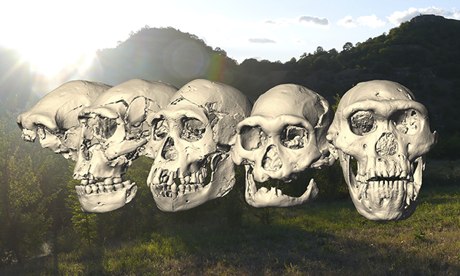
Five Homo erectus skulls found in Georgia The five H erectus skulls found in Dmanisi, Georgia. Photograph: Ponce de León, Zollikofe/University of Zurich 
  The site was a busy watering hole that human ancestors shared with giant extinct cheetahs, sabre-toothed cats and other beasts. The remains of the individuals were found in collapsed dens where carnivores had apparently dragged the carcasses to eat. They are thought to have died within a few hundred years of one another.

"Nobody has ever seen such a well-preserved skull from this period," said Christoph Zollikofer, a professor at Zurich University's Anthropological Institute, who worked on the remains. "This is the first complete skull of an adult early Homo. They simply did not exist before," he said. Homo is the genus of great apes that emerged around 2.4m years ago and includes modern humans.

Other researchers said the fossil was an extraordinary discovery. "The significance is difficult to overstate. It is stunning in its completeness. This is going to be one of the real classics in paleoanthropology," said Tim White, an expert on human evolution at the University of California, Berkeley.

But while the skull itself is spectacular, it is the implications of the discovery that have caused scientists in the field to draw breath. Over decades excavating sites in Africa, researchers have named half a dozen different species of early human ancestor, but most, if not all, are now on shaky ground.


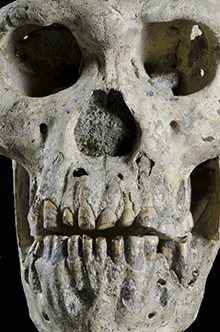
Homo erectus skull found in Georgia  
The most recently unearthed individual had a long face and big teeth, but the smallest braincase of all five H erectus skulls found at the site. Photograph: Georgian National Museum 
  The remains at Dmanisi are thought to be early forms of Homo erectus, the first of our relatives to have body proportions like a modern human. The species arose in Africa around 1.8m years ago and may have been the first to harness fire and cook food. The Dmanisi fossils show that H erectus migrated as far as Asia soon after arising in Africa.

The latest skull discovered in Dmanisi belonged to an adult male and was the largest of the haul. It had a long face and big, chunky teeth. But at just under 550 cubic centimetres, it also had the smallest braincase of all the individuals found at the site. The dimensions were so strange that one scientist at the site joked that they should leave it in the ground.

The odd dimensions of the fossil prompted the team to look at normal skull variation, both in modern humans and chimps, to see how they compared. They found that while the Dmanisi skulls looked different to one another, the variations were no greater than those seen among modern people and among chimps.

The scientists went on to compare the Dmanisi remains with those of supposedly different species of human ancestor that lived in Africa at the time. They concluded that the variation among them was no greater than that seen at Dmanisi. Rather than being separate species, the human ancestors found in Africa from the same period may simply be normal variants of H erectus.

"Everything that lived at the time of the Dmanisi was probably just Homo erectus," said Prof Zollikofer. "We are not saying that palaeoanthropologists did things wrong in Africa, but they didn't have the reference we have. Part of the community will like it, but for another part it will be shocking news."


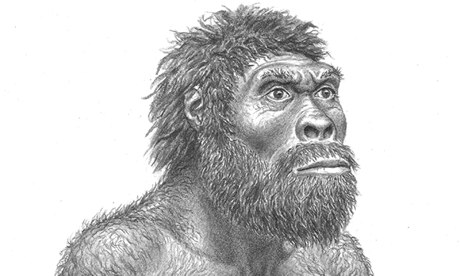
Reconstruction of Homo erectus Reconstruction of the early human ancestor Homo erectus from the latest skull found at Dmanisi in Georgia. Illustration: J H Matternes 
  David Lordkipanidze at the Georgian National Museum, who leads the Dmanisi excavations, said: "If you found the Dmanisi skulls at isolated sites in Africa, some people would give them different species names. But one population can have all this variation. We are using five or six names, but they could all be from one lineage."

If the scientists are right, it would trim the base of the human evolutionary tree and spell the end for names such as H rudolfensis, H gautengensis, H ergaster and possibly H habilis.

The fossil is described in the latest issue of Science.

"Some palaeontologists see minor differences in fossils and give them labels, and that has resulted in the family tree accumulating a lot of branches," said White. "The Dmanisi fossils give us a new yardstick, and when you apply that yardstick to the African fossils, a lot of that extra wood in the tree is dead wood. It's arm-waving."

"I think they will be proved right that some of those early African fossils can reasonably join a variable Homo erectus species," said Chris Stringer, head of human origins at the Natural History Museum in London. "But Africa is a huge continent with a deep record of the earliest stages of human evolution, and there certainly seems to have been species-level diversity there prior to two million years ago. So I still doubt that all of the 'early Homo' fossils can reasonably be lumped into an evolving Homo erectus lineage. We need similarly complete African fossils from two to 2.5m years ago to test that idea properly."

The analysis by Lordkipanidze also casts doubt on claims that a creature called Australopithecus sediba that lived in what is now South Africa around 1.9m years ago was a direct ancestor of modern humans. The species was discovered by Lee Berger at the University of Witwatersrand. He argued that it was premature to dismiss his finding and criticised the authors for failing to compare their fossils with the remains of A sediba.

"This is a fantastic and important discovery, but I don't think the evidence they have lives up to this broad claim they are making. They say this falsifies that Australopithecus sediba is the ancestor of Homo. The very simple response is, no it doesn't."

"What all this screams out for is more and better specimens. We need skeletons, more complete material, so we can look at them from head to toe," he added. "Any time a scientist says 'we've got this figured out' they are probably wrong. It's not the end of the story."

Sasquatch: Legend Meets Science

This is a rather interesting documentary though if you are seriously interested get the book!

http://www.amazon.co.uk/SASQUATCH-LEGEND-SCIENCE-Jeff-Meldrum/dp/0765312174


And check out  EVALUATION OF ALLEGED SASQUATCH FOOTPRINTS AND THEIR INFERRED FUNCTIONAL MORPHOLOGY  D. JEFFREY MELDRUM, Department of Biological Sciences, Idaho State University


http://www.isu.edu/~meldd/fxnlmorph.html


It's Official -The Yeti Is A Bear....Probably.


It is, supposedly, a series that hominologists / cryptozoologists  and others are getting excited over.  On Cryptozoology sites there is talk of UK contacts ready to record and upload the 'episode' to You Tube.

However, if you have read a newspaper, listened to the radio or seen TV snippets you'll know -EVERYONE KNOWS- the conclusion drawn -bear.

Zoologically it is interesting but just because someone said "these are yeti hairs" does not mean they are allegedly from a hominid.  On the other hand, if it proves yeti reports are of a 'new' species of bear that in itself is interesting.

It does NOT mean that Sasquatch is a bear.  Evidence suggests otherwise but scientists ARE taking note and studying material they are given.

And in case you missed the item:


New DNA research may have finally solved the mystery of the yeti. 

Tests on hair samples were found to have a genetic match with an ancient polar bear, with scientists believing there could be a sub species of brown bear in the High Himalayas that has been mistaken for the mythical beast.

Yetis, also known as the "Abominable Snowman" or "Bigfoot", have been recorded for centuries in the Himalayas, with local people and mountaineers claiming to have come face-to-face with hairy, ape-like creatures.

Bryan Sykes, professor of human genetics at the Oxford University, set out to collect and test "yeti" hair samples to find out which species they came from. In particular he analysed hairs from two unknown animals, one found in the Western Himalayan region of Ladakh and the other from Bhutan, 800 miles to the east.
After subjecting the hairs to the most advanced DNA tests available and comparing the results to other animals' genomes stored on the GenBank database, Professor Sykes found that he had a 100% match with a sample from an ancient polar bear jawbone found in Svalbard, Norway, that dates back at least 40,000 years - and probably around 120,000 years - a time when the polar bear and closely related brown bear were separating as different species.

Professor Sykes believes that the most likely explanation is that the animals are hybrids - crosses between polar bears and brown bears. The species are closely related and are known to interbreed where their territories overlap.

The professor said: "This is an exciting and completely unexpected result that gave us all a surprise. There's more work to be done on interpreting the results. I don't think it means there are ancient polar bears wandering around the Himalayas.

"But we can speculate on what the possible explanation might be. It could mean there is a sub species of brown bear in the High Himalayas descended from the bear that was the ancestor of the polar bear. Or it could mean there has been more recent hybridisation between the brown bear and the descendent of the ancient polar bear."

A photograph of a "yeti' footprint, taken by British climber Eric Shipton at the base of Everest, sparked global mania after it was taken in 1951.

Legendary mountaineer Reinhold Messner, who became the first man to climb Everest without oxygen, has studied yetis since he had a terrifying encounter with a mysterious creature in Tibet in 1986.
His own research backs up the Prof Sykes' theory. H e uncovered an image in a 300-year-old Tibetan manuscript of a "Chemo" - another local name for the yeti, with text alongside it which was translated to read: "The yeti is a variety of bear living in inhospitable mountainous areas."

Prof Sykes added: " Bigfootologists and other enthusiasts seem to think that they've been rejected by science. Science doesn't accept or reject anything, all it does is examine the evidence and that is what I'm doing."

His investigations features in a new three-part Channel 4 documentary series, Bigfoot Files, which starts on Sunday.

A book by Prof Sykes about his research, The Yeti Enigma: A DNA Detective Story, is to be published next spring.

http://uk.news.yahoo.com/dna-research-tackles-yeti-mystery-230129938.html#LKVn18w

Given that for many decades, even since the advent of DNA testing (very expensive), those looking for the Yeti have found hairs and other "artefacts" of yeti and just checked under a microscope and said "bear" or found fecal matter with hair -"bear" I find it funny.

There are going to be people out there screeching "That should have been MY discovery!"  And whis is it NOT their discovery? Because they would not test further.  Science "knows" everything out there and now that this pompous attitude has been dropped and DNA testing carried out....

I do not think many who are versed in the subject believed that yeti and Sasquatch/Bigfoot were related. The yeti never conformed to behaviour noted in Bigfoot.  Also, there are the attacks by yeti -killing one or more yak and even injuring people.

But, I am sure some will point out, just because these are said the be yeti hair does not necessarily mean they are yeti hair.  It won't stop the manic "Yeti is a mystery ape" crowd.

What does this all mean, though? Well, now every TV company, scientific institution are going to be getting money together for trail cams and better scientific evidence -even the first 'yeti' footage!

Luckily, the yeti is protected in its homeland and I think anyone thinking of going to hunt one would get very swift kicking out of the country.


Thursday, 17 October 2013

Fancy Something Strange, Weird and Sinister?


Some Things Strange & Sinister

Some Things Strange & Sinister
 
Terry Hooper-Scharf
Paperback, 
A4 (21 x 30 cms)
358 Pages  
Photographs, maps, illustrations
 
Price: £15.00 
PRICE IS A SPECIAL OFFER THAT LASTS UP UNTIL 30th OCTOBER 2013
 
After more than 30 years as an investigator of the weird, bizarre and sinister and more than forty as a naturalist, the author (a noted naturalist and UK police forces exotic wildlife consultant) has opened some of the many files he has accumulated dealing with such things as.. 
 
The Terrifying Events At The Lamb Inn -the famous case of inter-acting poltergeist that has a place in the canon of the paranormal.  The Ghosts Of All Saints Church, Bristol -a famous haunting.  The Dead Aquatic Creatures of Canvey Island, Essex -just what were the several creatures, humanoid in appearance, that were washed ashore from the 1940s-1950s? Captured bigfoot like creatures in India that disappeared! 
 
And the bizarre legend of Spring Heeled Jack is looked at as well as the fact that there were far more than one "Jack" and the very name was used to spread terror beyond London! This 2013 up-date contains an expanded chapter on the case.
 
All these cases are exclusively presented for the first time and with new added research previously unseen. Photographs,maps,line drawings and up-dated to make 358 pages looking at Things truly Strange and Sinister. 
 
Cryptozoologist,Ghost Hunter,Ufologist or Fortean:this book has something for everyone -including the just plain inquisitive!


Some More Things Strange & Sinister


Some More Things Strange & Sinister
 
 
Terry Hooper-Scharf
Paperback, 
A4 (21 x 30cms)
327 Pages 
Profusely illustrated with maps, illustrations and photographs previously unseen.
 
Price: £15.00 
SPECIAL OFFER PRICE LASTS UNTIL 30th October, 2013
 
Follow-up to the hugely successful Some Things Strange & Sinister. 
 
For those interested in Ufology,cryptozoology,hominology,unusual natural history,ghosts and mysteries in general. 
 
The secret history of gorillas -before they were 'discovered'. Includes accounts of mystery primates in the UK dating back to the 18th century.  Some photographs not seen in publication in over 100 years are exclusively presented here.
 
Wild men of Europe, the UK and US. Hominology. Some contemporary accounts from newspapers of some violent, deadly and plain strange wildmen -including the 19th century British wildman craze.
 
Also included are chapters on:
 
Giant snakes. 
 
 Amazons. 
 
The Giant serpent of Carthage. 
 
The Girt Dog of Ennerdale. 
 
The Beast of Gevaudan -sorting through the fiction presented by many to establish just what the true beast was -exclusive material included.
 
Crocodiles in the UK -unbelievable though it may be, this is not a modern urban myth but a fact.  However Medieval and 19th century crocodile encounters?
 
Silent City of Alaska. For the first time in over 100 years, exclusively presented is the actual photograph of "the City in the Sky" so talked about but never tracked down until now!
 
And much more. 
 
Updated with extra pages and photographs for 2013


Pursuing The Strange & Weird

2013 UP-DATE!

Pursuing The Strange & Weird
 Terry Hooper-Scharf
Paperback, 
A4 (21 x 30cms)
223 Pages 
Heavily illustrated with photographs, maps, line drawings -many exclusive.
 
Price: £15.00
Ships in 3–5 business days
SPECIAL OFFER PRICE UNTIL 30th OCTOBER, 2013


Much expanded section looking at Dead Aquatic (Humanoid) Creatures world wide from the UK, Tanzania and beyond.
 
The giant squid and yet undiscovered sea creatures -are the "sea monsters" of old dying out: are they becoming a thing of the past due to pollution, over-fishing of food sources?
 
Have submarine and ships crews encountered true leviathans. According to many 'experts' on these cases "yes" -but what are the facts?
 
Extinct animals at sea that have been re-discovered -a look at Stellar's Sea Cow, whale migrations and mystery aquatic light wheels that seem somehow connected -prey and predator or simple established migration of unknown sea creatures?
 
Sasquatch and other Hominids around the world -does re-evaluation and scientific methodology used in the re-examination of the Patterson-Gimlin footage of "Patty" prove that it/she really WAS an unknown hominid? And just how does science stand deal with these cases -for once the outright skeptics appear to be getting caught out.
 
Two early French UFO entity cases that still baffle are re-examined.  The persons involved gained nothing, even if the profound event changed their lives so are they real -genuine cases?
 
Also ghosts and photographs alleged to be of spectres that are labelled "unsolved", photograph of a strange creatures at the side of a German lake -a Other Dimentional Intelligence or a fake?
 
The Star-Child hoax and other hoaxes said to show evidence of genuine aliens or alien-human hybrids: the facts.
 
All dealt with by the naturalist and pursuer of the strange and weird