Total Pageviews

Friday, 1 January 2016

Dog or Cat And SHOULD A Farmer Shoot?

I have been called in over the years when sheep have been attacked or killed by a suspected puma or leopard.  The attack and kill methods are far different from those of canid attacks/kills.

The police had to deal with one case where a walker's dog went to sniff a dead sheep.  The farmer was not in sight when he fired his rifle and killed the dog as 'the killer' -I believe it cost the farmer several thousand in an out of court settlement.

The actual killer was a large cat- confirmed by a former African game hunter who examined the dead sheep and then called in a zoologist who had studied leopards in Africa.

I am aware of three farm dogs shot by farmers because they suspected their dogs had killed sheep. None of the farmers believed the "big cat nonsense" -in each case the farmers and/or members of their families SAW a large cat -in one case pulling a dead sheep into a hedgerow (but never seen killing a sheep). 

I have seen a few photographs of true dog attacks on sheep but that does not tell you which dog attacked -it might have been rustlers dogs not a local's dog.

So, when I was told a farmer intends shooting any walkers dog that is off the lead and near or in a field with his sheep I pointed out just how illegal this was.  I know a few farmers have asked me about this in the past.  My advice: don't shoot.  If you have insurance THAT covers you against livestock killed by a dog.  In the past, kills by large cats have been listed as "dog attack" by some insurers.

The National Sheep Association offer this advice http://www.nationalsheep.org.uk/dog-owners/advice-for-farmers/2486/destroying-dogs-that-attack/:

Destroying dogs that attack

NSA recommends that farmers only shoot dogs as a last resort, as the legality of a shooting depends on whether a farmer had a lawful excuse for shooting the dog in that individual circumstance. If it is necessary to shoot an attacking dog, please bear in mind the following points:-
  • Dogs are counted as property so shooting a dog could trigger a criminal damage charge.
  • In order for a shooting to be legal, you would have to show that you acted in the belief that your property (i.e. the sheep) was in immediate danger and that your actions were reasonable under the circumstances. What counts as ‘reasonable’ can differ in individual cases, depending on the situation. If, for example, you have had problems with a particular dog before and the owner has ignored requests to keep it under control, this would be a relevant factor. It is important to remember that you are not entitled to shoot the dog if it has already left the vicinity and is no longer a direct danger to your sheep, even if you fear it might come back and pose a threat in the future.
  • There is also the possibility of the dog’s owner suing you for trespass to goods. The Animals Act 1971 offers you the defence that you were protecting livestock if you can show that you reasonably believed that either: the dog was worrying or about to worry the livestock and there were no other reasonable means of ending or preventing worrying; or the dog had been worrying livestock, had not left the vicinity and was not under the control of any person, and there were no practical means of finding out who owned it
  • You must report the shooting to the police within 48 hours. If you do not, none of these defences will be valid in civil proceedings.
  • Under the Animal Welfare Act 2006, it is an offence to cause unnecessary suffering to dogs (or other protected animals). The factors used to decide whether the suffering caused by shooting a dog is unnecessary include: whether the suffering could reasonably have been avoided or reduced; whether the act which caused the suffering was for a legitimate purpose, in this case protecting property or another animal; whether the suffering was proportionate the intention of the action; and whether the conduct was wholly that of a reasonably competent and humane person.
  • Although the Act makes allowance for what it calls ‘the destruction of an animal in an appropriate and humane manner’, the law is based so heavily on circumstance that it is very difficult to know if your actions will count as this. You are at particular risk of falling foul of this Act if you fail to kill the dog cleanly with one shot. Offences can be punished with up to six months’ imprisonment and/or fines of up to £20,000. You could also be disqualified from keeping animals.
  • Shooting a dog also puts you at risk of committing a firearms offence. You could be prosecuted for breaking certificate conditions if you use a rifle or other section 1 fire arm to shoot a dog, unless the certificate conditions allow such use. Chasing a dog in order to shoot it has been known to lead to prosecution for trespassing with a firearm. Firearms offences are usually punished with imprisonment unless they are minor technicalities. A police review of your right to possess firearms will almost certainly result from shooting a dog. Your certificates may be taken away with no guarantee of them being returned.
 The information here is correct to the best of NSA's ability and cannot be used to defend action taken by individuals when a case of sheep worrying by dogs occurs.

First of the New Year!

The fact that 2015 gave me the opportunity to identify several "mystery" animals and solve some old cases is good. 

There is also the fact that I have corrected the "UFO record" so many times in just a month by going directly to the quoted sources -misquoted and not even checked by 'researchers'.

It proves once again why neither "cryptozoology" nor "ufology" can be considered a science.  Scientists from various disciplines have done and still do look into these subjects and that I can only commend because the true purpose of science and the scientist -amateur or professional- is to look at everything, study the evidence and then, if possible, reach a conclusion. The truth is not a very popular thing.

And the "skeptics" and their publications and organisations are not much better than those professing to belong to the false sciences. 

A strange craft is seen to land by four people who then see a tall, glowing eyed entity" -"obviously a meteorite and light reflecting from the eyes of an owl!"  or "Everyone is abduction crazy these days -its all psychological".  How do they know?  They read a couple articles by their chums or watched a ridiculous TV programme -all proving it's bunkum. 

"It can't be so it isn't" is not scientific or logical.  Firstly -who else is on record as reporting this very large meteorite (and it would have had to have been) that landed 50 feet away from witnesses?  No one but "it could not have been anything else"?  A very large meteorite did not hit Earth then -it merely streaked across the sky?  Did you check the "landing site"?  Why -it was only a meteorite? That is not science at all.  It discards every detail because you are an ass and say "science refutes this!"? Write "I'm a double-dumb-ass" 100 times. 

And the entity? "It looked tall because it was an owl sat in a tree branch!"  No trees.  "It was flying low" -and just hovered at the same spot for five minutes like owls do? 

Okay, but no one claimed any "alien abduction" so ---"It's all part of that hysteria.  You wait: hypnotist then the story will come.  Psychological!"

Hmm. "psychological" is what sums up the idiot makes wood cut-out after wood cut-out for TV shows to show how "flawed" the memory and eye is when it comes to distance and size assessment. Because only someone "not all there" would have each one of these tests disprove this 'fact' and stand there like a chump and say "See -I was right!"

"Everything is bunkum!" is not scientific.  Oh, you get your money from TV appearances, talks and books but more importantly you get to massage your ego by getting on TV.  Go away. You are a waste of time and your work is of no value because it does not scientifically assess evidence.

That said, the Phenomena folk are the same.

Not every scream in the woods is a sasquatch -it could be another "squatcher". 

Not every wood knock is a sasquatch -it could be another "squatcher".

A piece of masonry falling, a bit of plaster or other matter -not unusual in old or abandoned buildings.  It is not a sign of the paranormal.  Wood in building expands and contracts and you hear "thuds" and "bumps" that are quite loud.  Flooring and wood door and window frames expand and contract.  Wooden stairs are constantly readjusting -they undergo a lot of stress and foot traffic.  Creaks, knocks and so on are not signs of the paranormal.

Thanks to TV sensationalism and the people who thrive by feeding on this, every haunting is now an "evil demonic presence"/ "a dark entity" and kids no longer have imaginary friends -no, those are all demons. "Shadow figures" and dark masses -these only began years after the internet  was filled with (known) student pranks but, no, these jokes are all 'genuine'. 

Every single house in the United States (unless TV has lied to me!) has a "porthole"/"window" or "door" to Hell or some such.  Whatever happened to the "It was a little old lady who smiled then vanished" ghosts?  We KNOW who to blame.

Hoaxing and fakery are not "scientific documentation of the afterlife/paranormal".  Why are the Electronic Voice Phenomena recordings, video footage and all the "new inventions tuned to spirit energy" not handed over to scientists for that "scientific verification"?  I would not accept the word of a single person associated with these hoax programmes.

If you have a GENUINE piece of footage of a strange creature, a flying saucer or anything paranormal you get it evaluated by people not involved in the paranormal, cryptozoology or ufology -because 97% of them would be doubted if they said the sun rises each day.  You do not upload it straight to You Tube and title it "100% genuine footage of----"  And if you are not willing to give your real name do not expect to be treated as anything other than a hoaxer and do not offer bull-shit like "this could ruin my career" -there are serious and strict confidentiality rules with serious scientists.

So, let's just remember that around 98% of what is shown on TV is fake.  "The TV says---" well,in one show "It" is all genuine.  The next show "It" is all fake or misidentification".  TV people want you in their viewing figures because that increases commercial revenue.  They ain't there for science.

Remember that and if you see or hear something: investigate and if you are out of your depth then get in touch. And remember this and let it be your scientific mantra.....

A Response

Might I just respond to a couple of remarks left in comments which I have deleted as I prefer to give absolutely no free publicity to any disreputable con men involved in cryptozoology or ufology -neither of which are scientific subjects, though some reputable scientists have delved into both.

Information used without my permission, twisted, re-worded and even used to indicate that I have worked with any "cryptozoological" centre are incorrect.  I have corresponded with and written for many organisations and publications over the last four decades.  Luckily, some I have learnt were disreputable very early on and severed all ties with.

Others I have had to wait until they begin showing their true faces.  The big fat bully boys who think they cam "muscle" ladies in their 70s or get "the gang" to run hate and rumour campaigns against someone but can say "I have no control over what others write -it is a free country".  Well, "free" so long as you agree with this particular person.

I am not and have NEVER been a part of or associated in any way with any cryptozoological body as anything other than a writer.

I will leave the matter there.

Wednesday, 30 December 2015

A band of special, young stars has been discovered near the heart of the Milky Way

I really LOVE the fact that science discovers something,  then has to change its viewpoint.  I keep getting excited at what might be found next! Way back in 2008  we had this:

eso0846 — Science Release

Unprecedented 16-Year Long Study Tracks Stars Orbiting Milky Way Black Hole

10 December 2008
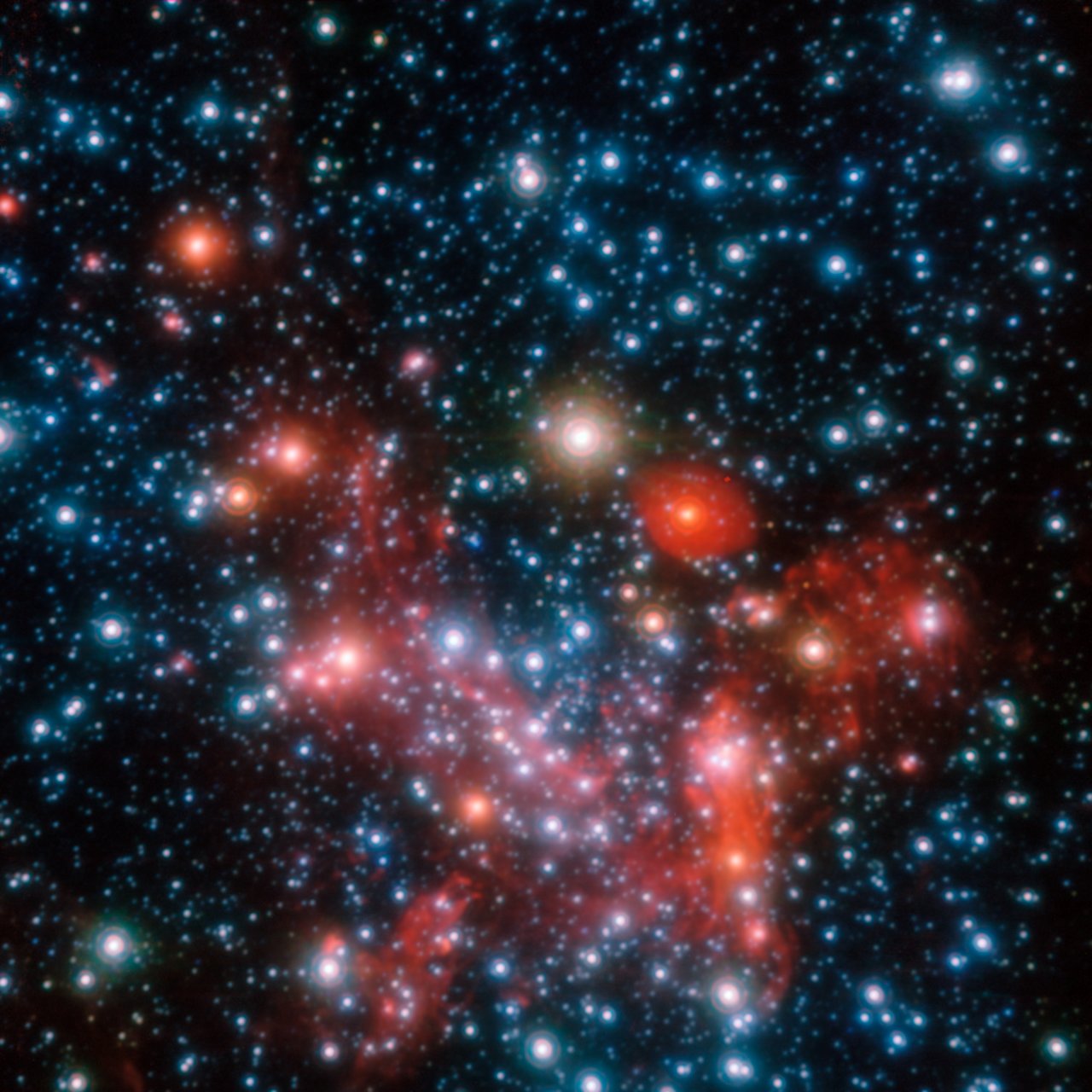
In a 16-year long study, using several of ESO's flagship telescopes, a team of German astronomers has produced the most detailed view ever of the surroundings of the monster lurking at our Galaxy's heart — a supermassive black hole. The research has unravelled the hidden secrets of this tumultuous region by mapping the orbits of almost 30 stars, a five-fold increase over previous studies. One of the stars has now completed a full orbit around the black hole.

By watching the motions of 28 stars orbiting the Milky Way's most central region with admirable patience and amazing precision, astronomers have been able to study the supermassive black hole lurking there. It is known as "Sagittarius A*" (pronounced "Sagittarius A star"). The new research marks the first time that the orbits of so many of these central stars have been calculated precisely and reveals information about the enigmatic formation of these stars — and about the black hole to which they are bound.

"The centre of the Galaxy is a unique laboratory where we can study the fundamental processes of strong gravity, stellar dynamics and star formation that are of great relevance to all other galactic nuclei, with a level of detail that will never be possible beyond our Galaxy," explains Reinhard Genzel, leader of the team from the Max-Planck-Institute for Extraterrestrial Physics in Garching near Munich.


The interstellar dust that fills the Galaxy blocks our direct view of the Milky Way's central region in visible light. So astronomers used infrared wavelengths that can penetrate the dust to probe the region. While this is a technological challenge, it is well worth the effort. "The Galactic Centre harbours the closest supermassive black hole known. Hence, it is the best place to study black holes in detail," argues the study's first author, Stefan Gillessen.

The team used the central stars as "test particles" by watching how they move around Sagittarius A*. Just as leaves caught in a wintry gust reveal a complex web of air currents, so does tracking the central stars show the nexus of forces at work at the Galactic Centre. These observations can then be used to infer important properties of the black hole itself, such as its mass and distance. The new study also showed that at least 95% of the mass sensed by the stars has to be in the black hole. There is thus little room left for other dark matter.

"Undoubtedly the most spectacular aspect of our long term study is that it has delivered what is now considered to be the best empirical evidence that supermassive black holes do really exist. The stellar orbits in the Galactic Centre show that the central mass concentration of four million solar masses must be a black hole, beyond any reasonable doubt," says Genzel. The observations also allow astronomers to pinpoint our distance to the centre of the Galaxy with great precision, which is now measured to be 27 000 light-years.

To build this unparalleled picture of the Milky Way's heart and calculate the orbits of the individual stars the team had to study the stars there for many years. These latest groundbreaking results therefore represent 16 years of dedicated work, which started with observations made in 1992 with the SHARP camera attached to ESO's 3.5-metre New Technology Telescope located at the La Silla observatory in Chile. More observations have subsequently been made since 2002 using two instruments mounted on ESO's 8.2 m Very Large Telescope (VLT). A total of roughly 50 nights of observing time with ESO telescopes, over the 16 years, has been used to complete this incredible set of observations.

The new work improved the accuracy by which the astronomers can measure the positions of the stars by a factor of six compared to previous studies. The final precision is 300 microarcseconds, equivalent at seeing a one euro coin from a distance of roughly 10 000 km.

For the first time the number of known stellar orbits is now large enough to look for common properties among them. "The stars in the innermost region are in random orbits, like a swarm of bees," says Gillessen. "However, further out, six of the 28 stars orbit the black hole in a disc. In this respect the new study has also confirmed explicitly earlier work in which the disc had been found, but only in a statistical sense. Ordered motion outside the central light-month, randomly oriented orbits inside – that's how the dynamics of the young stars in the Galactic Centre are best described."

One particular star, known as S2, orbits the Milky Way's centre so fast that it completed one full revolution within the 16-year period of the study. Observing one complete orbit of S2 has been a crucial contribution to the high accuracy reached and to understanding this region. Yet the mystery still remains as to how these young stars came to be in the orbits they are observed to be in today. They are much too young to have migrated far, but it seems even more improbable that they formed in their current orbits where the tidal forces of the black hole act. Excitingly, future observations are already being planned to test several theoretical models that try to solve this riddle.

"ESO still has much to look forward to," says Genzel. "For future studies in the immediate vicinity of the black hole, we need higher angular resolution than is presently possible." According to Frank Eisenhauer, principal investigator of the next generation instrument GRAVITY, ESO will soon be able to obtain that much needed resolution. "The next major advance will be to combine the light from the four 8.2-metre VLT unit telescopes – a technique known as interferometry. This will improve the accuracy of the observations by a factor 10 to 100 over what is currently possible. This combination has the potential to directly test Einstein's general relativity in the presently unexplored region close to a black hole."

Notes

These observations are the culmination of 16 years of a large monitoring campaign, begun in 1992 at ESO's New Technology Telescope with SHARP. It was then pursued at ESO's Very Large Telescope with the NACO and SINFONI instruments. These two instruments rely on the use of adaptive optics, which allows astronomers to remove the blurring effect of the atmosphere. As the centre of the Milky Way is very crowded, it is necessary to observe it with the finest resolution possible, hence, the need for adaptive optics.
Only radio signals, infrared light and X-rays can reach us from the Galactic Centre. While radio observations show mostly gas and X-ray observatories are sensitive to high energy processes, the infrared allows these stars to be observed.

More information

S. Gillessen et al., Monitoring stellar orbits around the Massive Black Hole in the Galactic Center, 2008, Astrophysical Journal, in press. Link to the article.
The team is composed of Stefan Gillessen, Frank Eisenhauer, Sascha Trippe, Reinhard Genzel, Thomas Ott (MPE, Garching, Germany), Tal Alexander (Weizmann Institute of Science, Israel), and Fabrice Martins (GRAAL-CNRS, University of Montpellier, France).
Reinhard Genzel was awarded the prestigious Shaw Prize in Astronomy for 2008 for this research (see ESO Press Release eso0818).
The research team maintains a web page on this project.

_______________________________________________________________


But this year came this:

 A band of special, young stars has been discovered near the heart of the Milky Way


The Universe is a mysterious place – comprised of mostly dark matter and dark energy, neither of which scientists fully understand. And now, a recent study shows that even our own cosmic neighbourhood can surprise us at times. 

Reporting in this month’s Astrophysical Journal Letters, a team of astronomers identified a band of special, young stars residing in one of the last spots they expected: near the heart of the Milky Way.
The remarkable discovery suggests that some unknown force is breathing new life into our galaxy’s centre.

Before the team’s report, astronomers thought the Milky Way’s centre, also called the galactic bulge, contained mostly old stars, which have been around for billions and tens of billions of years. The team’s discovery has uncovered a completely new component of our galaxy.

By analysing nearly four years of observations done between 2010 and 2014 with the VISTA Telescope at the Paranal Observatory in Chile, the team discovered a band of 35 extremely young stars.

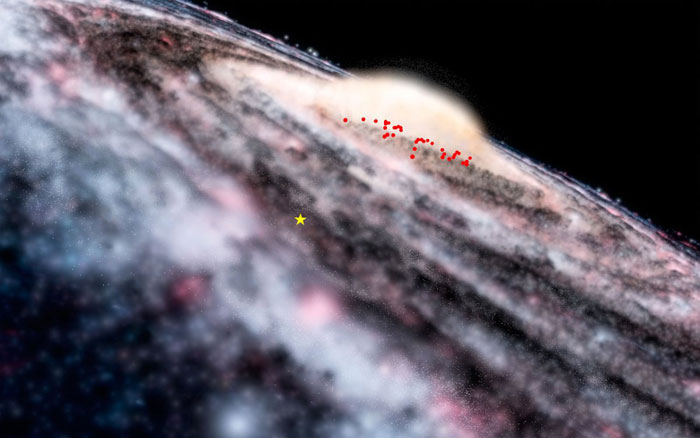
In the image below, the red dots represent the Cepheids, while the yellow star identifies our Sun:

111ESO- -Microsoft-WorldWide-Telescope
Credit: ESO/Microsoft WorldWide Telescope

These stars are of a particular class called Cepheids, which are famous for their pulsations that astronomers use to calculate extremely accurate distance between Earth and the star.

Each Cepheid has a unique pattern where it brightens, dims, and then repeats the cycle. Some Cepheids take days to complete a single cycle while others can take months.

“All of the 35 classical Cepheids discovered are less than 100 million years old,” Dante Minniti, who is a co-author of the paper and researcher at the University Andres Bello, Santiago, Chile, said in a European Space Agency press release. “The youngest Cepheid may even be only around 25 million years old.”
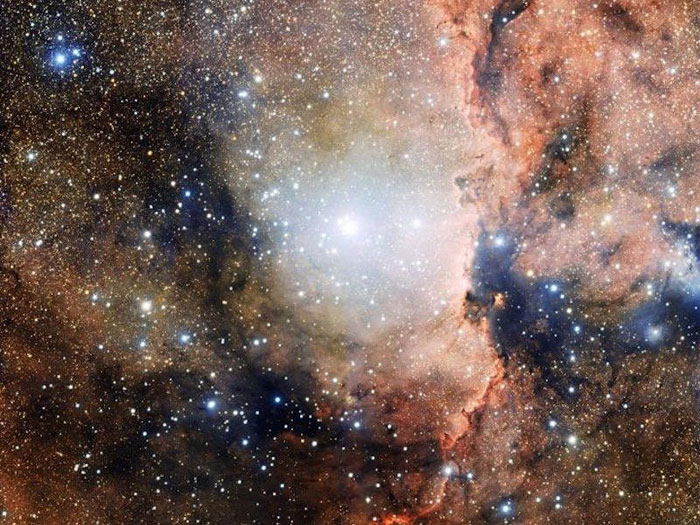
 111ESOCredit: ESO
For comparison, the Sun, which is in the prime stages of its life, is roughly 4.5 billion years old – 180 times older than the youngest Cepheid of this newly discovered group.

The team’s find “implies a continuous supply of newly formed stars in the central region of the Galaxy over the last 100 million years,” they stated in their paper.

The VISTA telescope is a powerful instrument for mapping the heart of our Milky Way galaxy, which is hidden from the human eye.
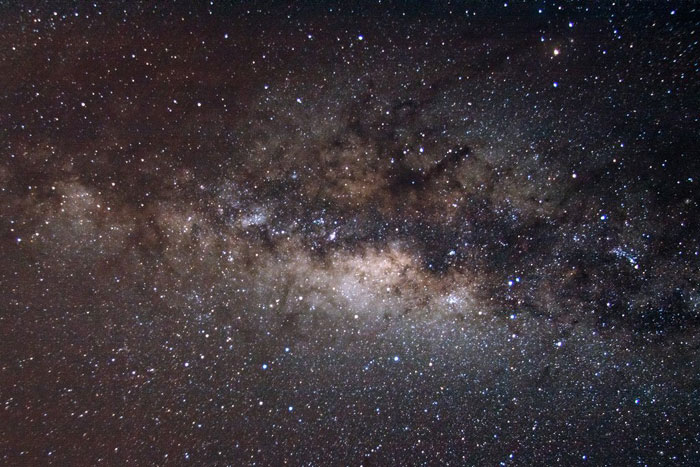
 111Dave-Young -FlickrCredit: Dave Young/Flickr
If you look toward the galactic bulge (shown above), you’ll notice that it is shrouded by dark, molecular clouds, which obstruct our view of what lies beyond.

But with VISTA, astronomers can see through the clouds as if they weren’t even there because it observes not in visible wavelengths (what humans see) but in the infrared.

Infrared radiation is not absorbed by the molecular clouds in the galactic bulge and instead passes straight through. Some of it eventually reaches Earth.

For this reason, the team has been using VISTA to map the Milky Way’s centre by seeking out Cepheid stars that lie beyond the molecular clouds. They call their project the VVV Survey.
 111Ashley-PCredit: Ashley P

Right now, our distance to the galactic bulge is uncertain. By using the pulsating nature of Cepheids, astronomers can get a better handle on this distance and eventually produce a three-dimensional map of the Milky Way’s centre.

In their latest analysis of the data VISTA has collected so far, the team identified 655 Cepheids. And when they looked at how quickly each star was pulsating, which is related to the star’s age, they were surprised to discover that 35 of their Cepheids were unusually young.

“This part of the galaxy was completely unknown until our VVV survey found it!” Minniti said.
The next step is to determine if these young stars formed where astronomers see them today, or if they migrated toward the centre from a more distant region of space.

Finding the answer will undoubtedly improve our understanding about the past and future of our galaxy as well as other galaxies like it throughout the Universe.

This article was originally published by Business Insider.

Man Goes For Drive Finds 'Dinosaur Egg'

 A glyptodont shell found in Carlos Spegazzini, Buenos Aires Province, Argentina on December 29, 2015
A glyptodont shell found in Carlos Spegazzini, Buenos Aires Province, Argentina on December 29, 2015

 A passer-by on Christmas Day found a meter-long shell on a riverbank in Argentina which may be from a glyptodont, a prehistoric kind of giant armadillo, experts said Tuesday.

A local man thought the black scaly shell was a dinosaur egg when he saw it lying in the mud, his wife Reina Coronel told AFP.

Her husband Jose Antonio Nievas found the shell beside a stream at their farm in Carlos Spegazzini, about 40 kilometers (25 miles) south of the capital Buenos Aires.

"My husband went out to the car and when he came back he said, 'Hey, I just found an egg that looks like it came from a dinosaur," she said.

"We all laughed because we thought it was a joke."

Nievas told television channel Todo Noticias he found the shell partly covered in mud and started to dig around it.

Various experts who saw television pictures of the object said it was likely to be a glyptodont shell.
"There is no doubt that it looks like a glyptodont," said paleontologist Alejandro Kramarz of the Bernadino Rivadavia Natural Sciences Museum.

"The animal became extinct thousands of years ago and it is very common to find their fossils in this region," he told AFP.

Glyptodonts are the ancestors of modern armadillos. They had big round armored shells and weighed up to a ton.

They lived in South America for tens of millions of years.

Kramarz estimated the specimen found by Nievas was relatively young at 10,000 years.


Ancient Egyptians Were Not So Dumb? Who Knew?

First we were told that civilizations such as Ancient Egypt were not that incredibly advanced. Yet they built the pyramids and more.

Ah, now they are gradually getting their "reps" up-dated bit-by-bit.  Neat.

Papyrus Reveals Ancient Egyptian Astronomical Knowledge

Photo credit: ITSARIYAPHON CHAIKULAP/Shutterstock

Researchers from the University of Helsinki have proposed that ancient Egyptians 3,000 years ago were the first to record the variability of a distant star – and their records could provide useful information for astronomers today.

A new paper published in PLOS ONE explains how the Egyptian Cairo Calendar from 1244 to 1163 B.C. describes the variability of a binary star system called Algol. In the calendar, there are two significant periods of time for two gods – 29.6 and 2.85 days. The former relates to the period of the Moon, while the latter almost perfectly matches the variability of Algol – which today is 2.867 days, or two days, 20 hours, and 49 minutes.

This theory had been proposed in 2013 but, understandably, had been met with some skepticism. However, the researchers now say they are more confident in their claims, and say that Algol relates to the deity Horus.

“I would have serious doubts, if someone claimed, for example, that the Bible contains information about water in Mars,” said lead author Lauri Jetsu in a statement. “We claimed that Ancient Egyptian religious texts contain astrophysical information about Algol. It was no surprise to us that there were, and there still are, sceptics.”

Shown is an extract of the Cairo Calendar papyrus, used courtesy of Lauri Jetsu

An eclipsing binary is a pair of stars that, as viewed from Earth, rotate around each other and block each other's light. Thus, this particular star dims regularly in brightness as it orbits its companion. Algol is found in the constellation Perseus about 92.8 light-years from us; the larger star is about 3.5 times the radius of the Sun, and the smaller about 2.7. They are separated by about 0.062 astronomical units (AU, one AU is the Earth-Sun distance).

The variability of Algol, which can be seen with the naked eye, was thought to have been first recorded by Italian astronomer Geminiano Montanari in 1667, although it was not until 1783 that British astronomer John Goodricke suggested another object may be the cause of the dimming. Based on this latest assumption, however, the record for discovery of this star's variability may have to be re-awarded.

Perhaps most interestingly, the discovery reveals that the variability of the star has decreased very slightly over three millennia, by about 0.017 days. Rather than being an error, the researchers postulate that this could be due to the transfer of mass between the two stars affecting their orbits.

“In fact, this would be the first observation that confirms the period increase of Algol and it also gives an estimate of the mass transfer rate,” added Jetsu, possibly providing an important tool for astronomers today to learn more about eclipsing binaries.

"Ninja Lanternshark"


Well, I keep writing that there are still plenty of things to discover in seas, lakes, rivers and oceans...but I still think the name is silly.

Shark Files: New Species "Ninja Lanternshark" Making Waves
There’s a new shark species in the water with a cool name and social media fans. Dubbed “Ninja Lanternshark,” the creature was found by researchers from the Ocean Science Foundation and described in a paper just published in the organization’s journal.


The find, which has lately hit the "trending" charts on Facebook, was based on the collection of eight specimens from the Pacific Coast of Central America. Its sleek appearance and stealthy ways helped earn the creature the common name “Ninja Lanternshark,” while its scientific name (Etmopterus benchleyi) is a tip of the hat to ”Jaws” author Peter Benchley, according to Hakai Magazine.


The name is more than just cool to the scientists. Lead researcher Victoria Vásquez told the publication that she wanted the new shark to stand out with “an interesting story,” given that lanternsharks are little known to the general public. Her team's find was the first documentation of that type of shark off Central America.


According to the researchers, the new shark was observed at depths of about 2,700 feet to 4,700 feet. It runs about 1.5 feet long and uses special skin structures to give off a faint glow that helps it blend in with the inky, low-light surroundings where its prey can be found (a stealth characteristic that helped win the shark the “ninja” moniker).

via Hakai Magazine