I must admit that I am very disappointed. On the 29th October I announced that the first issue of the AOP Journal was available. Since that time there have been several thousand views of the announcement.
And sales have totalled....zero
Now as it seems that no one wants to buy any of the books I have written -three sold since 2010- I thought that a 52 pages publication that was non-sensationalist and offered facts for £6 would be seen as a bargain.
The total lack of interest has made me decide that the amount of work involved in a regular, quarterly is not worth it. It takes a lot of time and energy and a hell of a lot of work to produce a 52 pager so to continue a publication that has attracted no interest is pointless. It does mean that I have now also shelved the Special Issues dealing with specific cases or subjects.
The first issue will be online store until it or I am gone. NO -there will be no freebies and certainly no free download version.
AOP JOURNAL 1
Paperback,
52 Pages
Price:£6.00 (excl. VAT)Prints in 3-5 business days
Technical and scientific based journal looking at what has become known as "UFOs" -including natural phenomena some not yet scientifically understood. This is NOT a sensationalist publication but will contain fully referenced articles and reports to help promote further serious study.
You don't need a time machine when you visit the French Space Centre headquarters in Toulouse - it's already a throwback to the 1970s. Green lawns sweep on to wide boulevards with stout long rectangular office blocks on either side.Thousands of UFO sightings are reported every year but not many countries are willing to spend money investigating them - there is just one dedicated state-run team left in Europe. Is France onto something?
It's almost Soviet-style in the heart of southern France. There are few signs of life even though 1,500 people, most of them civil servants, work in boxy offices along narrow unappealing corridors.
France has the biggest space agency in Europe - the result of the 1960s space race and President Charles de Gaulle's grand determination to keep France independent of the US by building its own satellites, rocket launchers and providing elite space research.
An offshoot of all that - France is the only country in Europe to maintain a full-time state-run UFO (unidentified flying objects) department. There used to be one in the UK and another in Denmark but they closed down years ago due to budget cuts.
France's UFO unit consists of four staff, and about a dozen volunteers who get their expenses paid to go on site and look into reports of strange sightings in the skies.
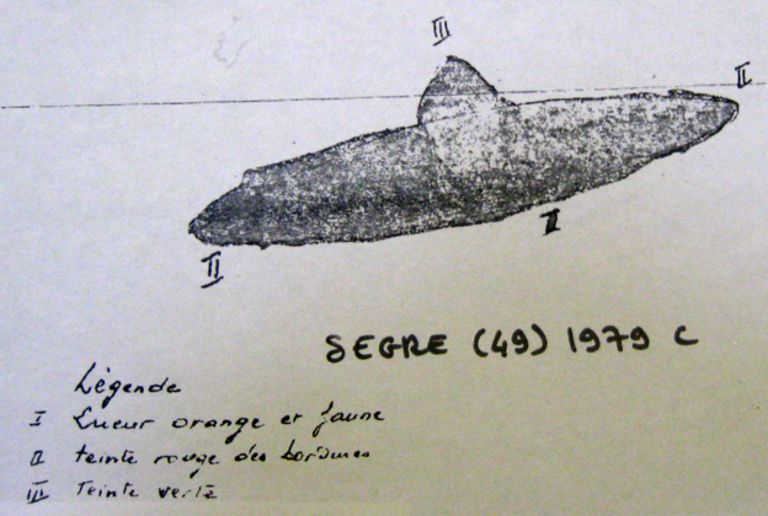
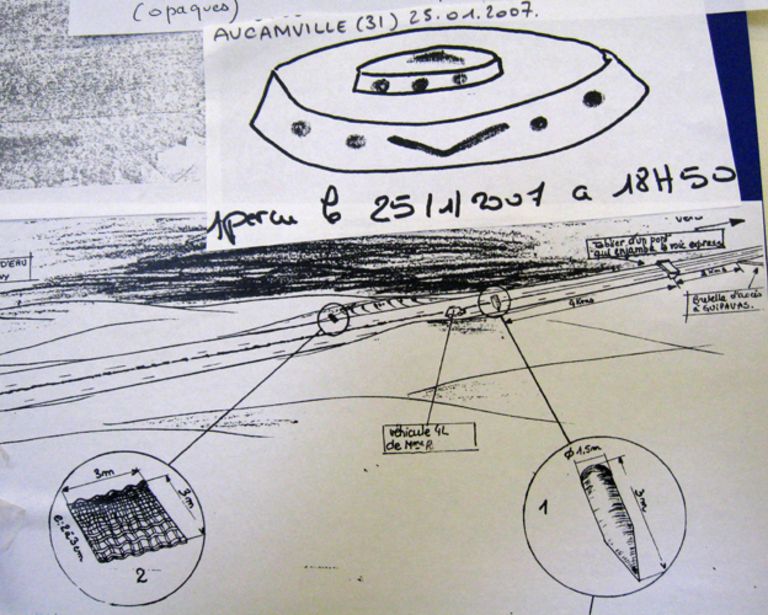
Image captionA drawing from the files at the French UFO department
The team is called Geipan. That's a French acronym for Study Group and Information on Non-Identified Aerospace Phenomenon.
Its boss is Xavier Passot. Surrounded by dozens of books on UFOs, and stacks of documents, he tells me his mission is to be as transparent as possible about strange sightings and to follow up on each one that his team receives.They publish their results ontheir websitewhich gets 30,000 hits a month. The team receives, on average, two UFO sightings a day. The department insists an 11-page form is filled out for each one. The idea is to provide details including photographs where possible but also weed out jokers and time-wasters.
If someone claims to have seen strange lights in the skies, the UFO team might go online to see whether the observation took place on a flight path - it can trace commercial air traffic going back more than a week.
The team also has access to military flight paths and is in touch with the air force and air traffic controllers.
Sometimes if its staff are really intrigued by photos they have seen or if there have been several witnesses to the same sighting, they will call the local police to ask whether they can be considered credible.
They might even check with neighbours to see whether they were out drinking that night or perhaps smoking something other than cigarettes.
Passot says many of the people who get in touch are smokers, puffing away outside bars or their own homes at night, gazing at the stars.
One of the boxy offices houses yellowing archives going back to the 1950s. The papers I look at contain eerie accounts of strange things encountered in the skies by fighter pilots on routine reconnaissance missions.
For what it's worth and for those who suspect there's conspiracy afoot, Passot tells me he has never covered up a UFO sighting.
I take a look at some amazing photos of strange lights and circular forms caught on camera. One, taken by a motorist, of a white ring shape above Marseille is particularly grabbing (the image at the top of this page). But the team figured that one out - it wasn't invaders from Mars, just the reflection of a small interior overhead light in the car.
In fact, the department can explain away nearly all these phenomena and, believe it or not, the most common culprits are Chinese lanterns sent up at night during parties. The investigators often telephone the local town hall to ask if, perhaps, there had been a wedding going on at the time.
Balloons and kites floating in the skies also get mistaken for alien craft, and space debris and falling meteorites giving off strange lights are more common than one might think.
More from the Magazine
Image copyrightGIORNALE DEL MATTINO
Sixty years ago a football match ground to a halt when unidentified flying objects were spotted above a stadium in Florence. Did aliens come to earth? If not, what were they?
But there are around 400 UFO sightings going back to the 1970s that the French team cannot explain. One, an alleged flying saucer landing near Aix-en-Provence in 1981, they take very seriously - there were landing marks and multiple witnesses.
So are there really little green men? Well, the jury's out on the colour but there are many working here, as well as others around the world, who are convinced there is some life out there.
And does the use of French taxpayers' money on UFO research make sense, particularly in these times of budgetary constraint?
That probably depends on whether you just saw an alien and, in the words of those Ghostbusters, who you gonna call?
I have read the rather inane comments from former ex-civil servant call staffer at the Ministry of Defence, Nick Pope (who definitely was not in charge of investigating UFOs out in the field or in any way different to the others who preceded him -the office looked nothing like Fox Maulder's!). He reckons, based on his wide scientific knowledge of anything that will catch media headlines, that Oumuamua could have become activated after SETI scans. I think, perhaps, Pope has been watching too much Star Trek. Just what "scanning" does he think took place? The article below, from 20th January this year explains what happened. No, reporter at the UK Daily Star newspaper, scientists did not believe that this was a yacht flying through space! "Sail" does not mean that. Really, they could not Google that? Let us imagine for one minute that this was a probe out looking for life and it was designed to look "unusual". Sent out into space rather like our Voyagers or other probes then any advanced civilization would recognise it as being made rather than natural. See my previous posting on the "Golden Record". It might well be that any extraterrestrial scientists created a probe to pick up signals showing life developing elsewhere. However, it would want to say "Hello" to advanced civilizations and the easiest way to do so would be to allow your probe to send an information boost to such a civilization: once the probe had received a communications burst aimed at it. We see something that might be unusual -a probe perhaps- we send a radio signal along the lines of "Welcome to our solar system". The probe detects this -intelligent life only sends signals after realising it is a probe: return information signal and send originating civilization a message also: "Intelligent signal received" then the probe continues. When it is said scientists "scanned" Oumuamua they mean it was checked to see if there were any radio or known signals coming from it. None were detected. This fact is ignored by ufologists and people like Pope: SETI checked for signals -we were told it checked because discovering sdignals would be momentous. No cover-up. The problem seems to come with people not realising just how vast the solar system, galaxy -universe- is. Astronomers try to use the knowledge gained to identify something -whether FRBs (Fast Radio Bursts) or unusual objects that look and behave oddly. Oumuamua may not be the first type of object looking like this to pass through our solar system but it is the first time we have detected one.
Read Ćuk's article and get more information that Nick Pope's tabloid or ill educated ufological sources give him.
I would love for Oumuamua to have been a space probe of some kind but the assessment that "it very well could have been" is based on guess-work and from people with a vested financial interest in finding such things (the astronomers involved are backed by a Russian millionaire's SETI attempt).
In truth, and I will keep saying this, we may have the evidence we need in older cases of Close Encounters of the Third Kind. Certainly even a basic study of these reports is showing remarkable trends.
In 2017, we discovered the first astronomical object to enter the Solar System from interstellar space. ‘Oumuamua (Hawaiian for “scout”) was discovered by the Pan-STARRS survey team in Hawaii on October 19th.
Interstellar Aseroid 'Oumuamua
By Matija Ćuk
One of the defining moments in planetary astronomy in 2017 is that this is the year we discovered the first astronomical object to enter the Solar System from interstellar space. Now known as ‘Oumuamua (Hawaiian for “scout”), the object was discovered by the Pan-STARRS survey team in Hawaii on October 19th. Over the next three weeks it was in turn classified as a comet, a long-period asteroid and finally, the first of the new class of interstellar objects.
As soon as `Oumuamua's true trajectory was confirmed, all available telescopes were used to study it as quickly as possible because it was moving away from Earth at a very high rate of speed. `Oumuamua was actually discovered already on its way out of our solar system, after it passed Earth and could finally be seen in the nighttime sky (when it was on the same side as the sun, it wasn’t visible). Now (late January 2018), `Oumuamua is too faint to see even through the largest telescopes, but its brief passage has given us some rare firsthand information on a distant solar system, and also left us with three surprises.
Before discussing the surprising aspects of `Oumuamua, here are some of the less unexpected facts of `Oumuamua:
It wasn't moving very fast relative to nearby stars – in fact, it was the Solar System that ran into `Oumuamua, rather than the other way around. This means that the star `Oumuamua originated from orbits the galaxy on an orderly orbit in the galactic disk, like most other local stars.
`Oumuamua is faint and small. We are not sure how small exactly as we don't know how reflective its surface is, but it's definitely less than a kilometer long.
Another unremarkable quality of `Oumuamua is its color, which is somewhat red and therefore very similar to that of some of our own comets and distant asteroids.
The first surprise of `Oumuamua is that it is not a comet. `Oumuamua was initially classified as a comet not because of having coma, or a tail (it has neither), but because we expected interstellar objects to be comets. Our giant planets have ejected many, many comets (and many fewer asteroids) into interstellar space during Solar System's formation. We know this because some of them were not quite lost, but were "stuck" in the Oort cloud, a giant swarm of comets orbiting the Sun at very large distances. Combined with the fact that comets are easier to see than asteroids for the same size of the nucleus (comets were known in antiquity and asteroids were discovered only in the 19th century), we expected the first interstellar visitor to be a comet, but we were wrong.
The second surprise of `Oumuamua is how elongated it is. `Oumuamua's changes in brightness over time imply that it is roughly cigar-shaped, with an axis ratio of 5:1 to 10:1. This is very extreme among asteroids in the Solar System, and would certainly not be expected if we randomly select one body from over hundred thousand known asteroids. If `Oumaumua's shape is typical of the population it comes from, things must be very different in its parent system from how they are here.
The third surprise was the fact that `Oumuamua is tumbling. At first it was noted that 'Oumuamua had a 7 or 8-hour spin period, but different measurements did not quite agree. It turned out that `Oumuamua's spin is not regular, but it executes a complex tumbling motion that shows different views of the body at different times. Some asteroids in our Solar System do tumble, but vast majority do not. We think that this is because internal motions of material inside asteroids (which are often just piles of rocks and sand loosely held together by gravity) damp this tumbling relatively quickly (astronomically speaking), leaving only asteroids that suffered recent collisions as tumblers. `Oumuamua spent many millions of years in the interstellar void, so it should have damped its tumbling, but it apparently did not. This made planetary scientists conclude that `Oumuamua is likely a solid chunk of rock or metal, without any internal structure or lose material.
So why is `Oumuamua the way it is? We do not know, but we do have some ideas. My own favorite hypothesis is that `Oumuamua is a piece of a planet destroyed by tides as it was passing close to a red dwarf star in a binary system. The idea is that the planet formed around the red dwarf's companion, but its orbit was destabilized and the planet swung past the red dwarf, about to be hurled into interstellar space. Red dwarf stars can be surprisingly dense, some of them are the size of Jupiter, but with a hundred times larger mass. This makes their tides very strong, and tides can disrupt bodies that come too close (like Jupiter disrupted comet Shoemaker-Levy 9 in 1994). If a planet can be shredded into trillions of fragments which are then ejected into interstellar space, such catastrophic events could produce more interstellar objects than regular ejections of comets and asteroids by planets.
So, what do we do now? Well, we wait for more interstellar objects to see what they are like, and we probably won't have to wait too long. A new telescope, the Large Synoptic Survey Telescope (LSST) is under construction in Chile, and it should become operational in 2022. LSST will be a robotic telescope that will take a complete scan of the whole sky down to very faint objects every three days, so it will very literally catch anything that moves. If `Oumuamua is not a complete fluke, LSST should detect about one such object every year.
`Oumuamua is the first and almost certainly won't be the last interstellar visitor we have discovered. And we are anxiously awaiting the next visitor.
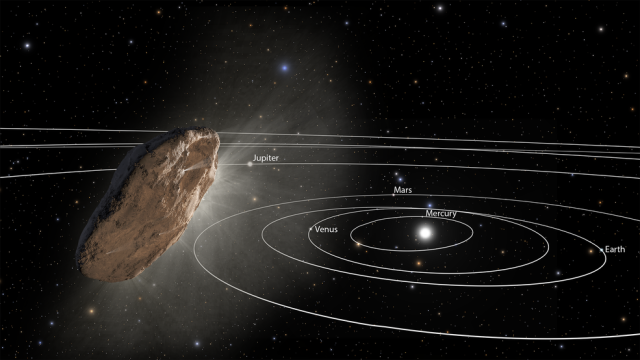
I thought I;d see what NASA has to say about the Oumuamua findings. Apparently no one bothered telling them and the last mention was in September. https://www.nasa.gov/mediacast/gravity-assist-planetary-defense-and-oumuamua-with-kelly-fast Thank the Zeta Reticulans for NASA _________________________________________________________________ Before you read this let me explain for the 100th time that the image shown is not a photograph of Oumuamua -I see it stated over and over online that it is such. It is something an artist has come up with nothing more. We have not seen Oumuamua up that close.
For me the shape was no problem since we still know relatively little about what goes on "out there". If you are a geologist -even someone who has chipped away at a block of coal- then you will know that a tap at the right point will split rock/coal. How it splits up depends on stress lines but long pieces are not that extraordinary. So you imagine a millennia old object being hit by smaller or larger objects as it travels from beyond our solar system -maybe en on entering it. Nothing shocking or odd.
There were some questions that needed answering but Science takes its time. Then we read that Oumuamua had: an “unexpected boost in speed and shift in trajectory as it passes through the inner solar system” That makes you pay attention.
More after this item:
Mystery interstellar asteroid Oumuamua 'could be gigantic alien solar sail sent to look for signs of life'
Patrick Grafton-Green,Evening Standard19 hours ago
The first known interstellar object to travel through our solar system could be a gigantic alien solar sail sent to look for signs of life, according to a new study.
The mysterious asteroid Oumuamua has been analysed by astronomers from the Harvard Smithsonian Centre for Astrophysics (CfA) after it was found to be unexpectedly speeding up.
NASA said earlier this year observations from their Hubble Space Telescope confirmed the object had an “unexpected boost in speed and shift in trajectory as it passes through the inner solar system”.
Scientists have now concluded that the asteroid “might be a lightsail of artificial origin” using solar radiation to propel itself forward.
The study said: “Considering an artificial origin, one possibility is that Oumuamua is a lightsail, floating in interstellar space as a debris from an advanced technological equipment.
“Alternatively, a more exotic scenario is that Oumuamua may be a fully operational probe sent intentionally to Earth vicinity by an alien civilisation.”
Professor Abraham Loeb, who carried out the study with Shmuel Bialy, told Universe Today: “Oumuamua could be an active piece of alien technology that came to explore our Solar System, the same way we hope to explore Alpha Centauri using Starshot and similar technologies.
“The alternative is to imagine that Oumuamua was on a reconnaissance mission.”
Before he died, Professor Stephen Hawking said the most likely shape for an interstellar spacecraft would be a "cigar or needle" as this would “minimise friction and damage from interstellar gas and dust”.
Researchers have previously said the object is likely to be the same size and shape as London's Gherkin building. ***********************************
Here is something for the conspiracy fraternity. We do have solar observatories with powerful instrumentation which is why we get such spectacular solar images. How long would it have taken to have those re-focussed based on the fact that Oumuamua might be an alien probe. If you look at what was happening at some solar observatories (New Mexico was closed down due to criminal activity by a staffer) in September were they refocussing?
To be honest I doubt solar observatories were being used to observe Oumuamua. Humans tend to pontificate and argue until...too late! If this was an alien probe then humanity screwed up. As soon as it was detected there were things we could have done to get better views (military satellites are up there but some general would be stamping his foot and yelling "NO! We gotta watch the Russkies!!").
If this was a probe it might be some civilizations version of Voyager but intended to be observed, contacted or encountered. Was anyone focussing attention on possible transmissions of various kinds from Oumuamua? There are so many questions but if this research is right then, yeah, we done screwed up.
Technical and scientific based journal looking at what has become known as "UFOs" -including natural phenomena some not yet scientifically understood. This is NOT a sensationalist publication but will contain fully referenced articles and reports to help promote further serious study.