The research took almost 40 years on some aspects (starting in 1977) and
if there is one book I have to hold up and momentarily get an ego over
it is this one. Wolves, foxes -including arctic foxes- Jackals and
coyotes in the UK. Many exotics just released to hunt or simply
dumped/escapees.
The history of foxes in the UK and how they were about
to become extinct (there may be no such thing as a true "British fox"
now) but were imported in their thousands each year "for sport" -even I
sat dumbfounded when I made certain discoveries such as stabling foxes,
what "bagging a fox" REALLY meant and more.
One naturalist of 60 years
read it and called it "The most explosive book on British wildlife ever"
and yet, not a single copy has ever sold.
And my old colleagues at the British Naturalist Association....I like to call them "the opposition" now.
THE RED PAPER
A4 format
Paperback,
202 Pages
Many illustrations and photographs
Up-dated 2011 edition includes
section on sarcoptic mange in foxes and treatment plus a list of
wildlife sanctuaries and rescue centres in the UK.
By the 1700s the British fox was on the verge of extinction and about to
follow the bear and wolf having been hunted for sport for centuries.
The answer was to import thousands of foxes per year for sport. But
foxes kept dying out so jackals were tried. Some were caught, some
escaped. Even wolves and coyote were released for hunting.
The summation of decades of work (1977-2011 and still ongoing) and research reveals the damnable lie of
"pest control" hunting but also reveals the cruelty the animals were
subject to and how private menageries as well as travelling shows helped
provide the British and Irish countryside with some incredible events.
The Girt Dog of Ennerdale is also dealt with in detail
I note a few "there was a reason they called it the 'Dark Ages'" items going around Face Book -all accompanied by images of Inquisitors going about their very unholy business. Yes, the Church did it's part but that was a minute part -but it seems people love church-bashing and blaming it for every historical bit of badness.
There were other reasons and I've mentioned these in my books and other articles over the last 25-30 years (it may be longer but I'm not keeping count!). For instance, the Italian historian Flavius Cassiodorus wrote about conditions that he experienced during the year AD 536:
"The Sun...seems to have lost its wonted light, and appears of a bluish colour. We marvel to see no shadows of our bodies at noon, to feel the mighty vigour of the Sun's heat wasted into feebleness, and the phenomena which accompany an eclipse prolonged through almost a whole year. We have had a summer without heat. The crops have been chilled by north winds, [and] the rain is denied."
And he was not alone in writing about this:
Procopius : "...during this year a most dread portent took
place. For the Sun gave forth its light without brightness...and it seemed
exceedingly like the Sun in eclipse, for the beams it shed were not clear."
Lydus : "The Sun became dim...for nearly the whole year...so that
the fruits were killed at an unseasonable time."
Michael the Syrian : "The Sun became dark and its darkness lasted
for eighteen months. Each day it shone for about four hours, and still
this light was only a feeble shadow...the fruits did not ripen and the
wine tasted like sour grapes."
In China it was reported that "the stars were lost from view for three months"
In accounts of "ancient UFO sightings" you will find a number referring to fiery discs and that this was "at the time of the great plague". The Plague of Justinian, as it was called by scholars. The Plague got its name from the Byzantine Emperor of the time, Justinian, and it is reported
to have begun somewhere in central Asia, spread across into Egypt before making its way into Europe. According to some accounts,the Plague of Justinian, was as bad as the Black Death which ravaged Europe in the Middle Ages.
No one was safe from the plague, the famine or the extreme -scientists, writers or others. It really was a "dark age" -blame the Church for a lot but not this. As we see, Flavius was writing in the 6th century. And the twelfth century BC is associated with the "Greek Dark Ages" and looking at historical records, experts have estimated that some forty (40) cities throughout North Africa, the Middle East, Europe,
and Asia were devastated and even disappeared at about
the same time due to a series of catastrophes.Those are great cities we know of.
Luckily, a very interesting article by Greg Bryant* has been preserved on the internet -see, it is good for some things. In this article, Bryant deals with the subject in much more detail and I really do recommend that you read it.
People seem to be confusing historical periods because The Holy Inquisition and so on was at a much later date -starting in the 12th century A.D..
And with all the phenomena reported back in the early dark ages I totally agree with the theory that a comet and comet tail -that many believe the Earth passed through (see Professors Fred Hoyle and
Chandra Wickramasinghe's excellent book Diseases From Space)or asteroid breaking up was behind a great deal of those troubled times.
I have mentioned over the years that a lot of things we used to know has been lost -pre-Viking era visitors using a known and charted route to what is now the Southern United States. Roman statuette found in Arizona, Pineapple depicted on the wall of a Pompeiian home and much more. Coastal cities and island cities we may consider legends/myths -if we have even heard of them- were lost to the sea in catastrophes. The " Amazon" was once home to a huge population before Europeans arrived and spread disease.
Above all else, though, we need to get our time periods right.
__________________________________________________________________________
* The Dark Ages: Were They Darker Than We Imagined? Bryant, Greg, Universe, September, 1999 http://gchbryant.tripod.com/Articles/darkages0999.htm
I'm sorry but this is quite explosive but it just gets a short Yahoo news item! Prof. Wickramasinghe is no new, clean shaven fella out to make a name for himself. Along with Sir Fred Hoyle he wrote the excellent Diseases From Space (1979), Evolution From Space (1981) and Life On Mars? (1997) along with many other books.
How ridiculous that organisations who send probes out into space to "learn" bicker over money and decide not to equip probes with something that might just show us that there is 100% "life out there!"
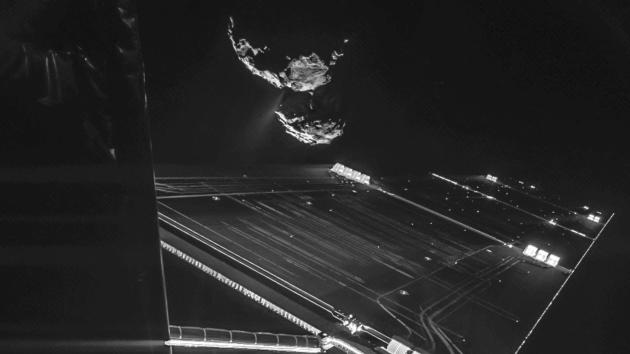
Evidence of alien life is "unequivocal" on the comet carrying the Philae probe through space, two leading astronomers have said.
The experts say the most likely explanation for certain features of the
67P/Churyumov-Gerasimenko comet, such as its organic-rich black crust,
is the presence of living organisms beneath an icy surface.
Rosetta, the European spacecraft orbiting the comet, is also said to
have picked up strange "clusters" of organic material that resemble
viral particles.
But neither Rosetta nor its lander probe, Philae, are equipped to
search for direct evidence of life after a proposal to include this in
the mission was allegedly dismissed.
Astronomer and astrobiologist Professor Chandra Wickramasinghe, who was
involved in planning for the mission 15 years ago, said: "I wanted to
include a very inexpensive life-detection experiment. At the time it was
thought this was a bizarre proposition."
He and colleague Dr Max Wallis, from the University of Cardiff, believe
67P and other comets like it could provide homes for living microbes
similar to the "extremophiles" that inhabit the most inhospitable
regions of the Earth.
They say comets may have helped to sow the seeds of life on Earth and
possibly other planets such as Mars early in the solar system's
existence.
Philae failed to attach itself to the surface of Comet 67P after being
dropped by mothership Rosetta in November, and bounced several times
before landing in the shade.
After being forced into hibernation by the lack of sunlight reaching its solar panels, scientists were euphoric when it began "waking up"
as the comet raced towards the sun. It is currently about 176.7 million
miles from Earth and travelling at more than 73,000 mph.
Computer simulations have suggested microbes could inhabit the comet's watery regions.
It has a black hydrocarbon crust overlaying ice, smooth icy "seas", and
flat-bottomed craters containing "lakes" of re-frozen water overlain
with organic debris.
Prof Wickramasinghe said: "What we're saying is that data coming from
the comet seems to unequivocally, in my opinion, point to
micro-organisms being involved in the formation of the icy structures,
the preponderance of aromatic hydrocarbons, and the very dark surface.
"These are not easily explained in terms of pre-biotic chemistry.
"The dark material is being constantly replenished as it is boiled off
by heat from the Sun. Something must be doing that at a fairly prolific
rate."
Another tantalising find was the discovery of organic "particle clusters" by Rosetta in the gases surrounding the comet, which resembled viral particles collected from the Earth's upper atmosphere.
"They might be viral particles," said Prof Wickramasinghe.
"The current estimate for the number of extra-solar planets in the
galaxy is 140 billion plus. Planets that can harbour life are really
quite abundant in the galaxy, and the next neighbouring system to us is
only spitting distance away. I think it's inevitable that life is going
to be a cosmic phenomenon.
"Five hundred years ago it was a struggle to have people accept that
the Earth was not the centre of the universe. After that revolution our
thinking has remained Earth-centred in relation to life and biology.
"It's deeply ingrained in our scientific culture and it will take a lot of evidence to kick it over."
I am referring to Michael Teal who became a member on the AOP site and has not TWICE tried spamming by telling people to contact him about "REAL" paranormal and stuff. I'm told he has done this elsewhere.
Moronic spamming achieves -nothing.
I might normally ask why he finds factual reporting, as on AOP, not to be discussing "REAL" paranormal and Bigfoot but to be honest if you do this kind of spamming once it is removed. Twice -and actually writing that it is you "again" -banned/blocked.
We had, a few months back, the revellation that an early Bible stated God (the Christian god), like other gods, had a wife. No one has really seen the collapse of civilisation....well, not in the way some might expect.
Now, if genuine and there seems no reason to call it untrue yet, we are told that Jesus was NOT crucified. I leave the arguing over that to the more religious minded -and expert! It would be interesting to see what Western scholars make of this.
*******************************************************************************
1500 Year Old Bible Claims Jesus Christ Was Not Crucified – Vatican In Awe
Much to the dismay of the Vatican, an approx. 1500-2000 year old bible was found in Turkey, in the Ethnography Museum of Ankara.
Discovered and kept secret in the year 2000, the book contains the
Gospel of Barnabas – a disciple of Christ – which shows that Jesus was
not crucified, nor was he the son of God, but a Prophet.
The
book also calls Apostle Paul “The Impostor”. The book also claims that
Jesus ascended to heaven alive, and that Judas Iscariot was crucified in
his place.
A report by The National Turk says that the Bible was seized from a gang of smugglers in a Mediterranean-area operation.
The report states the gang was charged with smuggling antiquities,
illegal excavations, and the possession of explosives. The books itself
is valued as high as 40 Million Turkish Liras (approx. 28 mil. Dollars).
Man, where is the Thieves Guild, when you need them?
Authenticity
According to reports, experts and religious authorities in Tehram insist
that the book is original. The book itself is written with gold
lettering, onto loosely-tied leather in Aramaic, the language of Jesus
Christ.
The text maintains a vision similar to Islam, contradicting the New
Testament's teachings of Christianity. Jesus also foresees the coming of
the Prophet Muhammad, who would found Islam 700 years later.
It is believed that, during the Council of Nicea,
the Catholic Church hand-picked the gospels that form the Bible as we
know it today; omitting the Gospel of Barnabas (among many others) in
favor of the four canonical gospels of Matthew, Mark, Luke and John.
Many biblical texts have begun to surface over time, including those of
the Dead Sea and Gnostic Gospels; but this book especially, seems to
worry the Vatican.
The Catholic Church wants in
What does this mean to Christian-derived religions and their followers?
Quite a tight spot. The Vatican has asked Turkish authorities to let
them examine the contents of the book within the Church. Now that the
book has been found, will they come to accept the it and its evidence?
Will they deny it altogether? Call it a “Muslim lie”, as did the “Truth”
Magazine, in 2000?
To many, this book is a beacon of hope, that believers soon realize that
the object of their adoration is arbitrary; and that all text,
especially religious text, is subject to interpretation.
What does this mean to atheists/agnostics/secular thinkers? Is the text real? Fake? Does it matter?
Hopefully, this news inspires the religious to ask questions, instead of pointing fingers or believing anything blindly.
We know that early Europeans and many other cultures reached the United States -Irish, Welsh, English and even it seems, later Romans stranded there. These mainly hit Central America, seemingly, South America but also the now Southern US -the main route seems to have been via the now Florida area.
Archival photo
of an Ainu coastal man may resemble what Kennewick man looked like when
he was alive. Photo credit: CBS Evening News broadcast Oct. 7, 2014.
Tales of tall, red-haired and bearded giants and others that seem to be Europeans exist in Native American lore. So, when this skull was found "experts" declared that it was European and had no signs of being Native American. Above: Kennewick Man based on facial reconstruction -Ainu like?
There are a number of documentaries on the subject:
Elaine Thompson—APA plastic casting of a controversial
9,200-year-old skull sits in the basement of archaeologist James
Chatter's home July 24, 1997 in Richland, Wash.
He may have
lived a simple life back then, but Kennewick Man’s remains have sparked
controversy and legal battles that the latest scientific investigation
may finally put to rest
Finding a human skull doesn’t happen often, but the skull that two
college students stumbled upon in the Columbia River in 1996 proved
rarer still. It happened to belong to an ancestor that roamed North
America nearly 8500 years ago. Near the skull were remains of
practically an entire skeleton belonging to a male who was likely buried
along the riverbank by his people in Kennewick, Washington.
Kennewick Man, as he is known, quickly became the subject of a custody battle
between scientists eager to study his remains, which are among the
oldest and most complete of a human ancestor in North America, and a
group of five Native American tribes who claimed the bones as the
Ancient One, one of their own forebears. The U.S. Army Corps of
Engineers, which manages the land on which the remains were found,
intended to return the ancient bones to the Native Americans. The
archeologists sued for the right to study them, and in 2004, a judge
ruled that the fossils should be studied further.
The results of that analysis were published in a popular book that
detailed the lifestyle that Kennewick Man likely led, but since then,
advances in genetic sequencing made it possible to do a complete genome
study of his DNA. And those results, published in the journalNature,
resolve a long-standing dispute over where Kennewick Man came from —
Europe or Asia, or whether he was, as the Native American tribes
claimed, an early ancestor who gave rise to some of the Native American
populations that subsequently resided in North America.
His genes show that Kennewick Man was more closely related to Native
Americans than to European or Asian populations. “It’s very clear the
genome sequence shows that he is most closely related to contemporary
Native Americans,” says Eske Willerslev, from the Center for GeoGenetics
at the University of Copenhagen, who led the analysis.
Hints of these results first leaked in January, when emails obtained
from a Freedom of Information Act request by reporters at the Seattle
Times revealed that Willerslev’s group shared some of their early
findings with the Army Corps of Engineers to update them on the genetic
analysis, which was done in Copenhagen. And presumably, it puts to rest
any lingering questions about Kennewick Man’s origins.
Those began when the first archeologist to evaluate the skull’s
anatomical features declared it to be more Caucasian than Native
American, and continued when Douglas Owsley, a physical anthropologist
at the Smithsonian Institution who is considered the expert on North
American human remains, agreed with that conclusion. Owsley pointed out
that the prominent forehead of Kennewick Man and thinner brain case made
him more like Japanese Ainu or Polynesians rather than Native
Americans.
His genes tell a different story, however, and when Willerslev’s
group also compared Kennewick Man’s DNA to that of the Ainu, Polynesians
and Europeans, they found that it did not share the same similarities
as it did with those of the contemporary Colville, a Native American
tribe from the Columbia River area that agreed to provide DNA samples.
No other Native American groups provided genetic material, so it’s
possible that other tribes have an even closer connection to the ancient
remains than the Colville.
The results do not show that Kennewick Man was a direct ancestor of
any tribe living today, says Willerslev. It’s not known whether, for
example, an older population of Native Americans living in North America
then split into a branch that led to Kennewick Man, and another to the
contemporary tribes such as the Colville, or whether Kennewick Man is
the ancestor of the Colville and other modern Native Americans.
The genetic analysis does little to change archeologists’ current
theories about the first North Americans. The first people to spread
into the Americas likely came 5,000 to 6,000 years before Kennewick
Man’s time, probably from Siberia via a now non-existent land bridge
that allowed them to traverse the Bering Strait.
As for Kennewick Man’s future, Willerslev says that he has been in
contact with several members of the Colville throughout the analysis and
says that “To me, they seemed pretty excited, and found it
interesting.” Whether the remains will now go back to the Native
American groups under the Native American Graves Protection and
Repatriation Act isn’t clear. But Willerslev acknowledges the irony in
the findings. “The reason why we came to this conclusion scientifically
speaking is because the remains were almost kept out of science,” he
says.
***************************************************************************************
Now, no more time wasting let's get back to searching for the real mysteries in America!


 The
book also calls Apostle Paul “The Impostor”. The book also claims that
Jesus ascended to heaven alive, and that Judas Iscariot was crucified in
his place.
The
book also calls Apostle Paul “The Impostor”. The book also claims that
Jesus ascended to heaven alive, and that Judas Iscariot was crucified in
his place.

