Total Pageviews

Tuesday, 1 January 2019

Ultima Thule Reached...

Now let's spend money on active SETI/CETI Probes

We really need to send out in random directions several smaller probes that are equipped with signal sending and receiving gear.


New Horizons: Nasa probe survives flyby of Ultima Thule

Alice BowmanImage copyrightNASA
Image captionAlice Bowman is congratulated on the confirmation of flyby success
The US space agency's New Horizons probe has made contact with Earth to confirm its successful flyby of the icy world known as Ultima Thule.
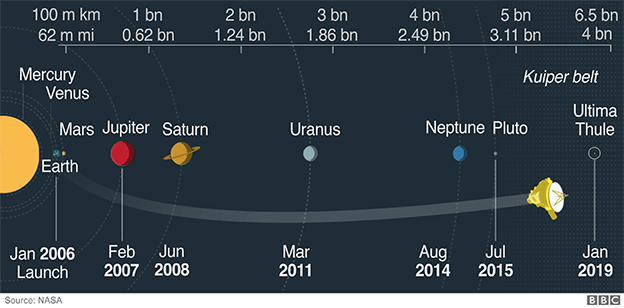
The encounter occurred some 6.5bn km (4bn miles) away, making it the most distant ever exploration of an object in our Solar System.
New Horizons acquired gigabytes of photos and other observations during the pass.
It will now send these home over the coming months.
The radio message from the robotic craft was picked up by one of Nasa's big antennas, in Madrid, Spain.
It had taken fully six hours and eight minutes to traverse the great expanse of space between Ultima and Earth.
Controllers at the Johns Hopkins University Applied Physics Laboratory in Maryland greeted the reception of the signal with cheers and applause.
"We have a healthy spacecraft," announced Mission Operations Manager Alice Bowman. "We've just accomplished the most distant flyby."
This first radio message contained only engineering information on the status of the spacecraft, but it included confirmation that New Horizons executed its autonomous flyby observations as instructed and that the probe's onboard memory was full.
A later downlink on Tuesday will see some choice images returned to give scientists and the public a taster of what New Horizons saw through its cameras.
If there is one note of caution it is that the timing and orientation of the spacecraft had to be spot on if the probe was not to shoot pictures of empty space! As a result, there'll continue to be some anxiety until the data can be examined.
"The highest resolution images taken at closest approach required perfect pointing, almost," said Project Scientist Hal Weaver. "We think, based on everything we've seen so far, that was achieved."
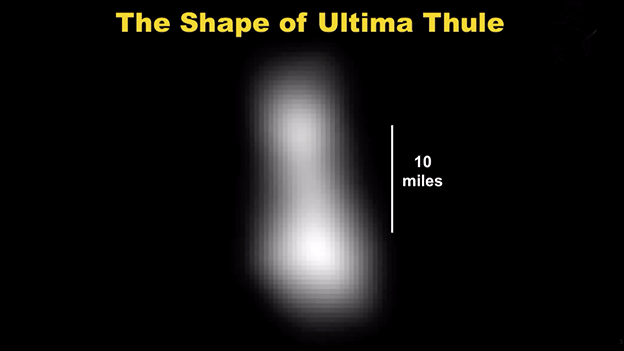
Ultima image from 31 DecemberImage copyrightNASA
Image captionTaken from a few hundred thousand km: A last image on approach to the target
Ultima is in what's termed the Kuiper belt - the band of frozen material that orbits the Sun more than 2 billion km further out than the eighth of the classical planets, Neptune; and 1.5 billion km beyond even the dwarf planet Pluto which New Horizons visited in 2015.
It's estimated there are hundreds of thousands of Kuiper members like Ultima, and their frigid state almost certainly holds clues to the formation conditions of the Solar System 4.6 billion years ago.
The vast separation between New Horizons and Earth, coupled with the probe's small, 15-watt transmitter, mean data rates are glacial, however.
They top out at 1 kilobit per second. To retrieve all of the imagery stored on the probe is therefore expected to take until September 2020.
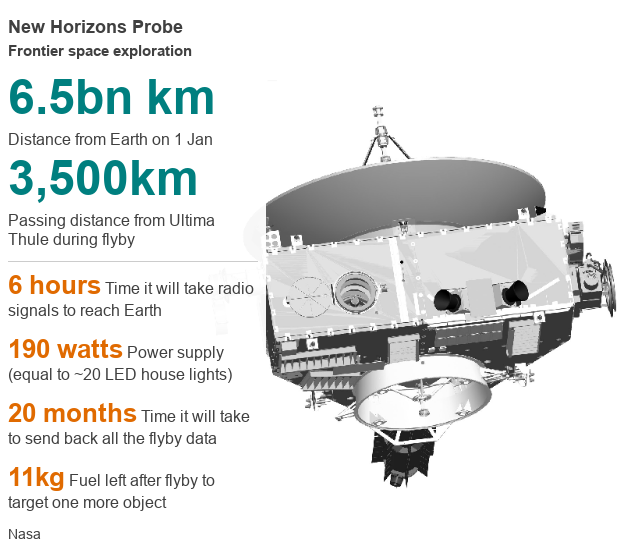
New Horizons profile
Distance to UT

What's so special about the Kuiper belt?

Several factors make Ultima Thule, and the domain in which it moves, so interesting to scientists.
One is that the Sun is so dim in this region that temperatures are down near 30-40 degrees above absolute zero. As a result, chemical reactions have essentially stalled. This means Ultima is in such a deep freeze that it is probably perfectly preserved in the state in which it formed.
Another factor is that Ultima is small (about 30km across), and this means it doesn't have the type of "geological engine" that in larger objects will rework their composition.
And a third factor is just the nature of the environment. It's very sedate in the Kuiper belt.
Unlike in the inner Solar System, there are probably very few collisions between objects. The Kuiper belt hasn't been stirred up.
New Horizons' chief scientist Alan Stern says: "Everything that we're going to learn about Ultima - from its composition to its geology, to how it was originally assembled, whether it has satellites and an atmosphere, and that kind of thing - is going to teach us about the original formation conditions in the Solar System that all the other objects we've gone out and orbited, flown by and landed on can't tell us because they're either large and evolve, or they are warm. Ultima is unique."
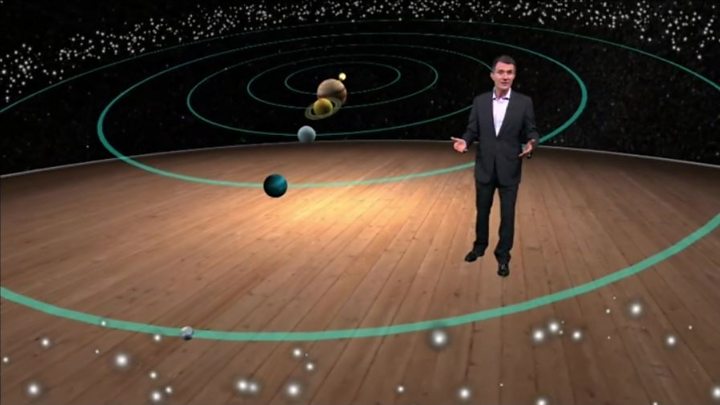
Media captionWhere is Ultima Thule? BBC Science Editor David Shukman explains

What does New Horizons do next?

First, the scientists must work on the Ultima data, but they will also ask Nasa to fund a further extension to the mission.
The hope is that the course of the spacecraft can be altered slightly to visit at least one more Kuiper belt object sometime in the next decade.
New Horizons should have just enough fuel reserves to be able to do this. Critically, it should also have sufficient electrical reserves to keep operating its instruments into the 2030s.
The longevity of New Horizon's plutonium battery may even allow it to record its exit from the Solar System.
The two 1970s Voyager missions have both now left the heliosphere - the bubble of gas blown off our Sun (one definition of the Solar System's domain). Voyager 2 only recently did it, in November.
And in case you were wondering, New Horizons will never match the Voyagers in terms of distance travelled from Earth. Although New Horizons was the fastest spacecraft ever launched in 2006, it continues to lose ground to the older missions. The reason: the Voyagers got a gravitational speed boost when they passed the outer planets. Voyager-1 is now moving at almost 17km/s; New Horizons is moving at 14km/s.

Presentational grey line
The BBC's Sky At Night programme will broadcast a special episode on the flyby on Sunday 13 January on BBC Four at 22:30 GMT. Presenter Chris Lintott will review the event and discuss some of the new science to emerge from the encounter with the New Horizons team.

Saturday, 29 December 2018

In Case You Need Convincing


The following page and word count for the prose books ought to prove how much work went into each:


Some Things Strange & Sinister   330pp   92,979 words

Some More Things Strange & Sinister  322pp  96,931 words

Pursuing The Strange & Weird       240pp  66, 911 words

The Bizarre Legend & Crimes of Spring Heeled Jack   54pp  19,138 words

Red Paper:Canids   202pp  67,261 words

The Girt Dog of Ennerdale  42pp    13,527 words

Strange & Mysterious Beasts   324 pp  70,539 words

UFO Contacts:Looking At The Evidence 530pp  171,972 words

Unidentified –Identified  220pp  73,671 words

Contact! Encounters with Extra Terrestrial Entities?  370pp  140,865 words

The Hooper Interviews  365pp   78,672 words


Total Word Count: 824,555

Of course that does not include the hundreds of images -some very rare of thought to have been lost 100-120 years ago, illustrations and countless reference and everything is factual -no lies or twisting facts to sell the book like most authors dealing with "World Mysteries"

Wednesday, 26 December 2018

Contact! Encounters with Extra Terrestrial Entities?


Special Limited Offer!

£15.00


The Search for Extra Terrestrial Intelligence (SETI) says that we may have to wait many thousands of years before any signals sent gets a response if they are detected.

The real SETI may already have established the there is alien life –and it has been visiting Earth for at least 70 years.

Once the mass of reports of 
Close Encounters of the Third Kind and entity encounters are sifted there remains a strong core of cases that defy logical explanation and suggest that these encounters have resulted in physiological effects and post traumatic stress.

Terry Hooper-Scharf of the CE3K/AE Project has led research into these reports for over 40 years and in this work takes a look at rare or obscure reports as well as cataloguing encounters from Germany and Portugal and focuses in on correlations in the reports and how the Dandenong (Kelly Cahill) encounter could be the best case ever reported.

Have the serious investigators and researchers looking into UFOs been unearthing better evidence of extra terrestrial life and contact with humans than established SETI ?


Product DetailsCopyright Terry Hooper-Scharf (Standard Copyright Licence)
Edition First
Publisher
Terry Hooper-Scharf/Black Tower Comics & Books
Published 26 December 2018
Language English
Pages 370
Binding  Perfect-bound Paperback
Interior Ink Black & white
Weight 1.03 kg
Dimensions (centimetres)  20.98 wide x 29.69 tall (A4)


Tuesday, 25 December 2018

"THIS PLANET WILL BE THEIRS." David Jacobs on the Richard Dolan Show. De...

Here we see what has destroyed ufology. Egotistical flim-flam men who promote and brush up each others egoes and get praise from the people watching this.  Note that none of the exposed negative aspects of Jacobs work.  just as these people will not expose the fact that Budd Hopkins altered, changed, did not disclose evidence that did not back up his theories.

This is all about self promotion and selling the schmucks books and merchandise. Jacobs is talking nonsense because he states 'facts' that he then proves are not facts by stating other points.

Without Hopkins, Mack and Jacobs the whole "Grey" abduction phenomenon falls to pieces. Listen to what Jacobs says -he contradicts himself.  He also babbles and makes no sense at times.

Science fiction pushed as fact.

Cumberland Basin Creature

Joshua Lacheln, whom I know personally, rushed around to see me having taken photographs of something "Really ****** weird!"

Joshua was with his wife taking photographs around the Cumberland Basin area of Bristol at 07:00 hrs when his wife pointed to steps leading up from the Basin onto the motorway. A couple of cyclists (seen in the photo) were looking down at something and Joshua thought it was plastic sheeting they were looking at and that undulating movements were due to a breeze blowing it.  However there was no breeze so he got closer and realised that the 'plastic' was moving a sort of 'arm'.

As whatever it was moved downward Joshua and his wife noticed an 'arm' that seemed to be feeling each step as it moved down and another moved through the side of the rails. Joshua's wife was semi shocked but shouted to him: "Joshua -photograph it or no one will believe this!" As he aimed his camera the thing on the steps seemed to "sit up" for a few seconds and he felt it was looking at him and his wife. 

Joshua just started taking photographs -some twenty in total, however, he was so scared that he was fumbling and only three came out any good and the others are blurred and not well focussed.

As whatever it was got to the platform step it raised itself up before the 'arms' grabbed the rail and it pulled itself over -the arms then stretched so that the thing lowered itself slowly onto the dock. It then undulated towards the water of the Bristol Channel and "fell in" and was observed moving quite fast in the water until it submerged and was no longer seen. "In the third photo you can see that the cyclists were turning and looking back at the steps.  They just seemed stunned and when we called out to them and asked if they had seen the thing the man shook his head and waved his hands and shouted 'We're not getting involved!' and then literally ran along the road -they seemed not to remember they had their bikes and that would have got them out of there fast!"

What is it? I have no idea and at first I thought it was a joke but Joshua was still shaken and you can seen protrubrences all over the body -if you can call it that. I'm stumped but will be paying a visit to the area tomorrow!


(c)2019 A J  Lacheln 

Invasion: UFO Encounters and Alien Beings

Sunday, 23 December 2018

Words...Enough

2018 comes to a close and the deeback/comments on this blog has not gone above zero -though a good few bloggers steal information from here and call it their own work.

The prose books have not sold -even the AOP Journal launched at a low price in October has not sold a single copy.

In late January, 2019 this blog will close because I['m not paid to do this and why have new findings stolen along with credit.  All findings are going in my books so that there is at least a published record.

Thank you for your lack of support