 We will no doubt be reading/hearing/seeing much more of this lame rubbish (I am being VERY polite) over the months but go to Bigfoot Evidence and READ the comments. Seriously.http://bigfootevidence.blogspot.co.uk/2015/08/breaking-raw-footage-of-men-shooting-at.html?utm_source=feedburner&utm_medium=feed&utm_campaign=Feed:+BigfootEvidence+%28Bigfoot+Evidence%29
Thursday, 13 August 2015
On the heels new bigfoot footage lastest sasquatch video
We will no doubt be reading/hearing/seeing much more of this lame rubbish (I am being VERY polite) over the months but go to Bigfoot Evidence and READ the comments. Seriously.http://bigfootevidence.blogspot.co.uk/2015/08/breaking-raw-footage-of-men-shooting-at.html?utm_source=feedburner&utm_medium=feed&utm_campaign=Feed:+BigfootEvidence+%28Bigfoot+Evidence%29
Medieval Sword Carries Mysterious Inscription
Here's one for you brain teaser lovers! This should be interesting to follow up!
By Elizabeth Palermo | LiveScience.com

The 13th-century weapon was found in the River Witham in Lincolnshire,
in the United Kingdom, in 1825. It now belongs to the British Museum,
but is currently on loan to the British Library, where it's being
displayed as part of an exhibit on the 1215 Magna Carta.
The sword looks fairly ordinary at first glance. Weighing in at 2 lbs., 10 ounces (1.2 kilograms) and measuring 38 inches (964 millimeters) long, the weapon is steel, with a double edge and a hilt shaped like a cross. But on one side of the sword is a mysterious inscription, made by gold wire that has been inlaid into the steel, which reads, "+NDXOXCHWDRGHDXORVI+."
What does this strange group of letters mean? No one knows for sure, according to the British Library, which recently posted information about the weapon on its website, along with a request for readers to help crack the seemingly incomprehensible code.
Is the message some kind of magical incantation, meant to empower the weapon's owner with mystical abilities during battle? Perhaps the inscription is a religious blessing, or maybe it's just the complicated signature of whoever forged the weapon. Those who read the British Library's blog post put these and many other theories forward regarding the sword's enigmatic message.
Dozens of commenters chimed in to help solve the mystery. And luckily, one of those commenters had a lot of insight into the history of inscribed swords in Europe. Marc van Hasselt, a graduate student of medieval studies at Utrecht University in the Netherlands, has studied similarly inscribed swords and said that these weapons were "all the rage" in 13th-century Europe. The British Library recently updated its blog post with more information from van Hasselt.
Wordy weaponry
Many inscribed swords have been found in countries including Poland, France, Sweden, the Netherlands and the United Kingdom, making the River Witham sword "part of a large international family," according to van Hasselt.
In 2006, researchers from Uppsala University in Sweden (as well as several other institutions) started the Fyris Swords Project, a research project dedicated to figuring out the historical context in which these inscribed medieval swords were used.
The River Witham sword was forged in Germany, which was then the blade-making center of Europe, according to the British Museum. And pre-Christian Germanic tribesman inscribed runes onto their swords, axes and armor to "endow the items with magical powers," the Fyris Swords Project researchers wrote in a paper published in the journal Waffen- und Kostümkunde (Weaponry and Costumes) in 2009.
It's possible that this ancient tradition was carried over to Christian times and that the inscriptions on the blades were therefore meant to "invoke God’s holy name and his grace to gain support and protection in battle," according to the researchers.
Such swords were likely owned by wealthy warriors, according to the British Museum, which speculates that the River Witham sword belonged to a knight or some other rich individual who rode into battle during the crusades of the late medieval period. The British Museum also suggests that such swords may have been a part of the ceremony in which a man became a knight and vowed to defend the church.
Cracking the code
Even though historians are fairly certain why inscribed swords were popular in the medieval period and who owned them, they still aren't sure just what these swords actually say. Interpreting the inscriptions on the blades is like "trying to crack a mysterious code," according to the Fyris Swords Project researchers.
While historians aren't entirely sure what language the letters on the sword represent, they are fairly certain that the letters are a short-form version of Latin, according to van Hasselt, who said that Latin was the "international language of choice" in 13th-century Europe. The first two letters on the River Witham sword are ND, which van Hasselt said might be a kind of invocation that stands for "Nostrum Dominus (our Lord) or Nomine Domini (name of the Lord)."
The XOXcombination that follows could refer to the Holy Trinity of the Christian faith. And the two plus sign-shaped symbols before and after the inscription are likely Christian crosses, according to the Fyris Swords Project researchers.
This sort of speculation about what the sword's inscriptions might represent has been going on for more than a century (researchers have been publishing their interpretations of the inscriptions in the journal Waffen- und Kostümkunde since 1904). The variety of the letter sequences on the swords makes it clear that the inscriptions are not general statements (i.e., a standard blessing written out in short form). Quite the opposite is true, according to the researchers.
"[The] inscriptions (even though sometimes showing a constancy of letters) are extremely variable and appear to be very personal. One might say the individual secret of every sword bearer. It must have been a special dictum [saying] so obvious and so self-evident to him that it was not necessary to spell out its significant meaning," the researchers said.

By Elizabeth Palermo | LiveScience.com
A medieval sword inscribed with a mysterious message is stumping researchers and causing a stir among armchair historians.
The sword looks fairly ordinary at first glance. Weighing in at 2 lbs., 10 ounces (1.2 kilograms) and measuring 38 inches (964 millimeters) long, the weapon is steel, with a double edge and a hilt shaped like a cross. But on one side of the sword is a mysterious inscription, made by gold wire that has been inlaid into the steel, which reads, "+NDXOXCHWDRGHDXORVI+."
What does this strange group of letters mean? No one knows for sure, according to the British Library, which recently posted information about the weapon on its website, along with a request for readers to help crack the seemingly incomprehensible code.
Is the message some kind of magical incantation, meant to empower the weapon's owner with mystical abilities during battle? Perhaps the inscription is a religious blessing, or maybe it's just the complicated signature of whoever forged the weapon. Those who read the British Library's blog post put these and many other theories forward regarding the sword's enigmatic message.
Dozens of commenters chimed in to help solve the mystery. And luckily, one of those commenters had a lot of insight into the history of inscribed swords in Europe. Marc van Hasselt, a graduate student of medieval studies at Utrecht University in the Netherlands, has studied similarly inscribed swords and said that these weapons were "all the rage" in 13th-century Europe. The British Library recently updated its blog post with more information from van Hasselt.
Wordy weaponry
Many inscribed swords have been found in countries including Poland, France, Sweden, the Netherlands and the United Kingdom, making the River Witham sword "part of a large international family," according to van Hasselt.
In 2006, researchers from Uppsala University in Sweden (as well as several other institutions) started the Fyris Swords Project, a research project dedicated to figuring out the historical context in which these inscribed medieval swords were used.
The River Witham sword was forged in Germany, which was then the blade-making center of Europe, according to the British Museum. And pre-Christian Germanic tribesman inscribed runes onto their swords, axes and armor to "endow the items with magical powers," the Fyris Swords Project researchers wrote in a paper published in the journal Waffen- und Kostümkunde (Weaponry and Costumes) in 2009.
It's possible that this ancient tradition was carried over to Christian times and that the inscriptions on the blades were therefore meant to "invoke God’s holy name and his grace to gain support and protection in battle," according to the researchers.
Such swords were likely owned by wealthy warriors, according to the British Museum, which speculates that the River Witham sword belonged to a knight or some other rich individual who rode into battle during the crusades of the late medieval period. The British Museum also suggests that such swords may have been a part of the ceremony in which a man became a knight and vowed to defend the church.
Cracking the code
Even though historians are fairly certain why inscribed swords were popular in the medieval period and who owned them, they still aren't sure just what these swords actually say. Interpreting the inscriptions on the blades is like "trying to crack a mysterious code," according to the Fyris Swords Project researchers.
While historians aren't entirely sure what language the letters on the sword represent, they are fairly certain that the letters are a short-form version of Latin, according to van Hasselt, who said that Latin was the "international language of choice" in 13th-century Europe. The first two letters on the River Witham sword are ND, which van Hasselt said might be a kind of invocation that stands for "Nostrum Dominus (our Lord) or Nomine Domini (name of the Lord)."
The XOXcombination that follows could refer to the Holy Trinity of the Christian faith. And the two plus sign-shaped symbols before and after the inscription are likely Christian crosses, according to the Fyris Swords Project researchers.
This sort of speculation about what the sword's inscriptions might represent has been going on for more than a century (researchers have been publishing their interpretations of the inscriptions in the journal Waffen- und Kostümkunde since 1904). The variety of the letter sequences on the swords makes it clear that the inscriptions are not general statements (i.e., a standard blessing written out in short form). Quite the opposite is true, according to the researchers.
"[The] inscriptions (even though sometimes showing a constancy of letters) are extremely variable and appear to be very personal. One might say the individual secret of every sword bearer. It must have been a special dictum [saying] so obvious and so self-evident to him that it was not necessary to spell out its significant meaning," the researchers said.
Commenters on the British Library website have suggested a number of
possible interpretations of the River Witham sword's inscription (which
you can read under the library's blog post). But just as with the other
inscribed swords found throughout Europe, it's unlikely that anyone will
be able to say with complete certainty just what message this medieval
sword conveys.
Octopus genetic code reveals 'alien creature' -IF you are a journalist or like over exaggerating
Just one more intelligent creature humans kill and eat -so stop complaining about wildlife stealing your bag of chips!
Press Association - Octopus DNA is highly rearranged and contains numerous so-called "jumping genes"
A new map of the octopus genetic code has revealed a creature so strange that it could be an "alien", say scientists.
Octopus DNA is highly rearranged - like cards shuffled and reshuffled in a pack - containing numerous so-called "jumping genes" that can leap around the genome.
US r esearcher Dr Clifton Ragsdale, from the University of Chicago, said: "The octopus appears to be utterly different from all other animals, even other molluscs, with its eight prehensile arms, its large brain and its clever problem-solving abilities.
"The late British zoologist Martin Wells said the octopus is an alien. In this sense, then, our paper describes the first sequenced genome from an alien."
The scientists who sequenced the genome of the California two-spot octopus report their findings in the journal Nature.
They discovered unique genetic traits that are likely to have played a key role in the evolution of characteristics such as the complex nervous system and adaptive camouflage.
Analysis of 12 different tissues revealed hundreds of octopus-specific genes found in no other animal, many of them highly active in structures such as the brain, skin and suckers.
Cephalopods, which include the octopus, squid, cuttlefish and nautilus, are a family of predatory molluscs with an evolutionary history stretching back more than 500 million years to a time long before plants colonised the land.
They inhabit every ocean at almost all depths and possess a range of features that call to mind sci-fi aliens. These include prehensile sucker-lined tentacles, highly mobile, camera-like eyes sensitive to polarised light, sophisticated camouflage systems that alter skin colour and patterns, jet-propulsion, three hearts, and the ability to regenerate severed limbs.
The scientists estimate that the two-spot octopus genome contains 2.7 billion base pairs - the chemical units of DNA - with long stretches of repeated sequences.
Although the genome is slightly smaller than a human's it is packed with more genes.
Reshuffling was a key characteristic of the creature's genetic make-up. In most species, cohorts of certain genes tend to be close together on the double-helix DNA molecule. A gene is a region of DNA that contains the coded instructions for making a protein.
In the octopus, there are no such groupings of genes with related functions. For instance, Hox genes - which control body plan development - cluster together in almost all animals but are scattered throughout the octopus genome.
It was as if the octopus genome had been "put into a blender and mixed", said co-author Caroline Albertin, also from the University of Chicago.
The role of the many transposons, or "jumping genes", remains unclear. These are sequences of DNA that have the ability to "jump" from one genome location to another.
Transposons are known to affect the regulation of gene activity and help shape genome structure. In the octopus, transposon activity was especially high in the nervous system.
Evidence of extensive RNA editing - allowing protein structure to be changed without altering the underlying DNA code - was also seen in the octopus.
Dr Ragsdale said: "The octopus
genome makes studies of cephalopod traits much more tractable and now
represents an important point on the tree of life for comparative
evolutionary studies. It is an incredible resource that opens up new
questions that could not have been asked before about these remarkable
animals."
Saturday, 25 July 2015
"Колоссальный кальмар" (Mesonychoteuthis hamiltoni)

Thanks to the person who sent me this link. Yes, I have seen it. In case you wonder what the description says:
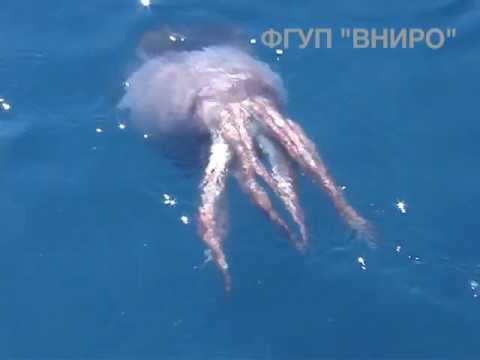
"Russian scientists were able to videotape the colossal squid (Mesonychoteuthis hamiltoni).
Interviews with specialists of the Russian Research Institute of Fisheries and Oceanography Ivan Istomin and Alexander Vagin: http: //polit.ru/news/2013/03/25/ps_co ..."
And you wonder why I have no wish to go into any ocean or sea?
Here is the Russian article -a very poor English translation follows:
Российским ученым удалось снять на видео колоссального кальмара
Видео: Иван Истомин/ФГУП ВНИРО
При каких обстоятельствах вы встретились с этим существом?
Александр Вагин: Это произошло в январе 2008 года в море Дюрвиля недалеко от побережья Антарктиды. Мы работали на южнокорейском рыболовном судне в качестве международных наблюдателей АНТКОН (Комиссия по сохранению морских живых ресурсов Антарктики) во время промысла клыкача. Это крупная ценная глубоководная рыба, которая водится в антарктических морях и достигает в длину до двух метров. Ловят ее с помощью донного яруса. Это прочный синтетический канат длиной несколько километров с грузами, к которому на поводцах крепятся крючки с кусками кальмара или небольшой рыбой в качестве наживки.
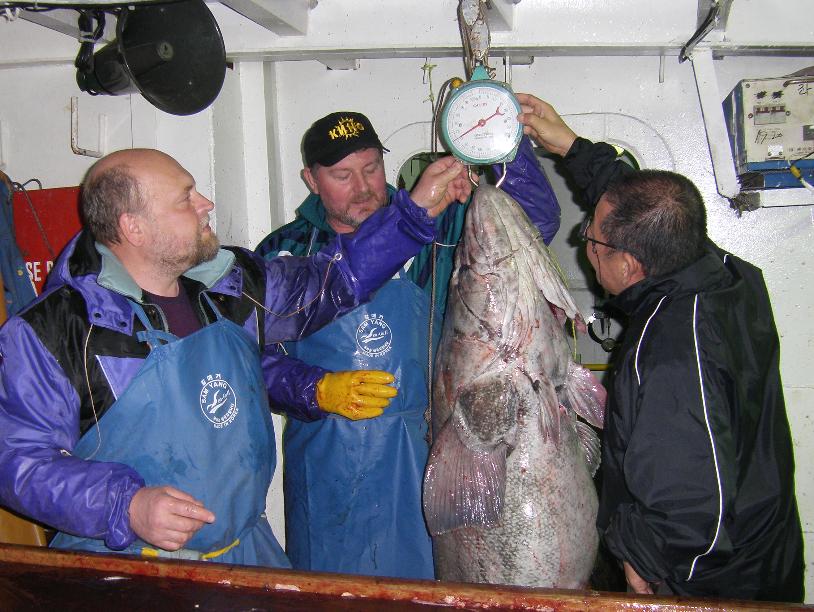
А. Вагин (слева) и И. Истомин (в центре) взвешивают пойманного клыкача
Как отреагировала команда? Наверное, не каждый день приходится сталкиваться с таким уловом.
А.В.: Матросы, среди которых были китайцы, вьетнамцы и индонезийцы, принялись громко кричать на непонятных языках, махать баграми и всячески «спасать» клыкача. Когда им удалось подцепить рыбу, кальмар отпустил свою добычу и погрузился в воду на несколько метров. Затем он снова всплыл, высунув из воды часть плавника. Цвет его в это время стал более блеклым. После чего кальмар развернулся и начал медленно погружаться, совершая так называемые ундулирующие движения плавником, которые прекрасно видно на видеозаписи.
Вам удалось определить размеры кальмара?
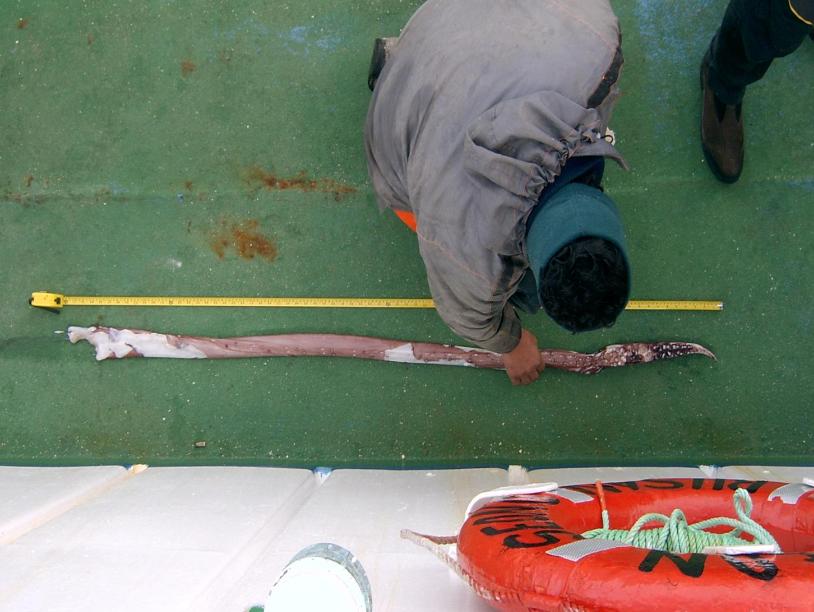
Щупальце колоссального кальмара из желудка клыкача. Фото Ивана Истомина
Да, действительно гигантский. Не так давно у берегов Японии запечатлели на камеру кальмара длиной всего 3 метра.
И.И.: Тут стоит сразу пояснить, что в природе разделяют два рода крупных моллюсков: Гигантские кальмары (Architeuthis) и Колоссальные кальмары с единственным представителем (Mesonychoteuthis hamiltoni). Тот экземпляр, который японцы сняли в естественной среде обитания, относился к первому роду, а наш - ко второму. На самом деле колоссальные кальмары довольно хорошо изучены, но, похоже, что этот был крупнее многих, исследованных ранее.
А что при этом было с рыбой? Кальмар нанес ей какие-то повреждения?
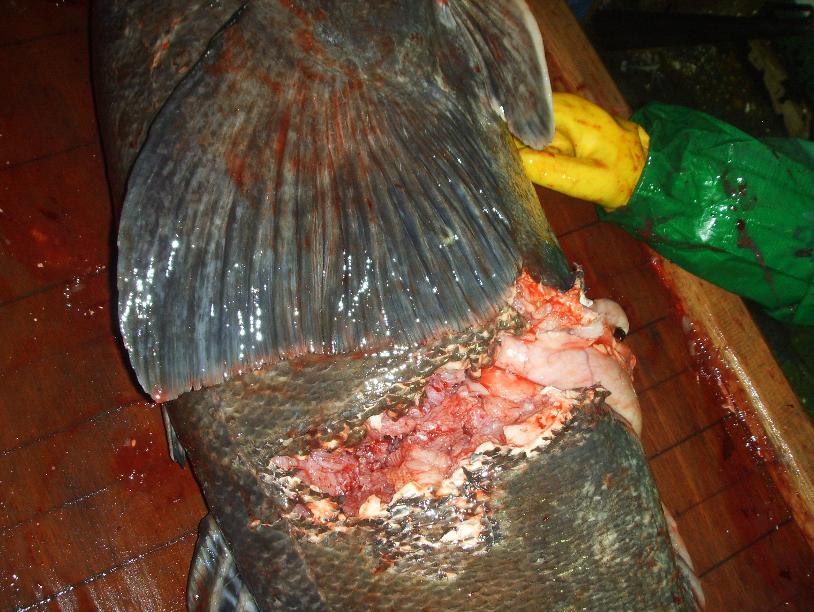
Следы, оставленные кальмаром на клыкаче (Dissostichus mawsoni). Фото Ивана Истомина
Не жалеете, что не удалось поймать самого кальмара?
И.И.: Капитан корейского судна не видел этот эпизод, и потом сильно ругался, что команда занялась спасением улова и не вытащила кальмара на палубу. С одной стороны, нам как ученым было бы интересно изучить это существо более подробно. Но тогда бы мы не получили замечательных кадров его движения. Так что мы больше жалеем, что не удалось понаблюдать за кальмаром подольше.
Вы регулярно принимаете участие в морских экспедициях, в том числе работаете на рыболовных судах. Известны ли вам другие случаи встречи с огромными кальмарами?
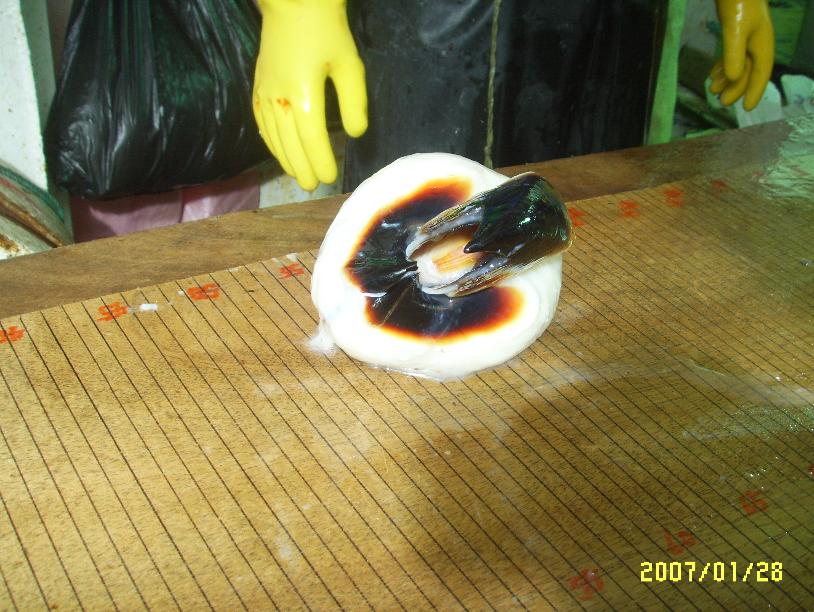
Клюв кальмара, извлеченный из желудка клыкача. Фото Ивана Истомина
И.И.: Другими словами, мертвые кальмары изучены достаточно хорошо. А вот видеть живого кальмара-гиганта, а тем более снимать его на видео в таких хороших погодных условиях удается исключительно редко! Хотя среди моряков всегда ходит много историй.
И о каких экземплярах вам приходилось слышать?
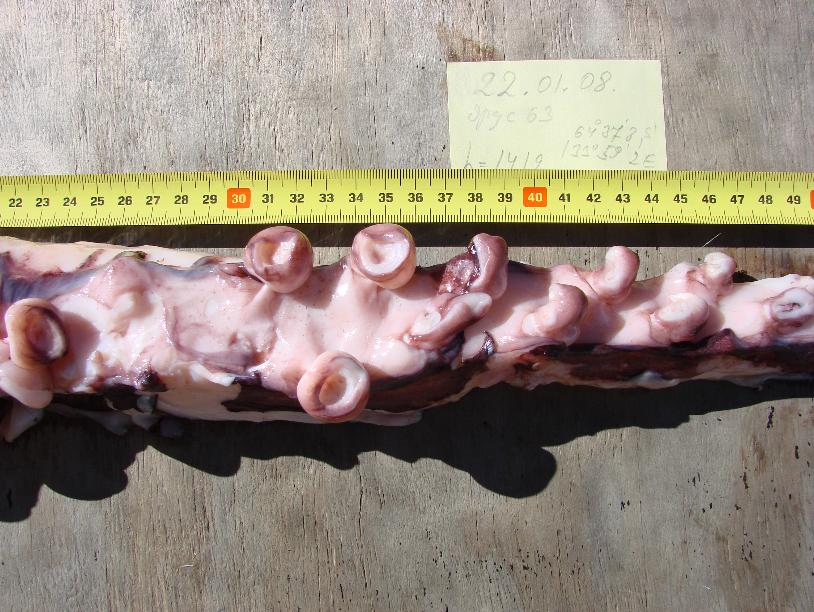
Фрагмент щупальца кальмара. Фото Ивана Истомина
Справка:
Гигантские и колоссальные кальмары являются не только самыми большими на планете беспозвоночными, но и занимают второе после кашалота место среди крупнейших хищников. Многие специалисты считают, что именно эти существа породили легенды о морском монстре Кракене, которые впервые появились в исландском фольклоре. Если колоссальный кальмар Mesonychoteuthis hamiltoni встречается только в южных морях у побережья Антарктиды, гигантские кальмары рода Architeuthis обитают практически по всему мировому океану. До недавнего времени предполагалось, что род гигантских кальмаров насчитывает, по крайней мере, 8 видов. Но последние генетические исследования, опубликованные в журнале Proceedings of the Royal Society, показали, что это не так. Ученые проанализировали ДНК 43 особей гигантского кальмара, найденных в разных точках планеты. Различия в геноме были столь незначительны, что все особи оказались принадлежащими к одному виду.
******************************************************************************

 Video: Ivan Istomin / FSUE VNIRO
In early 2013, world media reported that Japanese scientists in collaboration with Discovery Channel for the first time managed to take video of a living giant squid length of about three meters. But it turns out that Russian scientists from the All-Russian Research Institute of Fisheries and Oceanography for several years stored deep-video monster, whom they met in Antarctic waters. The correspondent of "Polit.ru" met with the experts of the Institute Ivan Istomin and Alexander Vagin to find out more.
Under what circumstances did you meet with this creature?
Alexander Vagin: It happened in January 2008, the D'Urville Sea off the coast of Antarctica. We worked on the South Korean fishing vessel as international observers ANTKON (Commission for the Conservation of Antarctic Marine Living Resources) during the toothfish fishery. It is a large valuable deep-water fish, which is found in Antarctic seas and reaches a length of up to two meters. Catch it with the bottom-line. This durable synthetic rope length of several kilometers with loads to which the hooks are attached to the streamer line with pieces of squid or small fish as bait.
A. Vagin (left) and Ivan Istomin (center) weighed toothfish
Ivan Istomin: The day we chose the lines set at a depth of about six kilometers. At some point on the hook to the side came close copy of toothfish, whose body tightly entangled huge squid tentacles. He appeared several times larger than their victim, and was at first light, and then change the color to bright red as the underwater part of our ship. By happy coincidence I had a camera with me and I had to remove this thing. Also very lucky with the weather - sunny windless days in these parts are not so often.
As a team reacted? Probably not every day have to face such a catch.
A .: The sailors, among whom were Chinese, Vietnamese and Indonesians began to shout loudly in a strange language, swing hooks in every way to "save" the toothfish. When they were able to pick up the fish, squid released its prey and plunged into the water for a few meters. Then he came up again, sticking out of the water of the fin. Colour it at this time has become more faint. Then the squid turned and slowly began to sink, making the so-called fin undulating movement, which is perfectly visible in the video.
You were able to determine the size of the squid?
Colossal squid tentacle of toothfish stomach. Photo by Ivan Istomin
A .: When the fish on deck, we have carefully studied it. It was a really big specimen length of 178 centimeters and weighing 65 kilograms. Comparing the size of the fish and squid in the photo, we determined that it has the mantle of about four meters in length and not less than half a meter in diameter. Overall length, apparently, was more than five meters. Usually, squid tentacles, four pairs of short-hand and a pair of long hunting. In our sample have been separated long tentacles. Most likely, he lost them in a fight with a predator. Before that its overall size could reach 8-10 meters.
Yes, really huge. Not so long ago off the coast of Japan captured on camera squid length of 3 meters.
I.I .: Here is immediately clear that the nature shared by two kinds of large clams: Giant squid (Architeuthis) and colossal squid with a single representative (Mesonychoteuthis hamiltoni). The one instance that the Japanese took off in their natural habitat, belong to the first race, and our - to the second. In fact colossal squid is quite well understood, but it seems that this was bigger than many previously studied.
And what if this was the fish? Kalmar caused her any damage?The traces left by squid for toothfish (Dissostichus mawsoni). Photo by Ivan Istomin
A .: All toothfish body was covered with traces of suckers, the largest of which reaches three centimeters in diameter. In the dorsal fin torn piece of meat kilogram two - to three of the spine. At the same time the fish was still alive.
Do you regret that it was not possible to catch the most squid?
I.I .: Captain Korean vessel had not seen the episode, and then strongly criticized that the rescue team took the catch and pulled the squid on the deck. On the one hand, we as a scientist would be interesting to study this creature in detail. But then we did not get great shots of his movement. So we are sorry that it was not possible to observe squid longer.You regularly participate in marine expeditions, including work on fishing vessels. Are you aware of other instances of meeting with huge squid?
The beak of the squid, extracted from the stomach of toothfish. Photo by Ivan Istomin
A .: The attack on the big squid hooked toothfish - not a rare phenomenon. In some areas of Antarctica where fishing is carried out, up to 10% of fish caught are traces of suckers and the wounds inflicted by "beak" squid. But usually they let their prey even in the depths, so the meeting was living giants are very rare. However, due to the peculiarities of biology of squid, scientists are able to study their remains. The fact that these creatures are monocyclic. That is, having reached a certain age, they produce offspring, and die shortly thereafter. After that they were either washed ashore or they become food of various marine predators. We often found in the stomach of the same toothfish tentacles up to two meters or pieces of mantle thickness of a few centimeters.
I.I .: In other words, the dead squid studied well enough. But to see a live giant squid, much less shoot it on video in such good weather conditions it is possible only rarely! Although among the sailors always been a lot of stories.And about some instances have you heard?Detail of squid tentacles. Photo by Ivan Istomin
I.I .: As you know, the largest giant squid Architeuthis instance was found on the shores of New Zealand. Its length, along with hunting tentacles was 17.4 meters. Among the fishermen hear stories about how, together with the caught fish raised a monster longer than two dozen meters. It is difficult to judge whether it's true or only fiction sea. But it is known that sperm whales on the skins, which are actively consume squid as food, they found the marks of suction cups diameter of several tens of centimeters. If we consider that our sample with a length of about five meters mantle had three-centimeter sucker, these stories do not seem too fantastic. No matter how long we may have studied the ocean, it will continue to hide from us its secrets.
Reference:Giant and colossal squid are not only the largest invertebrate on the planet, but in second place after the sperm whale among the largest predators. Many experts believe that these creatures spawned legends of sea monster Kraken, which first appeared in Icelandic folklore. If Mesonychoteuthis hamiltoni colossal squid is found only in the southern seas off the coast of Antarctica, giant squid Architeuthis genus are found almost all over the world's oceans. Until recently it was assumed that the genus of giant squid has at least 8 species. But recent genetic research, published in the journal Proceedings of the Royal Society, showed that it is not. The scientists analyzed the DNA of 43 species of giant squid found in different parts of the planet. Differences in the genome were so insignificant that all individuals turned out to belong to the same species.
Thursday, 23 July 2015
NASA’s Kepler Mission Discovers Bigger, Older Cousin to Earth


There are 4,696 planet candidates now known with
the release of the seventh Kepler planet candidate catalog - an increase
of 521 since the release of the previous catalog in January 2015.
Credits: NASA/W. Stenzel


This artist's concept depicts one possible
appearance of the planet Kepler-452b, the first near-Earth-size world to
be found in the habitable zone of star that is similar to our sun.
Credits: NASA/JPL-Caltech/T. Pyle
The newly discovered Kepler-452b is the smallest planet to date discovered orbiting in the habitable zone -- the area around a star where liquid water could pool on the surface of an orbiting planet -- of a G2-type star, like our sun. The confirmation of Kepler-452b brings the total number of confirmed planets to 1,030.
"On the 20th anniversary year of the discovery that proved other suns host planets, the Kepler exoplanet explorer has discovered a planet and star which most closely resemble the Earth and our Sun," said John Grunsfeld, associate administrator of NASA’s Science Mission Directorate at the agency’s headquarters in Washington. “This exciting result brings us one step closer to finding an Earth 2.0."
Kepler-452b is 60 percent larger in diameter than Earth and is considered a super-Earth-size planet. While its mass and composition are not yet determined, previous research suggests that planets the size of Kepler-452b have a good chance of being rocky.
While Kepler-452b is larger than Earth, its 385-day orbit is only 5 percent longer. The planet is 5 percent farther from its parent star Kepler-452 than Earth is from the Sun. Kepler-452 is 6 billion years old, 1.5 billion years older than our sun, has the same temperature, and is 20 percent brighter and has a diameter 10 percent larger.
“We can think of Kepler-452b as an older, bigger cousin to Earth, providing an opportunity to understand and reflect upon Earth’s evolving environment," said Jon Jenkins, Kepler data analysis lead at NASA's Ames Research Center in Moffett Field, California, who led the team that discovered Kepler-452b. "It’s awe-inspiring to consider that this planet has spent 6 billion years in the habitable zone of its star; longer than Earth. That’s substantial opportunity for life to arise, should all the necessary ingredients and conditions for life exist on this planet.”
To help confirm the finding and better determine the properties of the Kepler-452 system, the team conducted ground-based observations at the University of Texas at Austin's McDonald Observatory, the Fred Lawrence Whipple Observatory on Mt. Hopkins, Arizona, and the W. M. Keck Observatory atop Mauna Kea in Hawaii. These measurements were key for the researchers to confirm the planetary nature of Kepler-452b, to refine the size and brightness of its host star and to better pin down the size of the planet and its orbit.
The Kepler-452 system is located 1,400 light-years away in the constellation Cygnus. The research paper reporting this finding has been accepted for publication in The Astronomical Journal.
In addition to confirming Kepler-452b, the Kepler team has increased the number of new exoplanet candidates by 521 from their analysis of observations conducted from May 2009 to May 2013, raising the number of planet candidates detected by the Kepler mission to 4,696. Candidates require follow-up observations and analysis to verify they are actual planets.
Twelve of the new planet candidates have diameters between one to two times that of Earth, and orbit in their star's habitable zone. Of these, nine orbit stars that are similar to our sun in size and temperature.
“We've been able to fully automate our process of identifying planet candidates, which means we can finally assess every transit signal in the entire Kepler dataset quickly and uniformly,” said Jeff Coughlin, Kepler scientist at the SETI Institute in Mountain View, California, who led the analysis of a new candidate catalog. “This gives astronomers a statistically sound population of planet candidates to accurately determine the number of small, possibly rocky planets like Earth in our Milky Way galaxy.”
These findings, presented in the seventh Kepler Candidate Catalog, will be submitted for publication in the Astrophysical Journal. These findings are derived from data publically available on the NASA Exoplanet Archive.
Scientists now are producing the last catalog based on the original Kepler mission’s four-year data set. The final analysis will be conducted using sophisticated software that is increasingly sensitive to the tiny telltale signatures of Earth-size planets.
Ames manages the Kepler and K2 missions for NASA’s Science Mission Directorate. NASA's Jet Propulsion Laboratory in Pasadena, California, managed Kepler mission development. Ball Aerospace & Technologies Corporation operates the flight system with support from the Laboratory for Atmospheric and Space Physics at the University of Colorado in Boulder.
For more information about the Kepler mission, visit:
NASA Unveiling New Exoplanet Discovery from Kepler Telescope Today

NASA will unveil a potentially exciting discovery on Thursday (July 23) regarding the search for alien planets.

The mission of the Kepler Space Telescope is to identify and characterize Earth-size planets in the habitable zones of nearby stars. [See how NASA's planet-hunting Kepler spacecraft works in this Space.com infographic]
Credit: Karl Tate, SPACE.com contributor
Telescope is to identify and characterize Earth-size planets in the habitable zones of nearby stars. [See how NASA's planet-hunting Kepler spacecraft works in this Space.com infographic]Credit: Karl Tate, SPACE.com contributor

In a teleonference at 12 p.m. EDT (1600 GMT) tomorrow, the space agency will announce new findings made by the planet-hunting Kepler Space Telescope.
You can tune in to the announcement live via an online audio feed provided by NASA. A statement from NASA announcing the teleconference did not provide any additional details as to what new information will be unveiled.
"Exoplanets, especially small Earth-size worlds, belonged within the realm of science fiction just 21 years ago," according to the NASA statement. "Today, and thousands of discoveries later, astronomers are on the cusp of finding something people have dreamed about for thousands of years -- another Earth."
The $600 million Kepler Space Telescope launched in 2009 with the goal of studying the diversity of planet systems in the Milky Way galaxy. In addition, the mission aimed to find rocky, Earth-like planets orbiting their parent stars at a distance where liquid water could form (the so-called "habitable zone," or "Goldilocks zone").
The telescope detects planets with the so-called "transit" method: When a planet passes in front of its parent star, partially blocking its light, Kepler observes the tiny dip in the star's brightness. Kepler has detected 4,661 planet candidates, of which 1,028 have been confirmed.
In May 2013, Kepler ended the first phase of its mission when the second of four "reaction wheels" failed on the spacecraft. The reaction wheels are devices resembling a gyroscope that maintain Kepler's position in space.
The $600 million Kepler Space Telescope launched in 2009 with the goal of studying the diversity of planet systems in the Milky Way galaxy. In addition, the mission aimed to find rocky, Earth-like planets orbiting their parent stars at a distance where liquid water could form (the so-called "habitable zone," or "Goldilocks zone").
The telescope detects planets with the so-called "transit" method: When a planet passes in front of its parent star, partially blocking its light, Kepler observes the tiny dip in the star's brightness. Kepler has detected 4,661 planet candidates, of which 1,028 have been confirmed.
In May 2013, Kepler ended the first phase of its mission when the second of four "reaction wheels" failed on the spacecraft. The reaction wheels are devices resembling a gyroscope that maintain Kepler's position in space.
Follow Calla Cofield @callacofield.Follow us @Spacedotcom, Facebook and Google+. Original article on Space.com.
******************************************************************************

Thursday, 16 July 2015
Subscribe to:
Posts (Atom)