Total Pageviews

Friday, 8 January 2016

Loch Ness Monster A Giant Eel?

I've been trying to get to the bottom of this but so far nothing in the way of replies  and trying to contact reporters these days is ridiculous -but it does sound interesting!
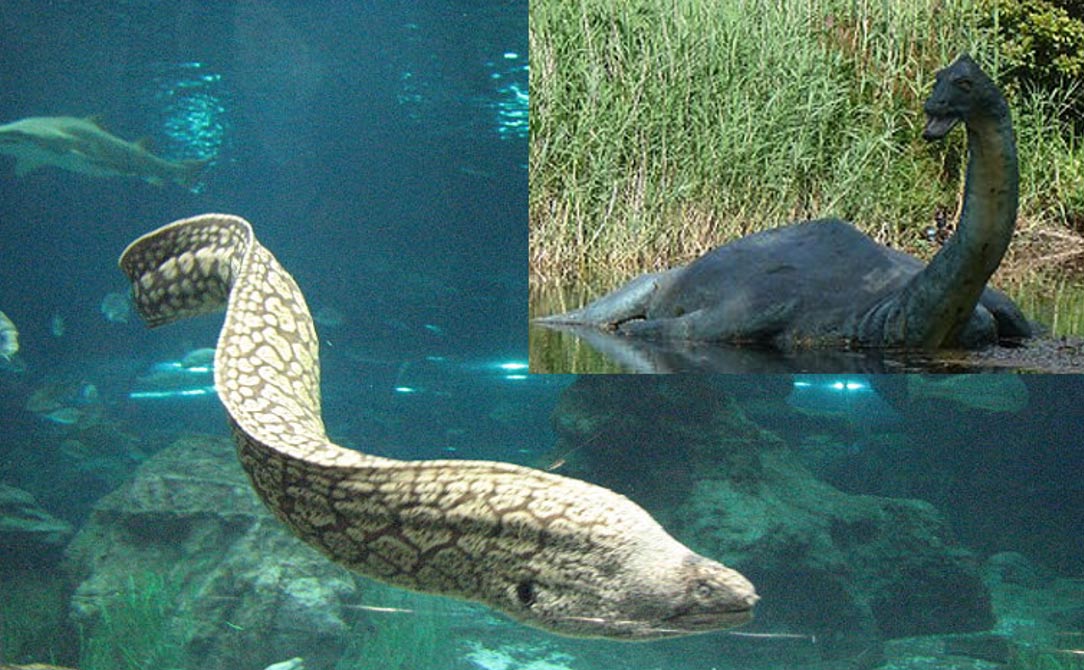
A European eel with some fish in an aquarium; most European eels grow to 23 to 31 inches (60 to 80 centimeters).

Could Nessie the Loch Ness Monster be a giant, 15-foot Eel? (Probably not)

The Loch Ness Monster is again in the news, as a Scotsman says his 2007 footage probably was not of the famed sea monster, but actually shows a 10-15 foot (3- 4.5 meter) giant eel. This too is unlikely. There is only one type of eel in Loch Ness, and it grows at the very most to 5 feet (1.5 meters). There have been reports of 7- to 9-foot (2.1-2.7 meter) eels taken in Loch Ness, but these dimensions seem to defy science.


Loch Ness is long at 22.5 miles (32 kilometers) and deep at 755 feet (230 meters), so many people who’ve claimed to have sighted the monster have said it has plenty of places to hide. Loch Ness contains more fresh water than all the lakes and in England and Wales combined.
A view from the shores of Loch Ness, looking south
A view from the shores of Loch Ness, looking south. (Public Domain)

The Scottish press is reporting that the mystery of the latest footage of Nessie, from 2007, has been solved. The Scotsman writes:
“The man who filmed some of the most famous footage of Nessie has admitted it could have been a giant eel. Gordon Holmes, who filmed jet-black shapes moving in Loch Ness from the roadside in 2007, agrees a U.S. computer expert who analyzed the footage has likely solved the mystery. Mr. Holmes, of Shipley, in West Yorkshire, now believes the creatures are eels between 10ft and 15ft long. The retired university technician has visited Loch Ness six times in the past. His two-minute video, shot from a layby on the A82, showed a long black shape moving just under the surface of the water. It made headlines around the world, but many expressed doubt.”
But this too has to be taken with a grain of salt. The largest eels are moray eels that grow to 10 to 12 feet (2 to 3 meters). And moray eels are not freshwater fish. They live in the ocean. There is a type of eel that grows in Loch Ness—the European eel or Anguilla anguilla that grows to, at the utmost, 5 feet or 1.5 meters. However, it is usually much shorter than that, about half the size.


Bill Appleton, owner of a software company in the United States, stabilized the footage of the “eel” and sent it to a paranormal website. Holmes says the stabilized video proves he saw a giant eel.


The Press and Journal reported Holmes as saying: “After several estimations, I believe the creatures were approximately 12ft [3.7 meters] long. Since eels do appear strange, ancient, scary-like beasties that may explain several of the Loch Ness sightings over the centuries.”


Some people truly believe a monster inhabits Loch Ness in the Scottish Highlands. Popular interest and belief in the animal's existence has varied since it was first reported in 1933 and made famous by a photograph supposedly taken by Robert Kenneth Wilson in 1934, depicted below.
Photo of the ‘Loch Ness monster’ taken by Robert Wilson.
Photo of the ‘Loch Ness monster’ taken by Robert Wilson. (Fortean Pictures Library)


Evidence of its existence is anecdotal, with minimal and much-disputed photographic material and sonar readings. The most common speculation among believers is that the creature represents a line of long-surviving plesiosaurs, a Mesozoic marine reptile.

However, the scientific community regards the Loch Ness Monster, affectionately known as ‘Nessie’, as a modern-day myth, and often explains sightings as misidentifications of more mundane objects, outright hoaxes, and wishful thinking.
‘Loch Ness Monster, Seasnake, Seamonster, Seeschlange, Meeresungeheuer.’ By Hugo Heikenwaelder.
‘Loch Ness Monster, Seasnake, Seamonster, Seeschlange, Meeresungeheuer.’ By Hugo Heikenwaelder. (CC BY SA 2.5)

Featured image: A European eel with some fish in an aquarium; most European eels grow to 23 to 31 inches (60 to 80 centimeters). (CC BY SA 3.0) Insert: A representation of Nessie at the Loch Ness Exhibition Centre in Drumnadrochit. (Public Domain)

By: Mark Miller

Idiots Obviously CANNOT Read...hence their being idiots...right.


A little aside before we get back to REAL things.


The moron who called me a jerk looking to find fakery in everything that Ghost Adventures does really ought to read my posts....I take it he can read because his spelling is awful.

He might do well to get in touch with the other jerk who mocks my credibility at having believed that the original Ghost Adventures documentary was real.  "Call yourself a paranormal investigator!"

Again, moron: R E A D my posts.  And, I have never claimed to be a "paranormal investigator" -I have investigated many things and neither do I call myself a "cryptozoologist" a "Ufologist" or any other fake "ology".

I am a scientific investigator. 

I was a wildlife consultant to UK and non-UK police forces on exotic fauna from 1977-2007 and did a lot more -IF you can work it out look at the "ABOUT" bit at the top of the page.

I know what this is all in aid of.  I've come across it more than a few times.  If you express an opinion based on provable fact and if your blog is getting a lot of views what happens is that "Tommy Envy" starts stamping his foot and hates it.  But then, as with these two idiots, the thought of starting an internet argument occurs to them -it might boost their own blog views.

Tough.

I have a policy of deleting offensive, name calling comments because the people making them obviously were not very well educated.

Yah-boo-sucks.

NASA's Kepler Comes Roaring Back

NASA's Kepler Comes Roaring Back with 100 New Exoplanet Finds


Artist's Illustration of Kepler Spacecraft
The artist's illustration shows NASA's planet-hunting Kepler spacecraft operating in its second-chance K2 mission.
Credit: NASA Ames/JPL-Caltech/T Pyle


KISSIMMEE, Fla. —
NASA's Kepler spacecraft has bounced back nicely from the malfunction that ended its original exoplanet hunt more than two years ago.

Kepler has now discovered more than 100 confirmed alien planets during its second-chance K2 mission, researchers announced today (Jan. 5) here at the 227th Meeting of the American Astronomical Society (AAS).

The $600 million Kepler mission launched in March 2009, tasked with determining how commonly Earth-like planets occur throughout the Milky Way galaxy. Kepler has been incredibly successful, finding more than 1,000 alien worlds to date, more than half of all exoplanets ever discovered.

The first five K2 campaigns, which each looked at a different part of the sky, "have produced over 100 validated planets," Ian Crossfield, an astronomer at University of Arizona, said today during a presentation at the AAS meeting. "This is a validation of the whole K2 program's ability to find large numbers of true, bona fide planets."

Crossfield said that Kepler observed more than 60,000 stars and found 7,000 transitlike signals during the first five 80-day observation campaigns. A validation process whittled some of these signals down to planet candidates, and then finally to validated planets, each of which has just a 1 percent chance of being a false positive, Crossfield added.

He also noted that K2 found more false positives among larger planets than small ones, and that more than half of the false positives were in multiplanet systems.

While planning K2, Kepler principal investigator Bill Borucki, who retired this past July after a 53-year NASA career, said the new mission could find "dozens, or maybe even hundreds" of exoplanets. Now, K2 has racked up more than 100, and lots of exciting extrasolar systems will likely be spotted in the future, Crossfield said.

"We're only a quarter or so of the way done, we hope," he said.

Email Sarah Lewin at slewin@space.com or follow her @SarahExplains. Follow us @Spacedotcom, Facebook and Google+. Originally published on Space.com.


Thursday, 7 January 2016

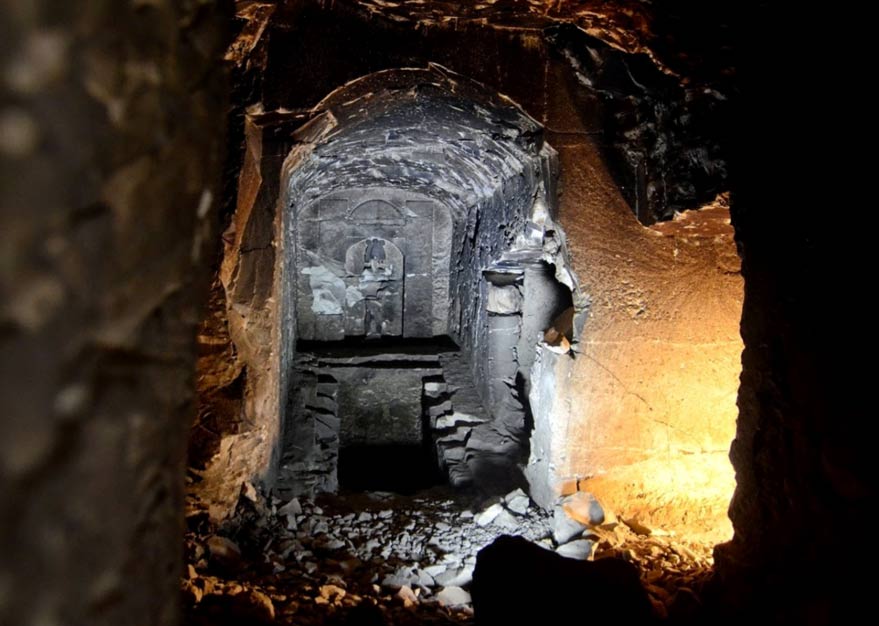
Believe It Or Not: Archeologists discover Mythical Tomb of Osiris, God of the Dead, in Egypt

Inside the replica of the tomb dedicated to the god Osiris

Archeologists discover Mythical Tomb of Osiris, God of the Dead, in Egypt

A Spanish-Italian archaeological team, in cooperation with the Egyptian Ministry of Antiquities, has made an incredible discovery in the necropolis of Sheikh Abd el-Qurna, on the West Bank at Thebes, Egypt – an enormous ancient reproduction of the mythical Tomb of Osiris as described by Egyptian legend, complete with multiple shafts and chambers. Inside the tomb complex, researchers found a carving of Osiris and a room with a wall relief depicting a demon holding knives.

Entrance to the funerary complex of Osiris
Entrance to the funerary complex of Osiris. Photo credit: MinProject (Archaeological Mission Canaria-Toscana).


According to the Spanish news agency EFE, the tomb embodies all the features of the tomb of Osiris, as told in ancient Egyptian legends, and is a smaller version of the design of the Osireion, built under Egyptian pharaoh Seti I  in the city of Abydos, Luxor.  Researchers believe the tomb complex dates back to the 25th dynasty (760 - 656 BC) or 26th dynasty (672 - 525 BC), based on a comparison to similar tombs that contain Osirian elements.

The complex consists of a large hall supported by five pillars. RTVE describes the structure as having a staircase from the north wall of the main room, leading down to the funerary complex, where there is a carving of Osiris, god of the dead, in the middle of a central vaulted temple.

To the west of the central temple is a funerary room with the reliefs of demons holding knives. The leader of the Spanish-Italian team that uncovered the tomb, Dr. María Milagros Álvarez Sosa, told EFE that the demons are there to protect the body of the deceased.

Opposite the statue of Osiris is a staircase with a 29.5 foot (9 meter) shaft leading to another chamber. Inside this chamber is a second shaft that descends 19.6 feet (6 meters) into two more rooms, which are currently full of debris.

“The symbolism of Osiris is very evident here, since all the elements recalling the mythical Osiris tomb are present,” writes Luxor Times Magazine, “a big staircase of 3.5 meter long with a 4 meter high ceiling at the bottom leading to the Netherworld and another one leading directly to the Osiris statue, which is therefore at a higher level and ideally isolated on ‘his island’; the Osiris statue itself; the empty corridor surrounding it which symbolizes the channel of water (see Osireion in Abydos); the expected burial chamber below the statue, thus identifying the deceased with Osiris.”
Sketch showing the outline of the tomb of Osiris
Sketch showing the outline of the tomb of Osiris. Drawing of the tomb's architecture made by Raffaella Carrera, MinProject (Archaeological Mission Canaria-Toscana).


Part of the tomb was initially discovered by archaeologist Philippe Virey in the 1880s and some attempts were made to sketch out the main structure in the 20th century. However, it was not until recently that the full extent of the structure was discovered through excavations. The funerary complex will continue to be explored and the chambers cleared of debris in the Autumn of this year.

Alvarez Sosa told EFE that the tomb is of "great importance" because “the burial chambers contain dead who slept their eternal sleep under the god of the dead, Osiris".

According to Egyptian mythology, Osiris, god of the underworld, was killed by Set, god of storms, disorder and violence, who shut Osiris in a coffin and threw it in the Nile river. After his body was recovered by Isis, Set tore his body into pieces and threw them back into the river. Isis collected all the pieces and bandaged the body together. This form of Osiris traveled to the underworld in a boat and became god of the dead.

The only body part Isis could not locate was the phallus, as it had been eaten by catfish.  Isis created a golden phallus and briefly brought Osiris back to life with a spell, which gave her enough time to become pregnant by Osiris before he returned to death. Isis later gave birth to Horus, who became seen as a representation of new beginnings and the destroyer of the evil Set.

Featured image: Inside the replica of the tomb dedicated to the god Osiris. Photo credit: MinProject (Archaeological Mission Canaria-Toscana).

By April Holloway

New species of human

Darren you were right.  No idea why but the original posting DID vanish!!

_____________________________________________________________________
"I told you so...."

17 December 2015

New species of human may have shared our caves – and beds

 New species of human may have shared our caves – and beds
As fire light flickered on the back of the cave, a group of people ate deer, porcupine and otter. Then a man solemnly took a large bone off the fire, broke it in half and sucked the bone marrow out. He then carefully painted the broken bone with red clay and buried it in the cave.

He observed this ritual because this bone belonged to another human species. One they shared not only the forest with, but also their beds.

This is the remarkable – though so far tentative – picture emerging from controversial discoveries from two caves in south-west China. If true, some think it could overturn our understanding of what it means to be human.

Among the discoveries appears to be a primitive human species, which most closely resembles the earliest human species, Homo habilis and Homo erectus.

But while these lived about 2 million years ago, this new species lived just 14,000 years ago, says Darren Curnoe of the University of New South Wales in Sydney, Australia, who lead the team behind the discoveries. This would make it the most recent human species to have gone extinct.

“If true, this would be rather spectacular and it would make the finds of truly global importance,” says Michael Petraglia at the University of Oxford, who wasn’t involved in the discoveries.

The work is excellent, he says, but is likely to leave many in the field unconvinced.

more plus map etc at: https://www.newscientist.com/article/dn28687-new-species-of-human-may-have-shared-our-caves-and-beds/

Wednesday, 6 January 2016

NASA Image Of Universe -ALL In One Image??

http://www.nasa.gov/images/content/630303main_pia15481c-full_full.jpg


Nasa releases images of entire universe – and we're over the moon

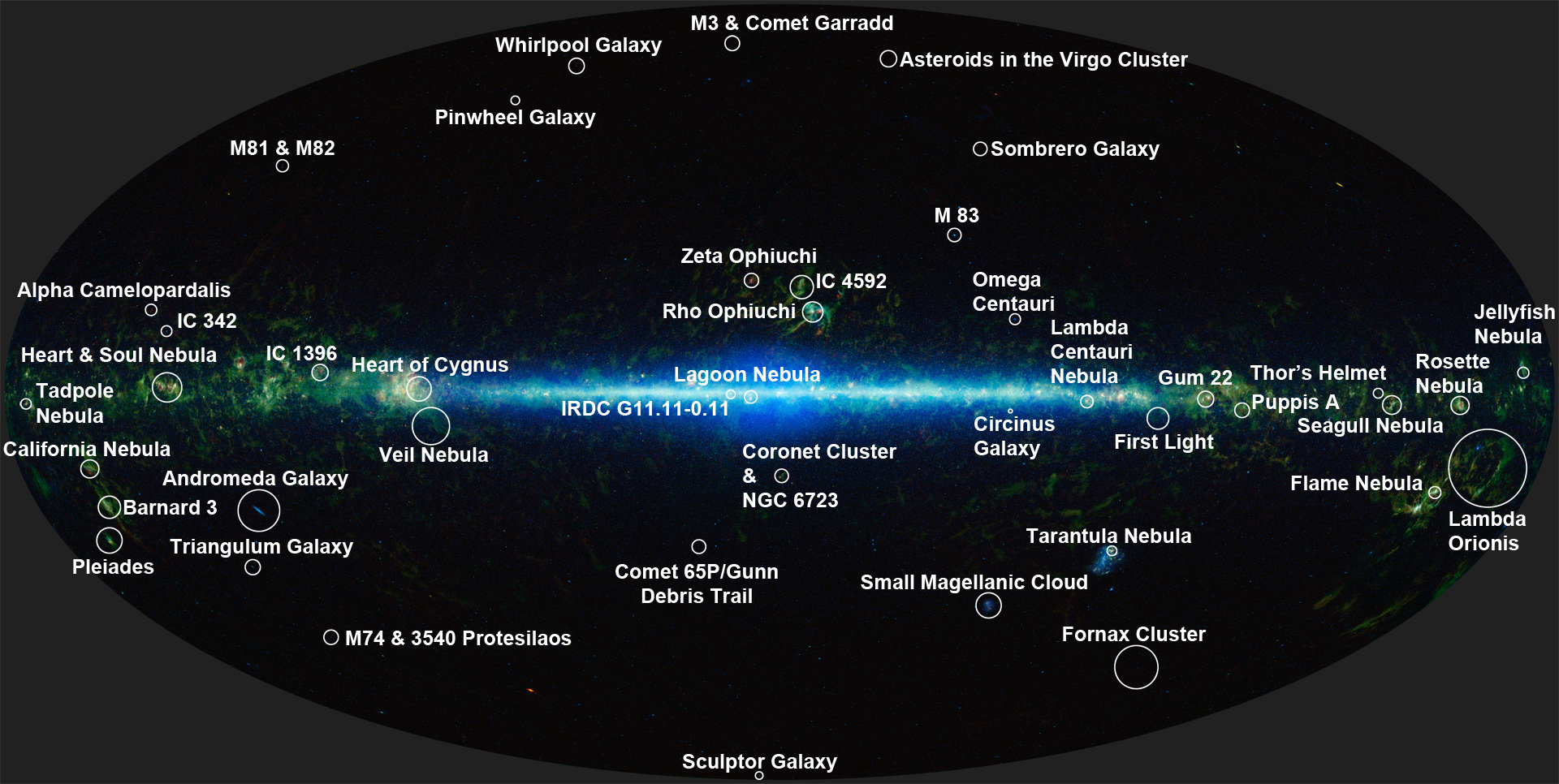
Image from Nasa is a mosaic of images covering the entire sky as observed by the Wide-field Infrared Survey Explorer 
 
 
The Fermi paradox, named for the physicist Enrico Fermi, goes something like this: given how big and old the universe apparently is, there is bound to be alien life out there somewhere. But given that the universe is so big and so old, if there's alien life out there, why haven't we earthlings encountered it yet? The experiment certainly has run its course for long enough now.

The paradox may play in the mind of anyone who catches an astounding image released this week by Nasa of … the entire universe. The full-size image (and what warrants full size as much as an image of the universe?) is here.

The image is actually a mosaic of the images covering the entire sky as observed by the Wide-field Infrared Survey Explorer (Wise). Wies is an unmanned satellite carrying an infrared-sensitive telescope. As with a flat map of the Earth's surface, the right and left edges of this oval shape are the same location in the sky. The bright belt is the Milky Way galaxy. Nasa explains:
The Milky Way is shaped like a disc and the solar system is located in that disc about two-thirds of the way out from the centre. So we see the Milky Way as a band running through the sky. As we look toward the centre of the Galaxy we are looking through more of the disc than when we are looking at large angles away from the centre, and you can see a noticeable increase in stars (coloured blue-green) toward the centre of the image … Residuals of the planets Saturn, Mars, and Jupiter are visible in this image as bright red spots off the plane of the galaxy at the 1.00, 2.00 and 7.00 positions, respectively.
The Space Sciences Laboratory at Berkeley has helpfully labeled some of the heavenly bodies visible in the image. Our favorites include Andromeda Galaxy, The Pleiades, Sombrero Galaxy, Heart and Soul Nebula and, of course, the Fornax Cluster. Just look at that up there. Look at that.

Looking For Aliens? Astronomers Unveil New Technique To Measure Pull Of Gravity

Damn but looking for alien civilizations is getting personal.  Now scientists are trying to work how obese aliens on a planet might be.....I think I got that right?

 |  By


Discovering Alien Life May Be Possible As Astronomers Unveil New Technique To Measure Pull Of Gravity

 
Astronomers have discovered a new technique to measure the pull of gravity, which could help us find alien life.

According to a team from the University of Vienna, this latest advance helps scientists better determine whether distant stars could be harbouring life.

"If you don't know the star, you don't know the planet," said study co-author, Professor Jaymie Matthews.
kepler telescope


"The size of an exoplanet is measured relative to the size of its parent star.


"If you find a planet around a star that you think is Sun-like but is actually a giant, you may have fooled yourself into thinking you've found a habitable Earth-sized world.

"Our technique can tell you how big and bright is the star, and if a planet around it is the right size and temperature to have water oceans, and maybe life."

What they are essentially measuring is the surface gravity of a star - an indication of how much you would weigh on that star.

The technique has been dubbed, "auto correlation function timescale technique” and it uses subtle variations in the brightness of distant stars recorded by satellites like Canada's MOST and NASA's Kepler missions.

By understanding the nature of other stars, we might be able to "find other planets like our Earth,” explained lead author Thomas Kallinger from University of Vienna.