The whole British Bigfoot situation is a con as well as down to very susceptable minds.
I have a very big library -ghosts, crypto, Fortean, UFOs and so on. In absolutely none of those is there reference to a large hairy humanoid (often cited is a "ghost case" where "cavemen" were seen around a fire. Woodwose are interesting but if there was anything they became extinct pre-12th century.
For my other work I have a BIG wildlife library with books and references going back to Medieval times. Books on hunting. On quadrupeds and other species even "oddity" reports but not one single mention of anyone ever reporting a "Bigfoot".
I spoke to many dubious people for my EAR work as well as l;and owners/estate managers, game keepers and they would tell me about ghosts as well as big cats and some of these people were born and raised in "active British Bigfoot areas" and guess what? Never a single word about a giant hairy man.
I think many sightings are due to altered states, misidentifications -some "hairy menm" turn out to be people in gillie suits. Others are fantasists.
I once offered to look at evidence gathered since I am what people keep calling a "noted naturalist" and these people were stating experts would not study the evidence. My offer had me slandered on one of the groups and members were told NOT to share anything with me. The group owner later apologised but would not tell her members she was wrong and it was okay to share so....
Then there was a fella told me to check out his "unchallengable"evidence on You Tube. A "tree knocking stick". It turns out that it was a stick found in the middle of a forest. "How did it get there?" I was challenged. Just search this blog for British Bigfoot.
It was a stick in the middle of woodland. It broke off a tree but "why was there no other sticks that size in the spot?" I was asked. Someone could have just picked it up for a dog or any reason.
It was a stick in the middle of the forest.
The response came back (in his mind I imagined the 1812 overture playing at full volume and a massive fireworks display going on) "You lose the argument. You cannot explain it!!!" and he then went into cheering himself for beating the debunker (but not with a stick found in the middle of a forest).
US TV shows and You Tube suddenly created the abductyion craze in the UK and everyone who watch "UFO Hunters" got their black urban combat gear and were Ufologists.
Then the US paranormal shows flooded You Tube and demonic possession, haunted houses, hell holes/gateways to Hell were in every British property. Everyone bought their urban combat (black of course) combat gear and became ghost hunters or paranormal experts.
In both of those genres made up, fabricated, lies were intreoduced as facts and "always having been recorded". None of it was. You Tube is not a training service.
Then, of course, US TV shows got into monsters and Bigfoot and then, suddenly, the UK was having Bigfoot sighted everywhere and "there have always been reports" -NO there have not. My late friends and I looked into every single thing that was odd or weird to look into it and get evidence or disprove it.
NEVER EVER a single British Bigfoot which, like the Owlman and other "cryptids" you can trace the origins back to and friends of a certain disreputable Fortean group. Lies are publicity and cash.
I can at least claim to have observed a mysterious primate in forestry with four other people present....but that was in Germany.
Big cats: The hunt for the puma caught roaming the Highlands in 1980
She was the ‘wild’ puma who became a celebrity after being captured in the Highlands 40 years ago.
She was the ‘wild’ puma who became a celebrity after being captured in the Highlands 40 years ago.
Felicity, as she came to be named, had been roaming the countryside in Cannich before being caught two years after farmers in the area started reporting a spate of attacks on their sheep.
There had been mystery animal sightings in the Highlands going back to 1927 when a lynx nicknamed the ‘Tiger of the North’ was caught in a trap set by a farmer after sheep and goats were attacked in the wild mountain districts of Inverness-shire.
Ted Noble
It was reported in 1977 that a man and his nephew at Farr, 10 miles from Inverness, “saw a lioness and two cubs” in a field and the next day a similar sighting was recorded at Culduthel.
However, matters came to a head in October 1980 after farmer Ted Noble took matters into his own hands following a continued unexplained loss of livestock for over a year.
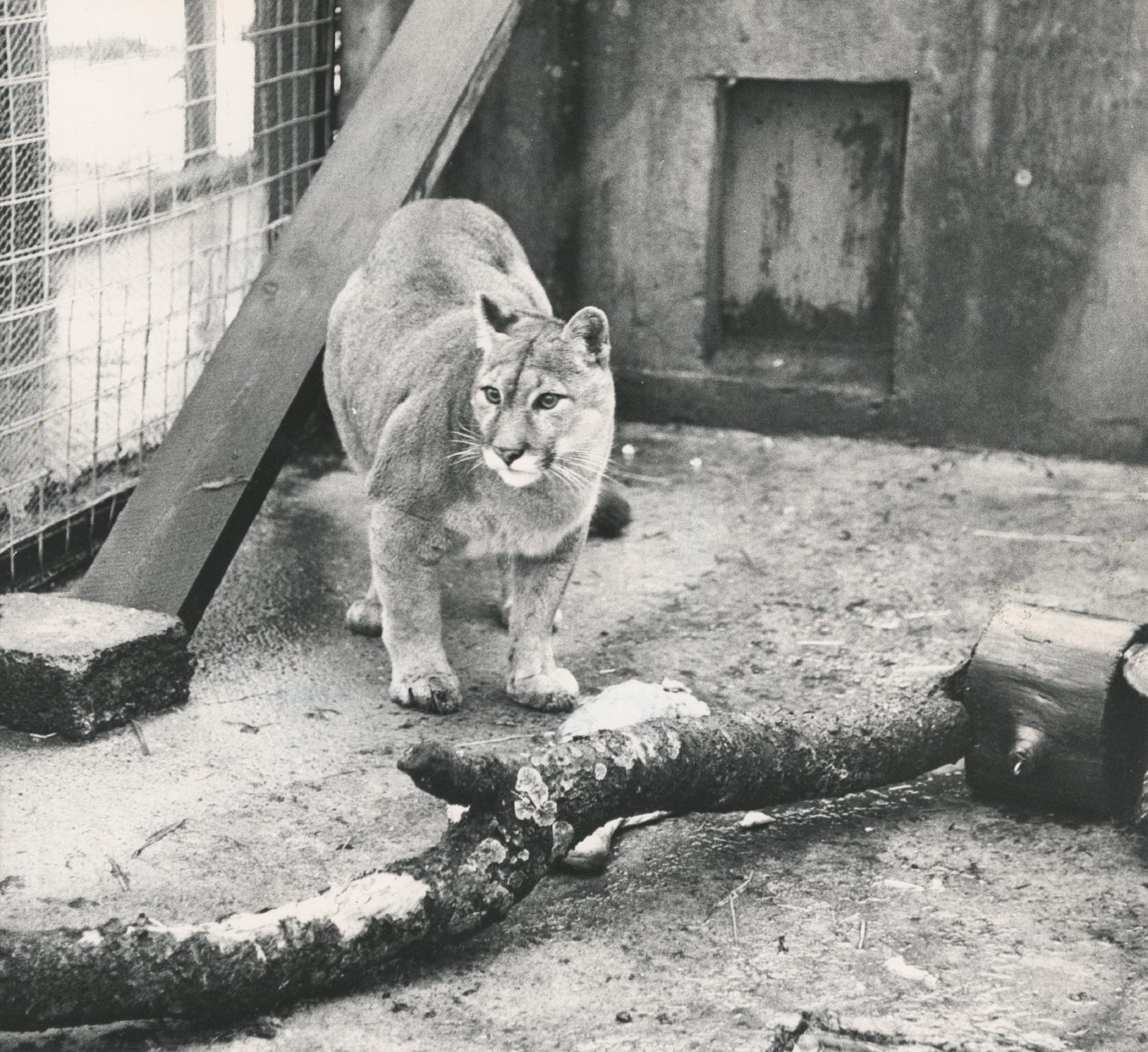
Felicity the puma.
Ted saw what he described as a “lioness or similar member of the big cat family” stalking ponies at his farm near Cannich.
Police searched in vain for the ‘lioness’ with the help of big-game expert Eric Stephens who said a lion could easily be living in the area where there were sheep, horses and deer because there was plenty of food and plenty of cover.
Ted continued to find the carcasses of farm animals, mainly sheep, mutilated and with their bones crushed.
The mystery beast had been sighted a number of times by other local people and eventually he decided to set a trap after becoming frustrated by police reluctance to make a further search.
Last laugh
The animal was enticed to a cage by a sheep’s head dangling from a rope at the entrance to the trap.
The captured puma made national news with one headline proclaiming: ‘Grrr-eat Scot! Farmer Ted Catches the Loch Ness Lion!’
“People were beginning to think I was nuts the way I was so obsessed with capturing this animal,” said Ted.
“But I have had the last laugh.
“I am pleased to have caught it but I am sad to have deprived it of a grand life.
“However, it was a destructive animal having killed sheep and ponies in the area and I had to end its freedom.”
Kincraig Highlind Wildlife Park director Mr Eddie Orbell and retired Detective Sergeant John Cathcart of Inverness.
Ted was aided in his successful trapping operation by Ian Graham, a senior inspector for the Scottish Society for the Protection of Cruelty to Animals, and by Janet Chisolm, a neighbouring farmer of nearby Tomich.
He also had advice on the correct methods to use from a retired Colonel who, in his younger days, had been a big game hunter in Africa.
The director of the Highland Wildlife Park at Kincraig, Eddie Orbell, confirmed the animal was a puma but his conclusion was that the big cat seemed too tame and too well fed to have been living wild.
He believed Felicity had been hand-reared as a cub and had been kept as a pet.
The origin of the puma was unclear but she even allowed experts who examined her to pet her behind her ears.
Overweight
Grantown vet George Rafferty undertook a close examination of Felicity after she was given treatment for a paw complaint.
“I was very surprised to find that the animal weighed 36 kilos – approximately 80lbs,” he said.
“This is definitely overweight for a female puma.
“I examined its teeth and found it has some incisors missing at the front, which is not unusual for an animal of its age.
“Its teeth are in remarkably good condition, although yellow with age. There is no tarter on them which suggests it has been living on a natural diet, as opposed to processed food.
“It has certainly spent most of its life in captivity.
“If it has been living rough I do not think it has been doing so for very long because of its bodily condition.
“There is also no doubt it has been used to contact with humans and is very well behaved.
“It loves to have its ears tickled and comes straight over to the bars of its cage when you approach.
“In fact we had great difficulty persuading it to go far enough away from us to fire a tranquiliser dart into it without doing any damage.”
Hoax
People soon began talking about a hoax and it was reported soon after Felicity’s capture that some eyewitnesses had seen a puma in a cage being driven around the area in a pick-up truck, although this could have been prior to the animal’s release.
Ted denied there had been a hoax and he was supported by Bob High from the Farmers’ Union who said that many farmers in the eastern Highlands had seen the animal, or lost livestock to it, but were afraid to speak out in case they were ridiculed.
Additional support came from Dr Hans Kruuk from the Institute of Terrestrial Ecology at Banchory, who analysed her faeces in the first hours of captivity which showed that Felicity had recently fed on deer, rabbit and sheep, suggesting that despite her advanced age and tameness she had indeed been hunting and surviving independently in the wild for some time.
The big cat sightings and livestock losses continued following Felicity’s capture and later a man wrote to Ted from a prison cell in England, confessing that he had liberated several big cats in the Glen Affric area after driving them up from south of the Border.
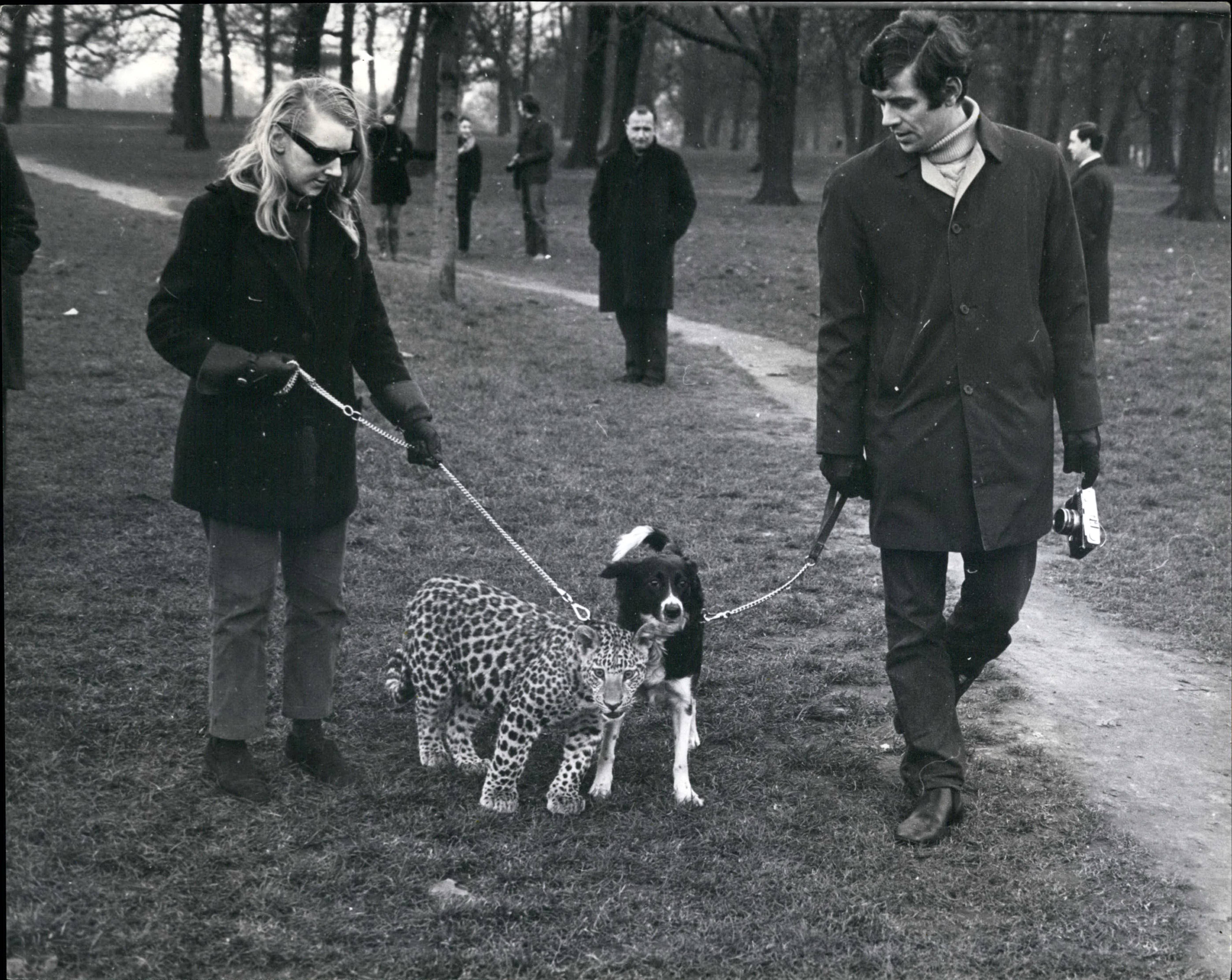
During the 1960s and 1970s it was perfectly legal in the UK to keep exotic animals as household pets, which ranged from leopards, pumas and panthers, to crocodiles and poisonous snakes.
Angela McWilliams, a 23 year old part-time secretary of Kensington, was often seen taking Michael, her pet leopard, for a walk in Kensington Gardens in 1967.
In 1976 the UK Government introduced tougher new licensing rules over the keeping of wild animals without a licence.
Given the choice of acquiring a costly licence or relinquishing their pets to animal sanctuaries, rumours started that some owners chose a third option, which was sending cats out into the wild.
Further twist
The great Highland puma puzzle took a further twist three weeks after the capture as scientists in Banchory revealed strong evidence of another mountain lion on the loose.
Special tests carried out on two sheep mauled on Garve farms in Ross-shire found they were killed either by a puma or some other big cat.
Felicity was a top tourist draw for the next four years at the Highland Wildlife Park, Kincraig, near Aviemore, until she died in February 1985.
After Felicity’s death, the puma was preserved by a taxidermist, and since then has been a prime exhibit at Inverness Museum.
‘Mystery predator’ at large prompted police investigation
Felicity the puma is often cited as evidence that there are non-native cats at large in the UK.
Sightings of big cats or photographs taken at a distance have fuelled theories about their presence for decades.
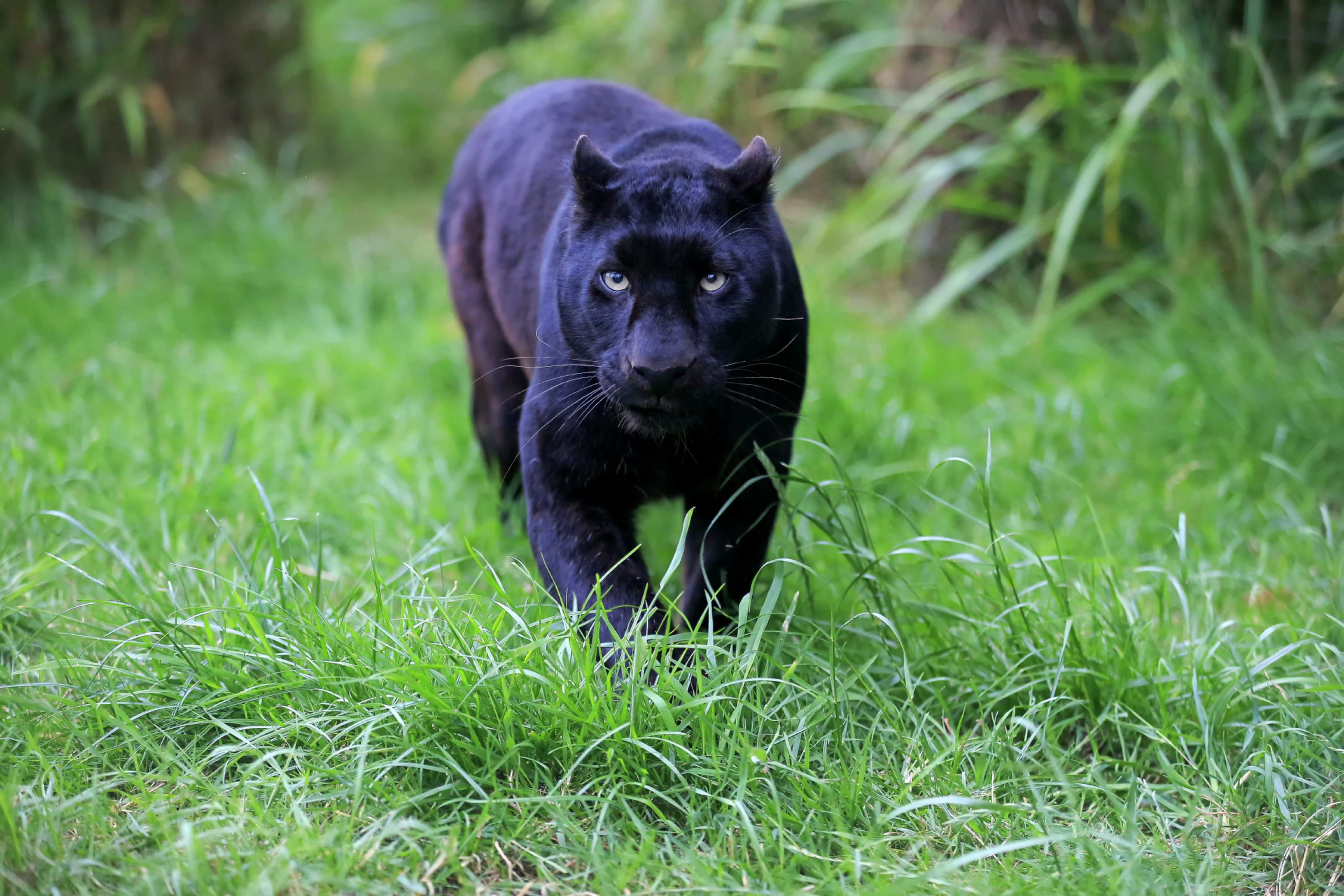
A black panther.
Police and government scientists worked together to try to identify a “mystery predator” that appeared to be at large in the far north.
Correspondence from the past two years between Police Scotland, Science and Advice for Scottish Agriculture (SASA) and other government-funded agencies was released after a freedom of information request.
Injured sheep
A police officer, whose name and title have been redacted, wrote to SASA in November 2018 asking for help in identifying a large paw print.
They wrote: “I’ve had lots of reports over the past three years of big cat sightings and activity on the north coast, mainly in the Bettyhill area of Sutherland.
“There have been sightings of a large feline and a lot of dead or injured sheep.
“On one occasion I was present when a ewe was brought in off the hill with two puncture marks on the front of her right shoulder and two at the back of it.
“The wounds were over three inches apart, while some of the recent carcasses have very large puncture marks.”
The officer conceded that it was a “very controversial topic” but added: “Some crofters say there have always been very big feral cats in this area. I’m told there is a photograph of one shot, years ago, which was over four feet long.
“We definitely have a wild cat population as well; I’ve seen one myself. We don’t have many domestic cats in the area; there is a very sparse human population and miles of unoccupied land.”
The officer sent images of a paw print and one of a “recent kill”, writing: “The carcass was stripped clean, down to the spine/skull.”
The response from the SASA was inconclusive. They replied: “I’m not sure about the footprint. It does look a bit like a feline print but is also reminiscent of a fox or a dog.”
One name is missing from this piece: Arthur Cadman. A veteran naturalist who I was corresponding with in the 1970s/1980s prior to his death. He had been studying a "family" of pumas and had even predicted that due to her age "Felicity" was likely to get trapped as she went for easier game.
This is WHY animals were still being killed after her capture and that capture was, obviously, not a set up/hoax.
When I contacted Ted Noble he was polite but I think the claims of a hoax made him less forthcoming. Ted suggested contacting Janet Chisolm who I corresponded with and was handling all the enquiries. Noble was afarmer and had no time for all the messing around.
I even spoke Ms Chisholm and she confirmed that she had also observed the pumas (plural) and had also made paintings of them and had a 10(?) page account she had written. I was told that I could get a copy of her account -for £10...later £15 and back then that was a lot of money compared to today and as she would not tell me anything about "the story" she had written I had no intention of paying out that much money especially when a journalist from The Scotsman told me "It reads like a childrens story."
There is a lot of evidence for puma still being in the Highlands but further away from farms and where there is plenty of wild game.
We have seen Arthur Cadman pass away and I was never able to find out what happened to all of his notes -and photographs. There were others such as the rev Gwilliam Williams in Wales and all of these people were not high profile newspaper publicity seekers but naturalists.
All of the old contempories of mine have gone. So to have people such as Nigel Brierley, Trevor Beer and Danny Kingdom who I was discussing a cat project with before his tragic death.
Thereare the senationalists and fantasy prone people out there but from all of the naturalists who began studying large cats in the 1970s I appear to be the last survivor. And my Red Paper: Felids will NEVER be published while the official stance of bodies such as DEFRA is to kill all 'non native species' as 'invasives'.
I was reminded today of a time that I was being interviewed by the BBC (before I blacklisted them in 1997) for a Radio 4 programme. We had briefly covered my work with exotics in the UK and there was an element of frustration from the BBC reporter that I would not discuss the work I did with UK police forces. I had explained that I was on the Partners Against Wildlife Crime list of experts and that I was also covered by the then Public Records Act (is that still a thing?). I advised forces and forces had observers contact me and so there was back and forth and like the police I treated people I spoke to in the greatest confidentiality -in fact in some cases it was the only way to get them to tell me what they saw and not fear ridicule or their name all over newspapers. I would not betray that confidence or today.
The BBC reporter was looking through notes and then seemed to have an idea: "How about telling us what animals have influenced you and your work?" There was a smile as the poor reporter expected something good.
I spoke for 30 minutes on jackals and hyenas. All the time the reporter was making notes and seemed as though on the verge of a breakthrough. "We have those in the UK -you've had reports come in?" Although I had explained everything the reporter's ears were selective in what they heard.
I had once had to travel across Bristol, after a snow storm disrupted roads, to get to BBC Whiteladies Road studio to be interviewed by a radio 5 reporter. A two hour journey there and another two hours home after an hour long interview. Altogether 55 minutes had been recorded. I waited for the segment on the radio days later. One minute. Five hours of my life wasted and never compensated as promised for a just about 1 minute sound bite. That could have been done over the phone.
Franklyn A Davin-Wilson c 1977 (c)2025 T. Hooper
When it comes to the question of "Why jackals?" the answer is simple.Around 1977 I was at a meeting of the British Flying Saucer Bureau in Bristol. I was invited by an astronomer who only informed me just before that he would not attend "You do your stuff" he told me...I still have no idea what my "stuff" was. Anyway, I was approached by a short man with rather odd clothing and a flattened "Russian Diplomat" style hat: Franklyn Angus Davin-Wilson He smiled at me and said "Your new here, aren't you?" As he held out his hand his smiled showed two long vampire fangs. He was rather disappointed at my reaction -people were usually either taken aback jumped back. I learnt that the teeth were actually from a dead fox and a dentist friend had made a false set of teeth for him to wear. He smiled again and told me that he liked the lack of panic "I think we are going to be friends" he told me.
During our following conversation he learnt of my interest in wildlife. As it happened he was also a very keen naturalist and I later inherited his collection of 19th century books on lepidoptera, arachnids and beetles. He asked what I thought about the "Vampire sheep slayer of Badminton" to which my response was that I had never heard of vampire sheep before; "Yes, they never thought that title through" was his response. The killing of sheep and draining of blood from their bodies had been reported on by Charles Hoy Fort (after who the "Forteans" name themselves). Fort had an habit of misreporting or even giving sources that contained none of what he included in his books. I have dealt with these incidents in both the 2010 and updated 2022 Red Paper Canids.
It took a few years of trawling through old newspapers at the Bristol Central Library before I had amassed a good amount of information on the case. It could be said that this was my first Jackal in the UK case.
Golden Jackal (c)2025 respective copyright owner
The Sevenoaks jackal was another (sadly, all of the cryptozoologists and Forteans who use my material never credit me). I had no idea at the time that for almost 50 years I would be studying jackals or that it would lead me to discovering why jackals were in the UK and the standard explanation was always that they had escaped travel;ling menageries (I leave out the brainless theory that they were somehow supernaturally transported here and then vanished).
Oddly, this led into my research on coyotes in the UK and wolves -again fully explained in my books even though at first I doubted what I had found as it was all in plain sight and easily findable but people had forgotten or preferred fantasy or dogma over fact. Incidentally, a lot of these 'mystery canid' reports come from the same areas where we get (historically to today) puma, lynx and panther reports: big hunting estates.
What about the hyena then? Again, late 1970s I was told about this mystery creature known as "The Beast of Gevaudan" that slaughtered live stock and people between 1764-1767 in France. Forteans and cryptozoologist had it marked down as a paranormal creature, a werewolf (I'm not joking), a Dire wolf -an extinct species of canine which was native to the Americas during the Late Pleistocene and Early Holocene epochs (125,000–10,000 years ago). Other Forteans seem to almost relish the theory that the 'beast' was a child sex killer (again, I am not joking) despite not all the victims being young or human.
There were certain t6hings in the accounts that as I read them struck a memory and the animal I had in mind was neither a "freak gigantic wolf" nor an extinct species. I was thinking of hyena. Today "copy and paste" is almost -it is- standard for people writing on these topics since they have no idea everything they need is in what someone wrote before them...and that writer probably also copied from someone else. No one seems to have looked at how the animal attacked and killed or the geography of the area.
Back in those days before the internet you wrote letters and it might take a week or two but you got responses. It takes a minute for an email to out out and no one responds now. But, as outlined in Mysterious and Strange Beasts, I received a reply and a paper published by a museum and it clearly identified the beast as a hyena. The fur was in storage up until (possibly) 1950s when it went "missing". The British press of the day even mocked the French over being messed about by a hyena.
A one off hyena killer. Well, uh, not really because there were other "beasts" in France at the time and some of those appear to have been hyena. Remnant population spreading out across a part of France or escapees breeding and living wild -that we cannot answer, However, after many decades I am still trying to find one last piece of evidence that may indicate that there was a population that eventually died off through inbreeding (I am currently trying to find a copy of that source).
hyena (c)2025 respective copyright owner
People think I am odd because I like hyena (or "hyenas" if you prefer). But I am still studying and researching hyena as I am jackals I have hefty files and one day I hope these may help promote further historical research as everything is referenced -sometimes with more than four reference sources.
That hyena and jackals crop up in my work on Old British foxes and even wild dogs should not be surprising. For many involved in Fortean or cryptozoology "it was a clearly identified dog" is not sensationalist or sexy enough to sell magazines or books. It always has to be "A previously unknown big cat"/ "Hyena"/ "Dire wolf"/ or "paraform (paranormal) creature".