Total Pageviews

Friday, 29 January 2016

Babylonians Used Geometry? So Where Do The Aliens Come In??

And once again we "Lost History" buffs sit back smugly.

Babylonians did this and not an alien in sight History Channel!
https://www.theguardian.com/science/2016/jan/28/babylonians-used-geometry-to-track-jupiter-1400-years-before-europeans?CMP=fb_a-science_b-gdnscience

Babylonians used geometry to track Jupiter 1400 years before Europeans

Astronomers discovered how to calculate Jupiter’s position with geometry between 350 and 50 BC, predating work of European scholars by 14 centuries
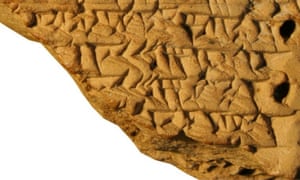
A fragment of one of the Babylonian tablets studied and which contains geometrical calculations.
A fragment of one of the Babylonian tablets studied and which contains geometrical calculations. Photograph: Mathieu Ossendrijver/British Museum
Babylonian astronomers calculated the position of Jupiter using geometry 1,400 years before the technique was previously believed to have been developed, according to an expert.

The finding, published in the journal Science, is based on analysis of ancient Babylonian tablets, believed to have been written between 350 and 50 BC.

They depict two intervals from when Jupiter first appears along the horizon, calculating the planet’s position at 60 and 120 days.

Previously, it was thought that Babylonian astronomers operated exclusively with arithmetical concepts, but the texts contain geometrical calculations based on a trapezoid’s area and its “long” and “short” sides, writes Mathieu Ossendrijver.

Ossendrijver, professor of history of ancient science at the Humboldt-Universität zu Berlin, says the ancient astronomers also computed the time when Jupiter covers half of the 60-day distance by partitioning the trapezoid into two smaller ones of equal area.

European scholars in Oxford and Paris were previously credited with developing such calculation in the 14th century, but Ossendrijver suggests they were far behind their ancient Babylonian counterparts.
“These computations predate the use of similar techniques by medieval European scholars by at least 14 centuries,” he writes.

Tuesday, 26 January 2016

Weird 'fish with legs'

 This 10-inch specimen, thought to be a type of frogfish, was found by Claudia Howse, Glenys Howse and James Beuvink while snorkeling in the Bay of Islands, New Zealand. It was sent to the Museum of New Zealand in Wellington for analysis, Jan. 19, 2016. (Photo: Glenys Howse)

If you read my books you would know why a "fish with legs" stirs up memories of Canvey Island, UK, Kilwa, Tanzania and other reports of Dead Aquatic 'Humanoid' Creatures!

Weird 'fish with legs' found by New Zealand snorkelers puzzles scientists


 http://www.chron.com/news/strange-weird/article/Weird-fish-with-legs-found-by-New-Zealand-6769410.php


An odd specimen found recently by snorkelers in New Zealand is being studied by experts to determine what it is.

The black creature, about 10 inches long, looks something like a fish with legs but also bears some resemblance to either a bird or a bat.

It was found by family members Claudia Howse, Glenys Howse and James Beuvink as they were snorkeling close to shore in New Zealand's Bay of Islands, according to the Museum of New Zealand Te Papa Tongarewa in Wellington.


Glenys Howse took a photo of the fish and sent it to the museum to ask for identification, spokeswoman Rebecca Edwards said by email Tuesday afternoon (Wednesday morning in New Zealand).

"This weird creature is likely to be a species of Frogfish, but we won't know until we have a chance to examine it closely!" the museum said Friday on its Facebook page. "Frogfishes have the fastest bite of any vertebrate. Their mouths expand at the speed approaching a .22 rifle bullet - and that's in a medium 800 (times) denser than air."

Andrew Stewart, the museum's fish expert, said by email that he would be thawing the specimen later in the day and would have an identification after examining the head.

The fish was found in about two meters (about six feet) of water close to shore on the northeast coast of North Island in the Bay of Islands.

Unbeknownst to the snorkelers, it was included in some kelp that was collected and put into the live bait well at the back of the boat.

"It was very alive when found but, sadly, it died before it could be re-housed in the Aquarium at Auckland (Kelly Tarlton's Underwater World), so it will now 'live on' as a scientific specimen in the National Fishes Collection held here at the Museum of New Zealand," Stewart's email said.


I'm surprised that they need to puzzle over this as it clearly looks like a Black Frogfish. There are different species of frogfish but you can find out more about this type and why it might cause a bit of confusion here:http://www.wildsingapore.com/wildfacts/vertebrates/fish/antennariidae/black.htm

 Sisters Island, Aug 07

Monday, 25 January 2016

The Fox In The Tree

Now, for many decades I've specialised in felids and canids. Canids, particularly foxes, have taken up most of my time.  1977-2007 I was a UK police forces advisor of exotic fauna but also, inevitably, canids in some cases.

So, when I tell someone that foxes have been known to live or sleep in trees, possibly even stash food in trees should I expect the looks or comments that say I'm 'joking' or have no idea what I am talking about?

Also, Wikipedia's entry on foxes, particularly in the UK seems a bit "off" because there were definitely foxes in UK cities prior to World War 2 as my book Red Paper: Canids shows.  But who am I to question Wikipedia?

But foxes are great at leaping and if a domestic dog can climb a wall or wire fence to get out of a garden then you can be sure a fox can.  I've seen then shoot up a 7feet high obstacle with a mouth full of sausage rolls!

Here are some photos to prove a point -all (c) respective copyright holders!


 Below: I think a lot of people have seen or heard of foxes sunning themselves on shed rooves or on top of house extensions, however, some will not believe foxes can get onto roof houses.  They do. If there is a way up there -shed, wall, out house or even a tree then do not be surprised: cats get on rooves, too, you know!


 Below: Come on -it was a sunny day and, really? All that exertion to CLIMB a tree?  Why....not...just...zzzzzzzzzzzzzzzzzz

__________________________________________________________________________
PLEASE SUPPORT THE NATIONAL FOX WELFARE SOCIETY

  • The National Fox Welfare Society A voluntary organisation dedicated to the UK Fox Population
    www.nfws.org.uk
    www.nfws.org.uk/mange
  • Long description
    National Fox Welfare Society have been in existence now for over 20 years dedicated to helping foxes across the UK. If you need mange treatment for a fox that you are feeding in your garden please visit our website www.nfws.org.uk and follow the links to our mange treatment section. We send it out free of charge so please just fill in our Free Mange Treatment Request form

    For fox t-shirts and other animal face t-shirts please visit our sister site www.animal-face-t-shirts.com

Thursday, 21 January 2016

Roman-Era Skeletons Found in York Surprise Some Scientists But NOT Historians!

I think some of these scientists need to seriously....read a book.  That the results came as a surprise to them shows a real ignorance of life in pre and Roman Britain and after.  Hamian archers from Syria, Numidian archers and cavalry from North Africa.  Britons joining the Roman army would be posted in Israel or some other far off land -mainly to prevent rebellion back home.  North Africans and Middle Eastern auxilliaries in Britain and  Europe. And there is even more.
https://s-media-cache-ak0.pinimg.com/236x/94/65/c4/9465c4e2f47af57435b7d93ba05be864.jpg
This from the National Archives web site.

Black Romans


The Multicultural Roman Empire

Our knowledge of Black people present in Britain in early times is scanty. However, studies by scholars, archaeologists and historians have pieced together evidence about the lives of Black Romans.

One historian, Anthony Birley, in his work The African Emperor: Septimius Severus, explains that between AD 193 and 211 the Roman empire embraced a multicultural mix of peoples from Syria, Germany, Britain, Spain and Africa. Eight African men had positions of command in the northern Roman legions, and others held high rank as equestrian officers.


One of these Africans was Emperor Septimius Severus (AD 145-211). He arrived in Britain in AD 203 and when he died in AD 211 he was cremated in York (Eboracum), the capital of Roman Britain.
back to top

An African Emperor - Septimius Severus (AD 145-211)

Septimius Severus was the first Roman emperor not born and raised in Italy. His father's family originally came from Libya (Leptis Magna) and his mother's family were Etruscans (Italian). His grandfather, a knight of the Roman empire, owned land near Rome, but Septimius grew up in North Africa with his father.

Septimius married Julia Domna, a Syrian, daughter of a high priest. The name Domna is derived from the archaic Arabic word dumayna, meaning 'black'. Septimius and Julia had two sons, Caracalla, the elder, born in AD 188, and Geta.

Because Septimius's ancestors were Roman citizens, he was entitled to be educated in Rome. He briefly practised as a lawyer, became a Roman senator, and from the age of 24 took part in campaigns in Spain, Syria, Gaul, Sicily and Athens. He spent much time extending Rome's borders eastwards across the Tigris in Mesopotamia and the Balkans. His education and experience won him strong support within the empire. He was described by contemporaries such as the famous physician Galen and the historians Herodian and Cassius Dio as 'a man of such energy...wise and successful...that he left no battle except as victor'.
back to top
In AD 193, following the assassination of Emperor Pertinax, Septimius Severus was proclaimed emperor.

Later, when the Caledonians (inhabitants of what is now Scotland) invaded Roman Britain in AD 208, Septimius travelled to this most western part of the Roman Empire. He made this remote region a separate province, under the commander of the Sixth Legion stationed at York, and launched an attack into Scotland.

Nearly a century earlier, around AD 122, the Emperor Hadrian (AD 117-38) had fortified the northern border of Roman Britain by building a defensive wall. However, Hadrian's Wall had been abandoned by a later governor of Roman Britain, Clodius Albinus, and the undefended frontier was overrun by the Caledonians.
Statue of Septimius Severus - opens new window
The African Emperor in Military Dress
Document
back to top
 Map of Hadrian's Wall - opens new window
Map of Hadrian's Wall
Document
Emperor Septimius spent the last years of his life reorganising Britain's northern border. In AD 197 he ordered the reconstruction of Hadrian's Wall, and in AD 208 the Romans once more took control of the wall. However, the region was abandoned again after his son Caracalla succeeded him as Emperor in AD 211.

Coins from AD 208 depict Septimius riding off to war, but due to a painful condition in his legs or feet (probably gout or arthritis) he was carried for most of the journey. During the winter of AD 210-11, his condition worsened, and he died at York in AD 211. His body was cremated, and his ashes - carried in an urn of porphyry (a purple-and-white stone reserved for imperial rulers) - were taken back to his homeland, Libya.

 You can find out more here: http://webarchive.nationalarchives.gov.uk/+/http:/www.nationalarchives.gov.uk/pathways/blackhistory/early_times/romans.htm


So, perhaps a bit more reading so as not to be so surprised next time?

Epoch Times:http://www.theepochtimes.com/n3/1947157-roman-era-skeletons-found-in-york-england-yield-interesting-dna-results/

Roman-Era Skeletons Found in York, England Yield Interesting DNA Results


The DNA from seven Roman-era skeletons found in York, England indicate the Roman Empire included both locals and immigrants.

Six of the skulls contained DNA matching people living in modern-day Wales, Trinity College Dublin geneticist Dan Bradley and his colleagues said in a paper published this week in the Nature Communications journal.

That wasn’t too surprising, but the researchers were interested to find that the seventh skull’s DNA matched from the modern-day Middle East.

“The nearest genetic matches were from Palestine or Saudi Arabia,” Bradley told National Geographic. “He definitely didn’t come from Europe.”

The results came from DNA preserved in dense inner ear bones, and were confirmed with analysis of chemical signatures in the skeleton’s teeth.

“This Near Eastern chap really, really stands out. He was from somewhere arid and hot,” said Gundula Müldner of the University of Reading, who performed the chemical analysis. “Where he fits best is the Nile Valley or an environment like that—we can’t pinpoint it exactly, but somewhere in the Near East.”
Experts said the latest findings may be the first DNA evidence of the Roman Empire’s cosmopolitan character, showing how even non-elite Romans traveled great distances.

“It confirms the cosmopolitan character of the Roman Empire even at its most northerly extent,” said professor Matthew Collins, of the BioArCh research facility in the Department of Archaeology at York, who co-ordinated the scientific analysis, in a statement.

“This is the first refined genomic evidence for far-reaching ancient mobility and also the first snapshot of British genomes in the early centuries AD, indicating continuity with an Iron Age sample before the migrations of the Anglo-Saxon period.”

Previous analysis of the skeletons indicated that they may have been gladiators or soldiers, and that some of the men grew up in colder climates, perhaps Germany or further east in continental Europe. It also showed that the men had poor childhood health and that many had brown eyes and black or brown hair, while one had blue eyes and blond hair.

Wednesday, 20 January 2016

Found: New Planet In Out Space. Found In Scotland -UKs Largest Worm


In outer space we discover a possible ninth planet of huge mass.

Meanwhile, back on Earth, in the UK, we find the longest worm.

The worm and its kind are far more important to us than that planet....but I just love this stuff!

Largest Earthworm in the UK Found on Scottish Island of Rùm, Study Says
The worms are the size of small snakes

 Dr. Kevin Richard Butt/University of Central Lancashire
Dr. Kevin Richard Butt/University of Central Lancashire

The largest earthworms in the United Kingdom were found on a Scottish island, Rùm, according to a recent study.

The worms are as large as small snakes, and they’re considered the largest earthworms ever found in Britain, according to results from the University of Central Lancashire’s Earthworm Research Group.
A team of researchers led by Dr. Kevin Richard Butt found dew worms (Lumbricus terrestris) that have an average weight of 11.6 grams, with some specimens reaching 12.6 grams.

Some of the worms got to be as long as 15.6 inches (39.6 cm), which is about three times the length of a normal earthworm.

Experts say the worms have flourished on Rùm island due to a lack of predators and rich soil.

Dr. Butt told the BBC: “These things weigh about twelve and a half grams – but the normal size for these things is about four to five gram.”

“When these things came out of their burrows they were like small snakes.”

Elaborating to the U.K. Telegraph, Dr. Butt said the worms are a significant member of the island’s ecosystem.

He noted, “Without their activities we’d be a lot worse off. They’re just as important as bees are in pollinating plants. They help aerate the soil and drain away water and stop surface erosion. These things have just have been left and have grown bigger and bigger.”

Dr. Butt’s findings were published in Scottish peer-reviewed scientific journal, The Glasgow Naturalist.
Google Maps
 Google Maps
“I first noticed the large worm burrows in 2005, so I had my suspicions that there may be some pretty big worms in the area. We went back out to investigate the following year and finding worms of this size was very exciting, especially when the Natural History Museum team confirmed that they had no specimens like this,” he explained on the university’s website.

“There are still unanswered questions and we plan to continue our research to find out as much as possible about these creatures. We’re also looking forward to exploring more rural areas in the UK and abroad, in the hope that we will make more exciting discoveries of this nature.”

There IS A Ninth Planet!


My late colleague Franklyn Davin-Wilson would be jumping up and down, pointing at me and shouting "Nyah! Nyah! In your face!" -or something similar.

But this IS exciting news.


New evidence suggests a ninth planet lurking at the edge of the solar system


This artistic rendering shows the distant view from Planet Nine back towards the sun. The planet is thought to be gaseous, similar to Uranus and Neptune. Hypothetical lightning lights up the night side.

Credit: Caltech/R. Hurt (IPAC)


By Joel Achenbach and Rachel Feltman

Astronomers at the California Institute of Technology announced Wednesday that they have found new evidence of a giant icy planet lurking in the darkness of our solar system far beyond the orbit of Pluto. They are calling it "Planet Nine."

Their paper, published in the Astronomical Journal, describes the planet as about five to 10 times as massive as the Earth. But the authors, astronomers Michael Brown and Konstantin Batygin, have not observed the planet directly.

Instead, they have inferred its existence from the motion of recently discovered dwarf planets and other small objects in the outer solar system. Those smaller bodies have orbits that appear to be influenced by the gravity of a hidden planet – a "massive perturber." The astronomers suggest it might have been flung into deep space long ago by the gravitational force of Jupiter or Saturn.

Telescopes on at least two continents are searching for the object, which on average is 20 times farther away than the eighth planet, Neptune. If "Planet Nine" exists, it's big. Its estimated mass would make it about two to four times the diameter of the Earth, distinguishing it as the fifth-largest planet after Jupiter, Saturn, Uranus and Neptune. But at such extreme distances, it would reflect so little sunlight that it could evade even the most powerful telescopes.

Confirmation of its existence would reconfigure the models of the solar system. Pluto, discovered in 1930, spent three-quarters of a century as the iconic ninth planet. Then, a decade ago, Pluto received a controversial demotion, in large part because of Brown.

His observations of the outer solar system identified many small worlds there – some close to the size of Pluto –and prompted the International Astronomical Union to reconsider the definition of a planet. The IAU voted to change Pluto's classification to "dwarf planet," a decision mocked repeatedly last summer when NASA's New Horizons probe flew past Pluto and revealed a world with an atmosphere, weather and a volatile and dynamically reworked surface.

Brown, who tweets under the handle @plutokiller and who wrote the book "How I Killed Pluto and Why It Had It Coming," said now may be the time to rewrite the textbooks yet again.

"My daughter, she's still kind of mad about Pluto being demoted, even though she was barely born at that time," Brown said. "She suggested a few years ago that she'd forgive me if I found a new planet. So I guess I've been working on this for her."

NASA's director of planetary science, Jim Green, cautioned Wednesday that there could be other explanations for the observed motion of the small bodies in the outer solar system. He referenced the famous dictum from Carl Sagan that "extraordinary claims require extraordinary evidence."

“The Sagan Rule applies. If it's there, find it. I challenge you. Somebody out there oughta find it," Green said.

But he said he was personally excited about the new research: "What an era we're in, where we’re discovering new things about our solar system that we never thought possible even a handful of years ago."

Brown and Batygin initially set out to prove that Planet Nine didn't exist. Their paper builds on earlier research by two other astronomers that revealed a peculiar clustering of the small, icy objects discovered in the past decade or so in the remote regions of the solar system.

In 2014, Scott Sheppard of the Washington-based Carnegie Institution of Science and Chad Trujillo of the Gemini Observatory in Hawaii published a paper in the journal Nature that discussed the potential existence of a giant planet affecting the orbits of those dwarf worlds. Sheppard and Trujillo noted a similarity in the motion of those bodies when they are closest to the sun.

"We thought their idea was crazy," Brown said, explaining that extra planets are always the "go-to suggestion" when astronomers find orbital behavior they can't explain. But he and Batygin struggled to debunk that hypothetical ninth planet. They used mathematical equations and then computer models, ultimately concluding that the best explanation for the smaller objects' clustering was the gravitational effects of something far bigger.

Such clustering is similar to what's seen in some asteroids that are about as close to the sun as the Earth. They wind up in stable orbits that keep them far from Earth and free from any significant disturbance by the Earth's gravity.

"Until then, we didn't really believe our results ourselves. It just didn't make sense to us," Brown said. But their modeling showed that a planet with 10 times the mass of Earth would exert an influence over the orbits of the smaller bodies and keep them from coming as close to the sun as they should. It would also slowly twist these orbits by 90 degrees, making them periodically perpendicular to the plane of the solar system.

"In the back of my head, I had this nagging memory that someone had found some of these modulating objects and not known what to make of them," Brown said. "And sure enough, these objects do exist. And they were exactly where our theory predicts they should be."

That's when the Caltech researchers started to take Planet Nine seriously. "That was the real jaw-dropping moment, when it went from a cute little idea to something that might be for real," he said.

Sheppard, who co-wrote the paper that Brown and Batygin set out to disprove, says the existence of a hidden planet is still a big unknown. "Until we actually see it for real, it will always be questionable as to whether it exists," he said, cautioning that the latest calculations are based on a relatively small number of known objects and that further observations and detections of perturbed bodies would bolster the hypothesis.

Still, Sheppard significantly upped the odds of discovery – from 40 percent before to 60 percent now. “Some people took it seriously, but a lot of people didn’t," he said of his own study's findings. "With this new work, it’s much more rigorous, and people will take it more seriously now.”

Brown said he puts the odds of Planet Nine being real as "maybe 90 percent."

From the Côte d'Azur Observatory in Nice, France, planetary scientist Alessandro Morbidelli agreed that the evidence was stronger this time. "I immediately felt that this paper, for the first time, was providing convincing evidence for a new planet in the solar system," said Morbidelli, an expert in these kinds of orbital movements who was not involved in either study. "I don't see any alternative explanation to that offered by Batygin and Brown."


"We will find it one day," he added. "The question is when."

The past two decades have seen a burst of discoveries as astronomers have scrutinized the light of distant stars and looked for signs of orbiting planets. More than a thousand such planets have been detected through analysis of starlight that has traveled across the vast interstellar distances. Brown and Batygin, however, have been searching closer to home, looking for objects that orbit the sun and remain unseen only because the outer regions of the solar system are exceedingly dark.

The thought of a hidden planet larger than Earth is intriguing, but for now it's difficult to say too much about the hypothetical conditions there. Brown believes it's probably an icy, rocky world with a small envelope of gas – a planet that could have been the core of a gas giant had it not been ejected into a wonky, highly elliptical orbit. It might not make its closest approach of the sun more than once every 10,000 years, and even then it would remain far beyond the known planets.

The situation mimics what happened in the 19th century when careful observation of the seventh planet, Uranus, indicated that there must be another body in far-distant space influencing its orbit. That work led eventually to the discovery of Neptune.

It would be difficult to see the ninth planet if it's not at or near its closest approach to the sun. Brown doesn't believe the object is at that point, saying it would have been spotted by now. But he does think that the most powerful telescopes on the planet, if pointed in precisely the right direction, might be able to detect it even when it is most distant from the sun.

"We've been looking for it for a while now, but the sky is pretty big," Brown said. "We know its path, but not where it is on that path."

He and Batygin hope their paper's publication will infuse the search with new energy. "If other people – better astronomers – get excited about the idea of finding Planet Nine, we could hopefully see it within a couple of years," he said.

The two know they may not get credit for that discovery. Until the planet is spotted directly with a telescope, any work surrounding it is theoretical. Brown, Batygin and other scientists who have made the case for Planet Nine's existence are providing treasure maps and clues – but someone else could very well strike gold before they do.

If and when it's spotted, Planet Nine would be evaluated by the same criteria that got Pluto demoted. Brown isn't concerned about that.

"That's not even a question -- it's definitely a planet," he said. One of the trickiest criteria for planet status, based on the standards set by the International Astronomical Union, is that a planet must "clear the neighborhood" around its orbital zone. It needs to have the gravitational prowess to change the orbits of other objects.

"Planet Nine is forcing any objects that cross its orbit to push into these misaligned positions. It fits that concept perfectly," Brown said.

The "Pluto killer" added: "Not to mention the fact that it's 5,000 times the mass of Pluto."


Monday, 18 January 2016

Do NOT Panic -The planets are about to align


Image Credit: Dr Alan Duffy using SkySafari


Australian Geographic
  • BY Anne Johnston |

On 20 January, all five bright planets – Mercury, Venus, Mars, Jupiter and Saturn – will appear in a line, visible to the naked eye.

FROM 20 JANUARY to 20 February, all five visible planets will sit in a line from the horizon to the moon - for the first time since 2005.

Dr Alan Duffy, research fellow at Swinburne University in Melbourne, said that this reasonably rare alignment is “essentially a quirk” of the universe. All the planets sit on a flat plane but have different yearly cycles – so for all five visible planets to happen to line up is “something well worth seeing,” he said.

According to Dr Tanya Hill, senior curator at the Melbourne Planetarium, there will be another chance to view the planets lined up in August, but then not again until October 2018.


From Wednesday 20 January, star gazers will have a 5.30am-5.40am AEDT (Australian Eastern Daylight Time) window to get the best view of the alignment.

Venus and Jupiter will be easiest to see and Mars, while a little harder, will have a distinctive red glow to look out for.

“The big challenge will be Mercury,” said Alan. Because Mercury is so close to the horizon, there is only a small time period when it has appeared before the sun comes up. Tall buildings and trees could also block your view of the final planet.

Alan’s advice is to find as clear a horizon as possible and, most importantly, a dark sky. While it isn’t impossible in the city, light pollution and sky scrapers will make the viewing much harder.

The alignment will be visible from 20 January until 20 Feburary and Alan suggests to go out on more than one day to watch the event if you don’t quite catch it the first time.

“There are only a few amazing things in the night sky that can be seen without any equipment,” Alan said, adding that it is worth the early morning rise.

Tips

  • The alignment will be visible to the naked eye from 20 January from 5.30am-5.45am AEDT until 20 February 5am-6am AEDT.
  • Hold your arm up in a straight line from the horizon to the moon and the planets should fall along that line.
  • Try to find a flat horizon and a dark sky.
  • Don’t give up! It may take more than one early morning to see the full alignment.