Total Pageviews

Wednesday, 30 August 2023

India’s moon rover confirms sulphur and detects several other elements near the lunar south pole

 https://www.msn.com/en-gb/news/world/india-s-moon-rover-confirms-sulphur-and-detects-several-other-elements-near-the-lunar-south-pole/ar-AA1fYNow?rc=1&ocid=winp1taskbar&cvid=a022f038b1b74ca1b19c28c6f84fb5e4&ei=18

India Lunar Mission
India Lunar Mission© ASSOCIATED PRESS

India’s moon rover confirmed the presence of sulfur and detected several other elements near the lunar south pole as it searches for signs of frozen water nearly a week after its historic moon landing, India’s space agency said Tuesday.

The rover's laser-induced spectroscope instrument also detected aluminum, iron, calcium, chromium, titanium, manganese, oxygen and silicon on the lunar surface, the Indian Space Research Organization, or ISRO, said in a post on its website.

The lunar rover had come down a ramp from the lander of India’s spacecraft after last Wednesday’s touch-down near the moon’s south pole. The Chandrayan-3 Rover is expected to conduct experiments over 14 days, the ISRO has said.

The rover "unambiguously confirms the presence of sulfur,” ISRO said. It also is searching for signs of frozen water that could help future astronaut missions, as a potential source of drinking water or to make rocket fuel.

The rover also will study the moon's atmosphere and seismic activity, ISRO Chairman S. Somnath said.

On Monday, the rover's route was reprogrammed when it came close to a 4-meter-wide (13-foot-wide) crater. "It’s now safely heading on a new path," the ISRO said.

The craft moves at a slow speed of around 10 centimeters (4 inches) per second to minimize shock and damage to the vehicle from the moon's rough terrain.

After a failed attempt to land on the moon in 2019, India last week joined the United States, the Soviet Union and China as only the fourth country to achieve this milestone.

The successful mission showcases India’s rising standing as a technology and space powerhouse and dovetails with the image that Prime Minister Narendra Modi is trying to project: an ascendant country asserting its place among the global elite.

The mission began more than a month ago at an estimated cost of $75 million.

India’s success came just days after Russia’s Luna-25, which was aiming for the same lunar region, spun into an uncontrolled orbit and crashed. It would have been the first successful Russian lunar landing after a gap of 47 years. Russia’s head of the state-controlled space corporation Roscosmos attributed the failure to the lack of expertise due to the long break in lunar research that followed the last Soviet mission to the moon in 1976.

Active since the 1960s, India has launched satellites for itself and other countries, and successfully put one in orbit around Mars in 2014. India is planning its first mission to the International Space Station next year, in collaboration with the United States.

Near mid-air collision with a cigar-shaped UFO ~ witnessed by helicopter...

Who's Out There? 1975 NASA Film About Extraterrestrial Life

Do fake paranormal investigators go to far? Best video yet!!

Monday, 28 August 2023

live worm found in Australian woman’s brain


It was a fairly regular day on the ward for Canberra hospital infectious diseases physician Dr Sanjaya Senanayake, until a neurosurgeon colleague called him and said: “Oh my God, you wouldn’t believe what I just found in this lady’s brain – and it’s alive and wriggling.”

The neurosurgeon, Dr Hari Priya Bandi, had pulled an 8cm-long parasitic roundworm from her patient, prompting her to call on Senanayake and other hospital colleagues for advice about what to do next.

The patient, a 64-year-old woman from south-eastern New South Wales, was first admitted to her local hospital in late January 2021 after suffering three weeks of abdominal pain and diarrhoea, followed by a constant dry cough, fever and night sweats.

By 2022, her symptoms also included forgetfulness and depression, prompting a referral to Canberra hospital. An MRI scan of her brain revealed abnormalities requiring surgery.

“But the neurosurgeon certainly didn’t go in there thinking they would find a wriggling worm,” Senanayake said. “Neurosurgeons regularly deal with infections in the brain, but this was a once-in-a-career finding. No one was expecting to find that.”

The surprising discovery prompted a team at the hospital to quickly come together to uncover what kind of roundworm it was and, most importantly, decide on any further treatment the patient might require.

“We just went for the textbooks, looking up all the different types of roundworm that could cause neurological invasion and disease,” Senanayake said. Their search was fruitless and they looked to outside experts for help.

“Canberra is a small place, so we sent the worm, which was still alive, straight to the laboratory of a CSIRO scientist who is very experienced with parasites,” Senanayake said. “He just looked at it and said, ‘Oh my goodness, this is Ophidascaris robertsi’.”

Ophidascaris robertsi is a roundworm usually found in pythons. The Canberra hospital patient marks the world-first case of the parasite being found in humans.

The patient resides near a lake area inhabited by carpet pythons. Despite no direct snake contact, she often collected native grasses, including warrigal greens, from around the lake to use in cooking, Senanayake said.

The doctors and scientists involved in her case hypothesise that a python may have shed the parasite via its faeces into the grass. They believe the patient was probably infected with the parasite directly from touching the native grass or after eating the greens.

Senanayake said the patient needed to be treated for other larvae that might have invaded other parts of her body, such as the liver. But given no patient had ever been treated for the parasite before, care was taken. Some medications for example could trigger inflammation as the larvae died off. An inflammation can be harmful to organs such as the brain, so they also needed to administer medications to counteract any dangerous side-effects.

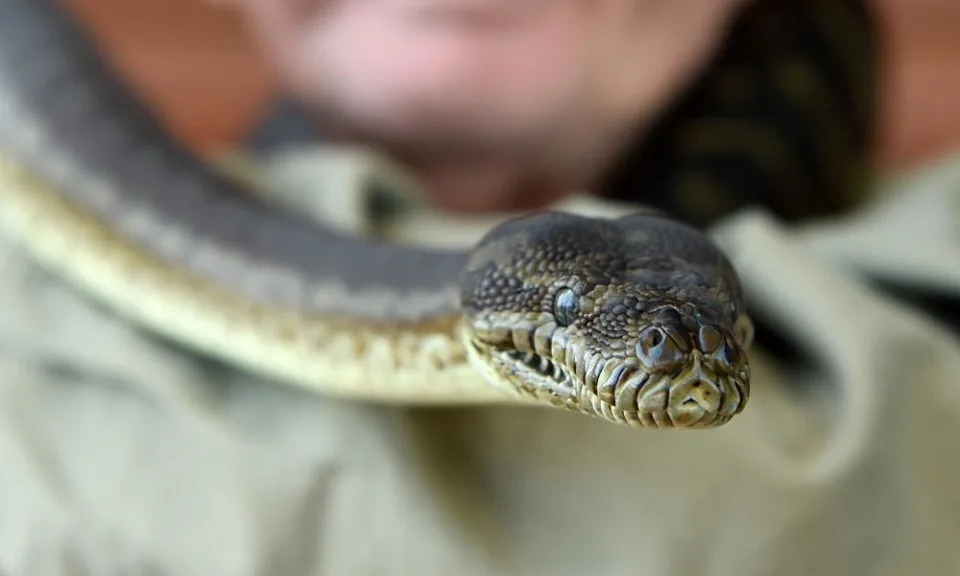
A carpet python
A carpet python – the more conventional host for Ophidascaris robertsi. Photograph: Dan Himbrechts/AAP

“That poor patient, she was so courageous and wonderful,” Senanayake said. “You don’t want to be the first patient in the world with a roundworm found in pythons and we really take our hats off to her. She’s been wonderful.”

The patient is recovering well and is still being regularly monitored, Senanayake said, and researchers are exploring whether a preexisting medical condition that caused her to be immunocompromised could have led to the larvae taking hold. The case has been documented in the September edition of the journal Emerging Infectious Diseases.

According to the US Centers for Disease Control and Prevention, three-quarters of new or emerging infectious diseases in people come from animals.

Senanayake said the world-first case highlighted the danger of diseases and infections passing from animals to humans, especially as people and animals start to live more closely together and habitats overlap more.

“There have been about 30 new infections in the world in the last 30 years,” he said.

Related: Rare flesh-eating bacteria kill three in New York and Connecticut

“Of the emerging infections globally, about 75% are zoonotic, meaning there has been transmission from the animal world to the human world. This includes coronaviruses.

“This Ophidascaris infection does not transmit between people, so this patient’s case won’t cause a pandemic like Covid-19 or Ebola. However, the snake and parasite are found in other parts of the world, so it is likely that other cases will be recognised in coming years in other countries.”

Infectious diseases physician Prof Peter Collignon, who was not involved in the patient’s case, said some cases of zoonotic diseases may never be diagnosed if they are rare and physicians don’t know what to look for.

“Sometimes, people die with the cause never being found,” he said.

“It’s worth taking care when encountering animals and the environment, by washing foods thoroughly and cooking food properly, and wearing protection like long sleeves so you don’t get bitten,” he said.