Please note that this article contains images that some may find disturbing. Sadly, some do not.
*************************************************************************
Above: The Falkland Islands Fox. Proving that "extinction is forever".
In his 1979 book,
The Wild Dogs In Life And Legend, Maxwell Riddle (1907-2002), noted canid expert, wrote a brief chapter entitled
Why You Should Know About Wild Dogs. He begins the chapter with these words:
"
The Wild Dogs of the world face extinction. They have been universally hunted and destroyed by man. In many cases, this has been caused by a desire for their skins and fur. Many of them, rightly or wrongly, have been considered to be livestock destroyers. And some have supplied man with furs, food, charms against disease and for medicine.
"In addition, just as our exploding world population is destroying the habitat and living conditions of the few remaining primitive human tribes, so are we destroying the habitat and food supplies of the wild dogs."
That was thirty six (36) years ago and despite these words, echoed by many, many others, not one thing has changed. Banff, Canada, has seen confrontations, though rare, between humans and hungry puma desperately looking for food on what used to be main game trails (and if a hungry large cat has made a kill just why do idiots try to "shoo" them away?) -and the wolves 'menacingly' move around the area.
But, hey, if they are a "potential human threat" we know how to deal with that, right? Yeah, send a bunch of "good ole boys" out with guns and traps (see, it's easier to shoot a canid or felid in a cage). Nothing makes a hunter more of a "man" (if you get my meaning?) that killing something. What it does for female hunters I have no idea -but they can smile prettily as the blood from the animal they just killed pours over their hands.
Hunters and their supporters maintain that any wild dog they are hunting (but mainly wolves) are killed to stop them threatening people or "depleting game". Of course, in the UK the slathering, ravenous killer known as "the fox" is the main target. "Fox attacks baby in bedroom!" How did a fox sneak in through the french doors the parents were seated in front watching TV, get past the family dog(s) and then get upstairs and bite the baby before escaping by the same route? Oh -they have a photograph of a fox in the garden.
Well, there you go.
Oh, keep this quiet but,like the people involved in all those other 'fox attack' stories that hit the news, the people involved support the local hunt.
And the "biggest male fox recorded in the UK" that was shot? Hmm. The oldest, and I mean oldest,trick in the world: hang the animal up so it is stretched out then get a child (seriously, these are parents?) to stand a few feet back from it -giant fox. I don't know what disturbs me more -the dead fox or the happy, smiling child.
 And you can even use an alsatian (German shepherd) the same way:

And when you find that the main mouth-piece over this fakery is a veterinarian and it emerges he has links with the local hunt....hmm. A connection?
Well yes. Obviously everyone involved has a very low IQ -even the newspapers suddenly realised this was all fake and part of a pro hunt campaign. Lay the vixen (which is smaller anyway) on her side but stretch out the legs of the larger dog fox and...
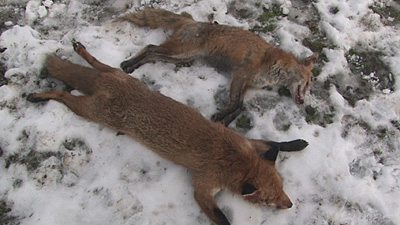
Of course, because, as many naturalists and zoologists will tell you, foxes were just hunted and never studied unless it was "I measured the fine dog-fox killed by the hunt...." That's changing a little now but as I pointed out, and I shall write it again, using over 127 fox hunting books, magazine articles, journals and much more, I proved in the
Red Paper: Canids that the British fox was hunted to near extinction and
many thousands were imported each year "to maintain the sport" and when those started running out...well, read the book.
I had actually never realised that,like the lynx, bear, beaver and wolf, the fox had been on the point of extinction. But one source led to another and then another and then questions such as "
Why would a game-keeper rescue a fox and house him in the estate stables?" led to other sources on "how to keep captive foxes wild for the hunt" and what had intended to be a quick look at UK foxes became far more.
"Blue foxes" and "white foxes" -arctic foxes- were hunted and killed and a few think these were just rare escapees from fur farms. They were releases for hunting.
Celebrity "animal lovers" -especially dog lovers- think it is great fun and "the tradition of the country" so like to cheer on a hunt if they see it -as actor Martin Clunes quite happily declared. A dog being ripped open by a pack of dogs is
not "great fun" it is a cruelty enjoyed by people who really should be made to undergo psychological evaluation.
Wolves are reintroduced to parts of Europe but are poisoned, trapped and killed by farmers and others quite illegally -local authorities know but most of those in local authority "go blind" since the same criminals support or provide their votes.
Let's look at it this way. The UK has a massive -massive- problem with rabbits, rats and other smaller animals. So, why is this?
It is because the predator has been removed from the food cycle. Feral and wild cats as well as foxes kill rats, rabbits and mice
for food. They are the pest control. Farmers with sheep flocks lose far more to drowning, falling off cliffs,being hit by cars, disease and rustling than they ever do from "fox predation".
One thing I learnt talking to farmers over thirty plus years is that still-born lambs tend to get thrown over hedges or put on walls because "The fox will dispose of it and we don't have to pay the local authority to remove them". I was shocked the first time I heard this but by the sixth time I realised it was almost standard practice.
Now, a fox thrown a dead lamb...there is no note reading "You can have this dead one but NO live ones" -you see the problem?
In the 1960s one naturalist-farmer used to count the number of rat tails left by foxes that had killed the rodents on his farm for food.
Australia claims an even bigger "infestation of rabbits, mice and rats" that is near impossible to control. Dingos, feral cats and dogs are poisoned, shot, snared and worse. It's more 'fun' to kill the bigger predator mammals (let's not bring up the thylacine -accused of being a sheep killer though never studied and now evidence seems to imply it was no sheep killer -too late!).
The predator is there for a very good reason.
Darwin mentioned
Canis fulvipes on the island of San Pedro. One sat watching the human landing party and Darwin walked up quietly behind it and killed it with his geology hammer. This fox species is deemed extinct now.
1778 Falkland Islands Wolf Fox by Stewart Stewart
In 1764, L. A. de Bougainville established the first settlement on the Falkland Islands. The Falkland Islands Wolf, actually it was a fox species found on both East and West Falkland, was so tame it would run up to men. Never met men before so there was no fear. Sailors entertained themselves by tempting it closer with a piece of meat in one hand and then kill it with the knife in the other hand.
Extinct is forever.
The excuse is always used that these predatory canids slaughter without need. Well, we know that is just an excuse to kill an animal -hunters get very annoyed and angry that they have to justify their sport. I have seen people cheer the fact that the puma appears to be returning to parts of the United States where it had been wiped out. Ahh, you think "people with senses" and then read "I can't wait til I can go and bag myself one of these!" Oh dear.
And what about the Hokkaido wolf? "The what?" Let me explain.
Hokkaido,Japan, was once the domain of the Hokkaido wolf aka the Ezo wolf (
Canis lupus
hattai, formerly known as
Canis lupus rex). This canid, along with the better known Honshu wolf, was one of two varieties
of wolf found in Japan. And it was not, for a very long time, "disapproved of".
In the case of the Ezo wolf it had a more traditionally wolf-like appearance than its
southern cousin, the Honshu which had a more dog-like appearance.
The skull of the Ezo wolf was large and formidable, with long, curved
canines, and the body dimensions were similar to that of grey wolves.
The Ezo wolf was typically grey in coloration, and significantly larger
and more fearsome looking than the wolves of Honshu. That writ, both had common ancestry in the Siberian wolves of the Asian mainland.
Some of the only preserved Hokkaido wolves remaining.
The Hokkaido wolves were at one time fairly common and were, as I noted, far from hated beasts. They were highly
venerated by Ainu people of northern Japan and were
considered to be powerful gods -along with bears and owls and featured
highly in Ainu myths, folklore, and poetry. The Ainu called the wolves by various names such as
Horkew Kamuy (Howling God),
Yukkoiki Kamuy (The God Who Takes Deer),
Horkew Retara Kamuy (White Wolf God), and
Horkew Kamuy-dono (Lord Wolf God). And to this very day many landmarks bear Ainu names pertaining to the wolves.
When it came to the Ezo wolves they were highly regarded for their hunting prowess. There
are many accounts of the Ainu seeking to domesticate them and this practice
was confirmed by several surveys by the Hokkaido Development Agency,
which found some Ainu villages actively raising wolf cubs. After being
raised among the villagers for around two years and becoming accustomed
to people, the Ezo wolves were then used as hunting companions and even released to go hunt deer for the village on their own.
Basically, humans and wolf working together and sustaining one another.
After the collapse of feudal government in 1868, Japan unfortunately started to
turn to the West for help in "modernizing" the nation. It was now that the government
became convinced that ranching was the key to Hokkaido’s future
agricultural prosperity. Horse and cattle ranches began popping up all
over Hokkaido, throwing humans and wolves into contact with growing
frequency. It was not long before tensions rose and the wolves were seen
as a threat to the booming ranching industry taking hold of Hokkaido.
With negative attitudes towards the wolves soaring, strychnine
poisoning campaigns were launched against them and a bounty system was
also put into place by the Hokkaido Development Agency to speed along
the extermination process. The days of human and wolf living together were over.
The wolves were so actively slaughtered that the number of
Hokkaido wolves plummeted with frightening speed. In 1889, within just
20 years of the start of the poisoning campaigns, the Hokkaido wolf was
considered extinct.
 (c) Respective copyright holder. Apologies but this is from an old file so I have no idea who to credit -anyone knows please let me know.
The Ainu have long held that the wolf existed well past this date,
and even to this day sightings reports come in occasionally. On rare
occasions, ranchers in modern times have complained of mysterious
killings of their livestock caused by some kind of wild animal. Hikers
and hunters have reported wolf howls as well, and there are occasional
reports of wolf scat or remains being found in the frigid wilds of
Hokkaido.
Could the Ezo wolf still be out there?
The wolves of Hokkaido story and that of the thylacine are almost a match. In fact, anywhere that humans want to start raising sheep, cattle or even game, the same story follows. The old tales of "wolves hunting down humans and slaughtering animals" are churned out and the press and media are quite happy to take the sensationalist attitude -fear and scary stories are "sexy" -they sell newspapers and magazines and boost viewer ratings (look at the "out of control, killer foxes" stories in the UK.
The image of the Falkland Islands Fox ("wolf") is always within site of where I work. In 2016 it will become the emblem here on the AOP Blog. I hope the above explains why.
Too many animals have become extinct because of butchery by a minority of humnans. But a minority that
the majority allows to get away with it.


